Finding a Greater Desire


There’s no question that you know someone who struggles with a sexual addiction, whether you’re aware of it of not. What’s more: If you’re a guy, there’s a very good chance that person is you (and that you’re all too aware of it).

These two small-group resources/devotionals created through the organization Harvest USA—one for each gender—will help facilitate churches to begin, and continue, the deep spiritual and emotional healing that’s necessary to overcome those addictions—and to replace them with a greater desire and satisfaction that can only be found in Jesus.

SS4MenFinalDavid White. Sexual Sanity for Men: Re-Creating Your Mind in a Crazy Culture. 248p., $17.99.

Ellen Dykas, editor. Sexual Sanity for Women: Healing from Sexual & Relational Brokenness. 208p., $17.99. Both New Growth Press.

SSforWomen5-pack(Disclaimer: I was editor for both of these books. Yes, the women’s one, too. 🙂 That’s not to say I’m overrepresenting the usefulness of these books… but full disclosure is relevant here—and frankly, a big part of the theme of both books.)

As hinted at by their subtitles—and although it’s worth noting that all the following issues are covered in both books—the men’s study spends more time dealing with such issues as extramarital relationships and/or pornography; whereas the women’s study dwells more on addictive/unhealthy emotional attachments, giving a significant amount of space to both opposite- and same-sex addictions.

Sexual Sanity for Men is a 14-week study, taking men’s groups out of “life in the wasteland,” into an encounter with Jesus and “a new brotherhood. Each week contains five devotionals, with reflection questions for each devotional. Men’s groups who get together to debrief these question each week will have plenty to chew on.

And make no mistake: Both of these books are meant to be worked through in community (or at least a mentoring relationship), no matter how painful that may be, especially at first. But as David White puts it:

Fighting alone is impossible. And as we’ll see later on, it’s totally against God’s design for our growth as Christians. When we fail repeatedly, the Christian life loses its luster. Our joy and zeal for the kingdom diminishes on two fronts. We feel like failures and hypocrites, but at the same time we delight in our sin even though it makes us miserable afterwards…. [T]he gospel heals our relationships. As we’re moved by the grace of God and compelled by the love of Christ, we’re able to lay down our lives for others. The more we learn the blessings of our relationship with Christ, the deeper our anticipation and hope will be in the life to come, and the more we’ll find our life now by losing it for his sake.

(As an aside, David’s explanation of the doctrine of total depravity a quarter of the way in helped me to finally “get it”—as well as evoked a nod and a “well yeah, I agree with that.”)

Sexual Sanity for Women digs even more directly into the roots of sexual addiction, as well the roots of co-dependency (both sexual and non-sexual), so that Christ’s light can shine into those places of darkness and shame. The study is broken down into 20 weekly sessions—no devotionals, although there certainly is homework and weekly reflection involved. In the words of editor Ellen Dykas:

[W]omen, like men, wrestle with sexual brokenness through the pursuit of what God calls “broken cisterns” (see Jeremiah 2:13)—sources of life, security, value that we look for in this world rather than in its Creator. Sexual and relational sin are examples of broken cisterns that women run to and have sought to find soul satisfaction in, rather than finding true life in God…. The sessions to come will guide women into a deeper understanding of God’s good design for sexuality, how and why women struggle with sexual brokenness, and how the grace and truth of Jesus Christ can be applied to these struggles.

To be certain, these books—and the steps they take you through—are hard work. But addictions are hard to break—and harder to remain stuck in. The delivery and the growth in Christ these studies offer are well worth the effort and transparency needed, and far beyond.

Posted in Uncategorized | Tagged , , , , | Leave a comment

Reframing the Gospel, or Diluting It?


Yeah, this one’s decidedly more scholarly than the usual fare here. And yet, at the heart of it is a very practical question: How does one adapt the gospel to the culture it’s being presented to—and when does it cross the line into compromising the gospel?

There are many different answers out there to that question, and A. Scott Moreau’s goal here is to present a solid overview of them.

contextualizationA. Scott Moreau. Contextualization in World Missions: Mapping and Assessing Evangelical Models. 432p., $28.99, Kregel Academic.

As Moreau notes, “Contextualization is the ‘mixing point’ of gospel and culture.” How that mixes is where it gets interesting. For example, what does one do with the Hidden Believer movement, where Muslims who accept Christ remain in the culture as declared “Muslim followers of Isa [Jesus]” (or are not even that forthright about their new belief)? Suffice to say, Moreau deals with these and many more questions.

The first section, “Foundations for Evangelical Contextualization” looks at a variety of evangelistic models for mission and interaction with culture, especially the opposing “critical realism” models of Paul Hiebert and Charles Kraft. Again, the questions being wrestled with amount to: When is adapting the gospel to the culture being incarnational, and when is it just syncretistic (and in the case of some theologians: is syncretism a bad thing)?

The latter section, “Mapping Evangelical Models of Contextualization,” devotes individual chapters to each of the different types of “initiators” of missionary contact—facilitator, guide, herald, pathfinder, prophet, and restorer—and ends with speculation about the “future trajectories” of missions and contextualization.

I won’t lie: A lot of this went right over my head. Nonetheless, there’s a decent amount of stories from the field that put some flesh onto some very cerebral concepts. In addition, the review questions at the end of each chapter are surprisingly down to earth, and do a good job of putting these heady ideas into… well, context.

Obviously, this is intended to become a textbook to help missions and seminary students understand the complexity of both the theories of contextualization as well as the deeper heart questions involved in trying to reach people groups with the gospel while still maintaining the gospel’s integrity. And in that, I believe Moreau is ultimately successful.

Posted in Uncategorized | Tagged , , , , , | Leave a comment

It’s Easier to Talk About Grace Than to Give It in a Book Review


I wanted to like this book; I really did. And once again, I got sucked in by the recommendations (and the apparently now-near-obligatory Rick Warren imprimatur foreword). But when all is said and done, it just left me kind of cold.

dirty godJohnnie Moore. Dirty God: Jesus in the Trenches. $15.99, 224p., Thomas Nelson.

To be sure, it’s the right subject matter—specifically, the power of receiving Jesus’ grace in our lives, and then extending that grace to others. And Johnnie Moore is just fine as a writer per se. It’s just that the book ultimately didn’t tell me anything I didn’t already know, and (to me, at least) tried too hard to sound “hip” in doing so, as if the cleverness would somehow hide the obviousness.

Just a few random samples: “Jesus didn’t wear Prada”; “Jesus fell like a bunker buster into the religious milieu of this day”; “I can see the crowd saying ‘Snap!'”; and comparing contemporary Christianity to biblical Christianity by comparing Pintos to Porsches. You get the idea. And yes, the experts he brings in—most prominently C.S. Lewis, Tim Keller, and Dietrich Bonhoeffer—lend some weight to his message (and again, I don’t have any problems with the message itself). But even more so, they make you want to put this book down and find the original books.

Also, while the chapters are in two groups—Getting Grace and Giving Grace—it doesn’t feel as if there’s really any progression going on. It seems these chapters could’ve been arranged in any order, and the net result would’ve been the same. In fact, I found myself thinking that the final chapter, “What Could Happen If Grace Covered the Earth,” would’ve made a really good introduction for a much better book.

That said (and this brings us to…), the last quarter of the book is somewhat better than the first three-quarters, particularly the chapters “God Might Want You to Fail Your Test” (i.e., so that you’re willing to receive God’s grace instead of “work for it”) and “A Grace-Starved Planet” (which ought to be self-explanatory).

But it’s just too little, too late.

Posted in Uncategorized | Tagged , | 2 Comments

Power Is Not Fruit


True spiritual power comes in the wake of spiritual fruit, not as a predecessor to it. The trouble is, we often confuse power with fruit. We see an influential or charismatic leader, and assume that natural ability (and the numbers it often generates) are a sign of God’s blessing. Very often, it is not. Very often, power is just power.

Even those who witnessed Jesus’ “triumphal” entry into Jerusalem were looking for power, not fruit. And yet, almost immediately after pulling into town on his stretch limo donkey Jesus says this:

Truly, truly, I say to you, unless a grain of wheat falls into the earth and dies, it remains alone; but if it dies, it bears much fruit. Whoever loves his life loses it, and whoever hates his life in this world will keep it for eternal life. If anyone serves me, he must follow me; and where I am, there will my servant be also. If anyone serves me, the Father will honor him (John 12:24-26, ESV).

wheat-ears-and-wheat-kernels Alone, we are kernels of wheat. We might be big, talented, self-impressed kernels, but kernels nonetheless. But by dying to self, God can turn us into stalks of wheat, which Jesus can then use to create and serve the bread of life to others. But it can’t happen until we die—then we can begin to grow. And then, we can bear real fruit—the kind that nourishes and enables others to grow.

So, are you feeling lucky—or more to the point, led? Lay down your power, so that God can turn it into fruit.

Posted in Uncategorized | Tagged , , | Leave a comment

The Flesh Is the Flesh


Another set of shards for the offering…

For those who live according to the flesh set their minds on the things of the flesh, but those who live according to the Spirit set their minds on the things of the Spirit. For to set the mind on the flesh is death, but to set the mind on the Spirit is life and peace. For the mind that is set on the flesh is hostile to God, for it does not submit to God’s law; indeed, it cannot (Romans 8:6-7, ESV).

Whether it’s reveling in sin, or in our natural strength and “good works,” the flesh is still the flesh. Whatever it does will still end in death—or will need to be put to death first. It is still hostile to God. Watchman Nee, in The Spiritual Man, puts it this way:

[S]elf-righteousness is not righteousness at all; it is actually unrighteousness…. Whether a person is good or bad, one thing is certain: he does not submit to God’s law. In being bad he transgresses the law; in being good he establishes another righteousness outside of Christ…. Just as a Christian must be delivered from the sin of the flesh through the cross, so he must now be delivered from the righteousness of the flesh by the same cross.

I look at these words—and a whole lot of other words spread around this blog—and wonder whether instead of their being prefaced with “by Carl Simmons,” it might not be more accurate to have it read “despite Carl Simmons.” Anything good you read here is God’s doing; I’m just fortunate on some days to be the conduit. And yet, how simultaneously self-vaunting and self-deprecating is that? “Who will deliver me from this body of death?” (Romans 7:24, ESV).

Depend on Christ. Only Christ. “[T]he hour has come for you to wake from sleep. For salvation is nearer to us now than when we first believed…. [P]ut on the Lord Jesus Christ, and make no provision for the flesh, to gratify its desires” (Romans 13:11, 14, ESV)

Posted in Uncategorized | Tagged , , , , , | Leave a comment

The Power of Surrender


This is still kind of rough shards of thought, but bear with me; I think I’m onto something here… plus, it ties in to my other random devotional pieces as of late…

Everything God gives us is done with the goal—His goal—that it be spent for His glory. The thing is, maybe especially as Americans, we tend to think of giving only in terms of money. And to be sure, our money can represent a number of things lurking behind it. But what about the gifts, spiritual or material, that He’s given us?

And moreso, what about the authority—or, more rawly put, power—He’s entrusted us with, whether that’s in our marriages, our families, our work, our church? Are we as willing to give that away for the sake of those who don’t have it?

Power, like money, is something to be given away to those who need it, rather than hoarded. We serve an all-powerful Lamb who was willingly slain for us, and we must be willing to follow.

Chris Heuertz, in his remarkable book Simple Spirituality, described the measure of our love this way, “It’s not what you give—but what you keep.” Conversely, what we insist upon keeping reveals where we’re still lacking in love.

What we release, lives; what we hang onto dies with us. Thank God for what He’s given you; and ask God to open your hands, and to release what you’re holding onto.

Posted in Uncategorized | Tagged , , , | Leave a comment

Songs Made for When You Begin Again


To paraphrase the immortal words of John Mendelsohn: I am annoyingly partial to Bill Mallonee—both the man and the music. If you’d like more exposition on how much, go here; otherwise I’m going to stick more to the new music this time out. 🙂 (And I apologize in advance for repeatedly reinventing the English language below; Bill reviews are too much fun for the likes of me, and a welcome break from the usual seriousness of this blog.)

Last year gave us the return of Studio Bill after five years, and The Power and the Glory was worth the wait. This new’un continues that creative resurgence (although you could well argue that since the guy’s been putting out roughly 2-3 hours’ worth of new music every year for nearly a decade, he never really un-surged), as well as a lot of the themes of TP&TG. The Neil Youngisms are still intact here (although there’s nothing as stompin’ as “The Ghosts That I Run With” this time out); however, the Byrdsiness and/or GramParsonisms are noticeably more ramped up this time out (I know, none of them live all that far down the street from each other, but there is a difference). And this one has a more live feel in general, FWIW.

More importantly, the sense of rebirth that especially marked the closing songs of TP&TG are now front and center on this one—in the words of the man hisself, this is about “getting reborn again, in the finest of places.” And trust me, that’s as relevant to me as it it’s been to him these days.

Bill Mallonee. Amber Waves. CD $20.00 here; download $14.99 here.

That all said: I have to admit, this album has been a bit of a “grower” for me. The first few listens, it came out of the gate strong, especially with the few little musical tweaks that make a big difference in each of the first few songs, but then I had a hard time staying in the flow. But that’s all been remedied, and now I can help you, too. 🙂

But let’s get to those opening tunes and tweaks: The title song is all about rebeginnings (and in fact supplies the lyric that graces today’s header). It also starts off as one of the Neilier songs here, but then takes a decidedly different chord turn on the chorus that makes you sit up and take notice. The guitars ramp up minor-chordedly even further on “To the Nines,” and  some driving harmonica and a decent guitar solo are thrown in for good measure; and the equally driving but more upbeat “One Kiss at a Time” includes a moog, for crying out loud. Put together, Bill’s definitely sounding reinvigorated here from the get-go.

But “Faith (Comes Soaked in Gasoline)” was the linchpin that finally got me into that flow of the rest of this album, what with its Grapes-of-Wrathlike simultaneously sense of loss and rebeginning:

they say the Savior had nowhere to lay his head
and pretty soon neither shall we
one thing about faith you can be sure of
well, it comes—soaked in gasoline

There’s also a few songs here that could almost be called ambient folk—not in the more recent “War-on-Drugs/McGuinn-headbutts-Eno” sense of the term, but in that they’re songs that’re so still that they kind of take you into their own little world. The first, and arguably best, of those is “Long Since Gone,” replete with yet more loss and yet more beginning: and they all say one thing / back on the hill / it ain’t come back yet / maybe it never will…. / when you’ve got nothing to trade on / you’ve nothing left to lose.”

“Pillow of Stars (Fate and Sad Reversals),” then, comes as a (folk-)rocking benediction, complete with a chorus that works for both old Reformed Bill and more recent universalist Bill:

Baby, when you love you find out who you are;
Wherever you lay your head, may there be a pillow of stars.
And though fate and sad reversals slow your journey home
I know you’ll get there, ’cause that deal was done
a long, long time ago.

Extra points also for the lyric: “I dunno why I speak these words / to break my own heart.”

“It Was Always Autumn in My Heart,” while an apt metaphor, is the one misfire for me here. It just feels rushed and ungelled, especially in the opening couple verses. Fortunately, things rebound quickly with “Once Your Heart Gets Broken (It Just Keeps on Breaking).” Loved it on the Kerouac compilation Ti Jean; love it now (although I think I still prefer it in the original key; go follow the link and compare for yourself, and then buy that one too while y’r at it):

One thing they don’t tell you, ’cause we’re so good at fakin’;
once your heart gets broken, kid, it just keeps on breaking.

“Yeah Yeah Yeah (Faith Like a Butterfly’s Wings)” leads in with one of those ambient-folk intros (which reprises later on), then switches into a melody/tempo not totally unlike that VoL standard “Solar System.” The early WPA tune “A Break in the Clouds,” on the other hand, is probably the loudest thing and most Youngian thing here—certainly the feedbackiest, and a welcome shot of adrenalin: “now what I found out about the truth is she usually don’t get heard / and what I think about Love is she always gets the last word / on the streets of this God-forsaken town…. she’s such a lonely girl/ kinda a dust pearl / here is your other world / and a break in the clouds.”

“What You Take (And What You Leave Behind)” gets its Rickenbackers on, and I’m thinking it might be the “sleeper” song on this album. Plus it uses the word “oblique” in a song; I’m the only other person I know who’s ever done that. 🙂 “Walking Disaster,” which follows, would be the most VOLish thing here. (Which I suppose, is still saying it sounds like the Byrds with a deathwish. :)) “And the river of love she still rolls on, long time after the well has run dry.” Perfect.

The closer, “Into God Knows What,” takes us back into gentle ambiance, and adds a bit more elegiac feel for good measure: “let me go down easy, when the box gets shut / let me go down easy, into God knows what.” Nice job, too, on the strings that softly push their way in near the end.

And so there we are. And if you got this far, you know what needs to be done next. Make it happen.

Posted in Uncategorized | Tagged , , | 3 Comments

Leading Out of Who You Are


In a way, this book’s title is a bit of a misnomer. Not that it’s not about mentoring—and to be certain, the book’s main audience is mentors (of some sort). But really, this book is more about discovering what God’s already trying to do to grow us, what this process looks like, and therefore what we should be on the lookout for—and in fact, what we just need to step back and let God do.

Randy D. Reese and Robert Loane. Deep Mentoring: Guiding Others on Their Leadership Journey. 240p., $20.00, IVP Books.

Thus, the subtitle captures the essence of this book more precisely. Even then, however, we probably need to expand our definition of the word “leader.”

Those familiar with the work of (president) Randy Reese’s and (educational designer) Robert Loane’s organization VantagePoint3—specifically The Emerging Journey, The Equipping Experience, and The Enriching Conversation courses/workbooks—will recognize the concepts (and sometimes even the wording) here pretty readily. For the majority of you who aren’t familiar, it’s worth noting that Reese is an enthusiastic disciple of J. Robert Clinton, whose Leadership Emergence Theory is all over this book. VP3’s (and this book’s) focus is on “Leading Out of Who We Are”—to help others discover how God has made them and to help them lead out of that, rather than try to fit them into some proscribed leadership mold.

And all of us are leading in some way, whether we think of it that way or not. Thus, as the authors put it early on, “There is a need for a subtle but critical paradigm shift—moving from an enlisting way of ministering in our communities to more of an investing way of ministering.”

There’s a lot of emphasis on the power of story throughout this, especially in the opening section “Noticing God’s Already-Present Action.” One of the assignments, given in pieces throughout the book, is the development of a personal narrative—chronicling your life and seeing how God has worked through it, whether you were aware of His presence at the time or not. Having worked through this, and shared it with a group (and vice versa), I can testify firsthand that’s it’s a powerful experience.

The second section is the bulk of the book, and walks us through four stages of development: Foundation, Preparation, Contribution and Multiplication. I won’t give it away but suffice to say the Contribution section whacked on me pretty hard. Example:

God’s transforming work within us must always precede the transforming work God desires to do through us. If this were not the case… we would crumble and disintegrate under the weight of God’s blessing and work. Why? Because our character and person could not hold up to what God wants to give us.

For someone who’s been in an extended waiting period, those were good words to hear.

The third and final section is devoted to how to implement leadership formation. In the authors’ words, “we are involved in a deepening work, a particularizing work, a hospitable work, and a patient work…. Christian leadership formation is an act of cultural resistance. As we stay true to our work, we will naturally guide the leadership formation of others with greater particularity and care in Jesus’ name. It will become our nature.”

This is a book that’s making my re-reads list. There’s a lot here to absorb—and more importantly, a lot left here to grow into. (Personally, I hope that by the next time I read this—which should be about September 2016 [yeah, I’m like that]—I’ll be wrestling more with Multiplication.) But if you’re engaged in growing the people around you—and you are—you owe it to yourself to start working through this.

Posted in Uncategorized | Tagged , , , , | 1 Comment

Children of the Promise


I’ve been coming across our title phrase—or rather, it’s been coming across me—a lot lately (Rom. 9:8, Gal. 4:28). How do we live like “children of promise”? One way to look at it also came across me lately…

As I’ve been working through the prayers in Dawn to Dark (review, for those who missed it, here), one of the exercises was to reflect on my baptism, nearly 30 years ago. What I remember was this: I had no real desire to do it, but I did it anyway out of obedience. And ironically (or fittingly), the week that followed was one of the most joyful of my life.

Obedience isn’t popular in our time (or any, really), let alone in our country. We’d rather be “relevant,” or “tolerant,” or really anything that “proves to God” that we love Him short of obeying Him (and thus really shows that we love other people’s approval a lot more).

But the fact is, we are children of the promise. And we cannot fulfill the promise we have in God without obedience.

We must believe that God really intends to save us and use us for His purposes, not ours. And we must pursue knowing and desiring God’s purposes. And then—even when we do understand or “feel led”—walk them out in obedience. Because that’s what a child of promise does.

Posted in Uncategorized | Tagged , , , | 2 Comments

Making Time for God, and Letting the Words Speak for Themselves


Let me get this confession out of the way first: I am liturgically disabled. 🙂 And having gone from no religious background whatsoever to the reformed-arminian-charismatic-relational Christian mutt I am today, I’ve never really felt the need to hunt down any liturgical materials either.

Doug Jones, however, felt differently—although Christians of any persuasion should be able to identify with the struggles that eventually led him there:

Even though I knew praying was important, I still found it so difficult. Prayer, as I was learning it, seemed to be a rigorous mountain—one I was unable to climb. When I tried my hand praying in this spontaneous fashion, I found doing so to be a stumbling and difficult art at which I was not particularly gifted….

What if there is a way to pray that is more about our heart attitude and less about our ability to put our own words to prayers?

That latter question is eloquently answered with Dawn to Dark.

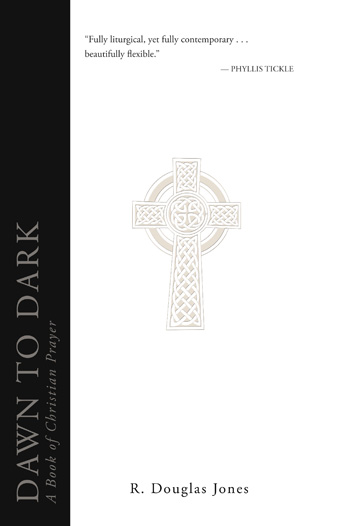
R. Douglas Jones. Dawn to Dark: A Book of Christian Prayer. 288p., $14.99, The House Studio.

The bulk of this book is the two weeks’ of prayers that carry the pray-er, as promised, from dawn to dark—and drawn from a variety of sources including psalms, hymns, The Book of Common Prayer, Celtic prayers from Iona, St. Benedict’s Prayer Book, etc. Each of the four daily prayer times will likely run you a half-hour, so budget your time wisely.

The book is lovely just for the language itself, and for its unwavering focus on God’s glory—this is true vertical worship. And it’s worth noting that the design of the book itself reflects the feel of the words. It’s just really nicely done all around.

The first thing I noticed, as I actually took the time to work through this book on my own, is that it’s not so much the prayers themselves working within me. True, they’re prayers squarely focused on God’s glory instead of my laundry list, and that in itself is an improvement; but what I really found affecting me were the times of silence that were built in between the different sections of prayer. We’re in such a hurry to try to establish God’s peace in our hearts. Doug’s (ancient) process forces us to slow down enough to allow God to speak to us—and as a consequence, us to Him as well.

Now mind you, I don’t expect to switch over to a prayer book on a permanent basis. But working through Dawn to Dark was kind of a liberating experience—as well as one more weapon in the arsenal, if you will. Sometimes we need to just step back and join the chorus of those before us, especially when our own spirits and words have become exhausted. Thus, Doug Jones helps equip us here for the journey deeper into God’s heart, and no Christian can get by without moving on in that journey.

Posted in Uncategorized | Tagged , , , | 1 Comment