Mercy Is a Three-Way Street


Robert Gelinas’ first book, Finding the Groove, was a paradigm-shifter for me. Not only did its “jazz theology” help unlock my faith in a new way, but its sense of creativity was a heavy influence especially on my own Growing Others. And you didn’t have to be a jazz fan to appreciate it. (However: As another side-effect, I now have a stack of Ellington, Armstrong, Davis, Monk, and Brubeck CDs to go with my Coltrane collection. :))

His new book, too, is a paradigm-shifter. But this time, instead of going out of the box, the approach here is simple and single-minded. And no less profound for that.

mercy prayerRobert Gelinas. The Mercy Prayer: The One Prayer Jesus Always Answers. 192p., $15.99, Thomas Nelson.

That said, if you think the book is just about the Mercy Prayer itself (i.e., “Lord, be merciful to me, a sinner”), you’d be dead wrong. It’s the centerpiece, to be sure, but this is really a book-long contemplation on the reality of God’s mercy, and the implications of that for each of us. (And once again, it’s unlocked some creativity at my end; stay tuned for a follow-up post to this in the next day or two.)

The opening chapters establish the reality of a merciful God—something we claim to believe but don’t nearly as often act upon as if it were true. Before we can believe in the power of the Mercy Prayer, we must first believe in the power (and the existence) of a merciful God.

The shift in focus comes near the end of the chapter “Echoes from Eternity”: “As Christians, we have decide to fight sin,” he says. “What most of us didn’t know is that to seek victory over sin is to choose to suffer.” We all need to see God’s mercy in our lives, and all around us. When we arrive eternally in God’s presence we will be eternally reminded of that mercy, but in the meantime we need to remind ourselves. Robert gets us started down that path here.

It’s then that we’re formally introduced to the prayer itself. Robert not only walks us through it, but shows us how to incorporate it into every part of our lives, so it literally becomes like breathing. (And that’s not bad English; I literally mean “literally”—you’ll have to read the book to find out why.)

From that basis of God’s mercy toward us, and our desire to seek it, comes a third direction: the desire to extend God’s mercy to others. We are all called to get involved in others’ suffering—not always to relieve it but to always bring Christ into the midst of it. Much time is spent breaking down the implications of Jesus’ words in Matthew 9:13: “It is not the healthy who need a doctor, but the sick. But go and learn what this means: ‘I desire mercy, not sacrifice.'” It’s here that the vision-casting takes place, of what a mercy-filled world might look like:

As we walk with God, we gain vision for how we can do great things with God. We begin to see the world not as it is but as it should be. We begin to ask God, “If you could change one thing in the world through me, what would it be?” God responds, and with him we begin to do justice. We roll up sleeves and start cleaning up polluted streams. We get involved in our local school to curb the low graduation rates. We start petitions that draw attention to the extremely high abortion rate of Down Syndrome babies….

[M]ercy [also] reminds us, as we teach a man to fish, we shouldn’t forget that he’s hungry. So give him a fish for today, and then get on with the lesson.

Interested? Begin seeking mercy for yourself first. The book will certainly help you through every step of that path.

Posted in Uncategorized | Tagged , , , | 1 Comment

Do, Because You Are


Consider this a kinder, gentler version of past ruminations on this subject…. as well as (in the case of the next paragraph) a leveraging of one small reworking within Lay It Down: the book (in hopeful anticipation of official publication not so far down the road)…. but that in turn got me thinking further….

We often talk today about the need to be “missional,” but the fact is, that’s what Jesus has called us to be all along. We’re not only called to be saved as individuals, but to live in the realization that “we are his workmanship, created in Christ Jesus for good works, which God prepared beforehand, that we should walk in them” (Ephesians 2:10).

However, with the rediscovery of the importance of serving others—of actually acting on our faith, of doing—we must not forget the importance of being with Jesus. Without that, all our doing is just… doing. We may be serving others, but we’re not truly serving God—and thus, not serving others in the way God truly calls us to. The actions may be there, but the Spirit is absent.

Truth be told, a lot of service is an effort to ameliorate the “bad PR” Christianity gets these days. We need to get over that. It really isn’t our problem. We need to focus on Christ, then upon what He wants from us. The service that comes out of that will do its work—because it’s His work. God will take care of His reputation, and yours.

Do, because you are. Jesus will use you, if you’re His. Count on it.

Posted in Uncategorized | Tagged , , , | Leave a comment

Making Sunday School Work Anywhere, Anyway, Anyhow


Assembling what could well be considered a Baptist all-star team here — including Thom Rainer, Elmer Towns, and my boy Josh Hunt — Steve Parr presents a variety of success stories in the world of Sunday School, and in Christian education in general (including small groups). The message here is simple: No matter what your situation, your Christian-education program can excel.

sunday schoolSteve R. Parr, editor. Sunday School That Really Excels: Real Life Examples of Churches with Healthy Sunday Schools. Foreword by Allan Taylor; introduction by David Francis. 208p., $14.99, Kregel Ministry.

For the most part, this isn’t a how-to book; this is a “how we did it, and why you can too” book. Thus, most of the 17 chapters here focus on a different set of circumstances, from excelling with small and/or rural congregations (or, to quote the title of Josh’s chapter, “Excels in the Middle of Nowhere”), to excelling in a declining church (or rather, “out of decline,” per Bob Mayfield), to successfully integrating Sunday school and small-group ministry (in chapters by Elmer Towns and Tim S. Smith, respectively). Read them all, but chances are you’ll find a chapter that addresses your church’s current situation and how other churches have made it work.

In the final two chapters, Parr himself gives us a “tour” of a variety of success-story churches from all around the country; then finally, “A Plan to Excel-erate Your Sunday School.” Most churches excel in one or more of the points Parr presents, but by addressing all of them—from outreach to leadership to simply showing appreciation for your people—churches will be able to plug the holes and close the back doors in their ministry.

The opening chapter, an interview/dialogue between Parr and LifeWay president Thom Rainer, brings the whole book into focus: No matter what your situation, there is opportunity to adapt and to innovate—and in fact, the situation God’s placed your church in demands that you adapt to it. Another very important point made during this dialogue is that Sunday School—or whatever it’s called or how it’s implemented in your church environment—can never be separated from the Great Commission: “Is there a better way to introduce someone to Jesus than studying God’s Word with them?” Rainer asks at one point. Indeed.

Posted in Uncategorized | Tagged , , , , | Leave a comment

What Are Your Re-Reads (revisited)?


Since I’m in waiting mode right now — both in terms of “hopefully impending good news” and in terms of “books I need to review” — thought I’d revisit a fun topic I’d first done a couple years ago…. Some of the names have changed, but the point remains the same…

The following is a list of books that God has spoken to me through big-time, so much so that I keep coming back to them for more, and discover something new every time as I do. Some are classics, some are fairly recent (and thus I’ll try to connect you with the reviews that help explain them, when relevant). But I re-read one of these every month, on top of whatever else I’m reading. It’s my way of helping God help keep me in line. :)

Also, I’ve set this list up so that the books cycle through in a way that reflect the scope and sequence of Growing Out—a spiritual-formation book, a character-formation book, a gifts/calling book, a mentoring book, a leadership book, a personal-mission book, and then back again. I also put space between books by the same author. All of it’s my way of maintaining balance (and/or channeling my apparent OCD in a productive manner :D).

Anyway, enjoy this list. Use it to fill in your own gaps. And help fill in some of mine, too, by posting here about your re-reads. Tell me what books God has spoken to you through, over and over. A’ight?

So, starting with the book I’m re-reading right now (and my most hardcore re-read; I’ve probably been through it a dozen times now):

Changed Into His Likeness—Watchman Nee
Whole Life Transformation—Keith Meyer
What Jesus Demands From the World—John Piper
Getting Rid of the Gorilla — Brian Jones
Prayers for a Privileged People—Walter Brueggeman
Celebration of Discipline—Richard Foster
The Great Omission: Reclaiming Jesus’ Essential Teachings on Discipleship—Dallas Willard
With Christ in the School of Prayer—Andrew Murray
Reflections on the Psalms—C.S. Lewis
Christianity for Modern Pagans: Pascal’s Pensees, Edited, Outlined & Explained—Peter Kreeft
Desiring God—John Piper
Pastoring With Passion — David Holt
The Irresistible Revolution—Shane Claiborne
Praying Successfully—Charles Spurgeon
The Gift of Being Yourself—David Benner
The Divine Conspiracy—Dallas Willard
Unashamed to Bear His Name — R.T. Kendall
Instruments in the Redeemer’s Hands: People in Need of Change Helping People in Need of Change—Paul David Tripp
Outgrowing the Ingrown Church—C. John (“Jack”) Miller
Too Small to Ignore—Wess Stafford
A Praying Life — Paul Miller
Of the Imitation of Christ—Thomas a’Kempis
Freedom of Simplicity—Richard Foster
Conjectures of a Guilty Bystander—Thomas Merton
The Crucifixion of Ministry—Andrew Purves
Hearing God—Dallas Willard
Power Through Prayer—E.M. Bounds
The Knowledge of the Holy—A.W. Tozer
The Cost of Discipleship—Dietrich Bonhoeffer
Future Grace — John Piper
Deep Mentoring: Guiding Others on Their Leadership Journey — Randy Reese and Robert Loane
Spiritual Leadership—J. Oswald Sanders
The Little Flowers of Saint Francis
In the Heart of the World — Mother Teresa
Prayer: Finding The Heart’s True Home—Richard Foster
The Sermon on the Mount — R.T. Kendall
The Person and Work of the Holy Spirit — R.A. Torrey
The Pursuit of God—A.W. Tozer
Simple Spirituality—Christopher Heuertz
The Spiritual Man—Watchman Nee (This one’s a monster. I give myself 3 months for this one.)
Sacred Companions: The Gift of Spiritual Friendship & Direction—David Benner
Restoring the Soul of Leadership—Ruth Haley Barton
The Dark Night of the Soul—St. John of the Cross
Renovation of the Heart—Dallas Willard

Posted in Uncategorized | Tagged , , , , , , , , , | 1 Comment

Getting from the Pastoral to the Personal


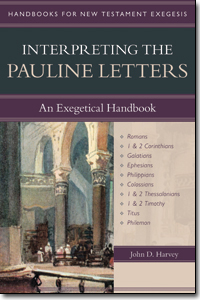
Yep kids, it’s time for another layman’s review of the scholarly…. That said, the book does a fine job of addressing the content, as well as some of the lesser-known exegetical points, of the apostle Paul’s letters in one pretty concise overview—and as such, could be a great resource for pastors, teachers, and even small-group leaders who want to dig a little deeper.

pauline lettersJohn D. Harvey. Interpreting the Pauline Letters: An Exegetical Handbook. 216p., $22.99, Kregel Academic.

This book, the second in a series of four books (the others being Gospels/Acts, General Letters, and Apocalypse) helps us to better understand both the thoughts and heart of Paul (although admittedly, it’s more about the thoughts :)). John Harvey helps us to take Paul’s (and Pauline scholars’) denser thoughts and get to a place where we can put them into use today.

Before getting into the theology, the opening chapters discuss the genre of letter writing and the letters’ historical background, and take each letter through that grid to prepare readers for the theological/textual issues that come later.

Pastors and teachers will find Section 7, “From Text to Sermon,” especially helpful. In this, the longest of the book’s eight chapters, Harvey takes us through Colossians 3:1-4 and Philippians 3:12-16, respectively, and walks us through textual criticism, analysis, and finally synthesis and “homiletical packaging,” so that pastors (and congregants) move from understanding to application.

The final chapter provides a variety of resources that readers can use to dig in further, to both help readers understand the overall interpretation of Paul’s letters (concordances, dictionaries, etc.) as well as specific commentaries on each of Paul’s 12 letters. A glossary of terms is also provided, and again will prove helpful to non-scholars trying to tackle what’s here.

Because Paul’s letters range from the systematic to the pastoral to the personal, there’s a lot to take in here. Harvey’s role here is to reveal the threads that hold them all together, and that’s what changes this from simply a useful resource to an interesting read.

Posted in Uncategorized | Tagged , , | Leave a comment

Feelings Are Not Faithfulness


Just a brief word today, but God gave it to me a month ago and I’ve found it really helpful, so I’m passing it on. I’m not sure how it may play out in your life specifically, but I suspect it does, and will.

And it’s this: Your feelings are not your faithfulness.

I’ve let this word percolate enough to see it play out in a couple general directions. First, when we’re down: It gets easy to want to “self-medicate” in any number of ways to avoid the pain of living—or more accurately, to delay the pain then have to pay it back with interest. But again, your feelings are not your faithfulness. God’s not judging you by how difficult (or happy) your life is right now, but by how you’re responding to it right now. Are you putting Him first, no matter what you’re feeling?

And how about when things are going better (or you’re at least feeling better about your circumstances)? It’s real easy to let down our guards after the black cloud has passed. Satan used fear, depression and insecurity to take out Saul, and used prosperity and success to take down David and Solomon—he’s not picky about how he gets the job done. Therefore, we need to be vigilant at both ends, and to stay obedient to God—no matter what our feelings are saying to us. Even when we’re happy, our feelings are not our faithfulness.

It’s interesting that we always like to reference 1 Corinthians 10:13 without the backdrop, so let me close by starting at verse 12 for the sake of you guys that are in
“a good place,” then circle back to verse 13 for the sake of us melancholy types:

Therefore let anyone who thinks that he stands take heed lest he fall. No temptation has overtaken you that is not common to man. God is faithful, and he will not let you be tempted beyond your ability, but with the temptation he will also provide the way of escape, that you may be able to endure it.

Posted in Uncategorized | Tagged , , , , , , , , | Leave a comment

A Groundwork for the Gospel


And speaking of 1-on-1 discipleship…. Here’s a resource all you disciplers can utilize to help new Christians begin to more fully understand the Gospel, and to help them begin to more deeply pursue a relationship with Jesus….

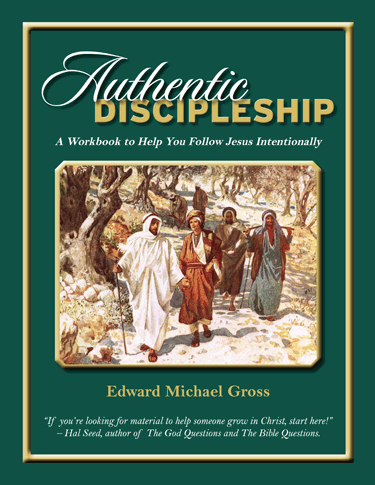
Authentic-Discipleship-FC-375Edward Michael Gross. Authentic Discipleship: A Workbook to Help You Follow Jesus Intentionally. 128p., $12.99, New Book Publishing/Reliance Media.

As its subtitle suggests, this is a workbook, but one meant to be worked through together as both disciple and discipler. Ed Gross’ intent here is to provide a groundwork both for discussion and for a deepening faith and understanding of Christ’s work in our lives. The 19 sessions here address both theological and personal issues, and while there’s a decent amount of work to each session, it’s not as overwhelming/”boot-campish” as I’ve seen with a lot of other disciplemaking resources. This workbook covers a lot of ground, but it’s doable rather than discouraging.

The first two units, “A Good Beginning” and “Christ in You,” provide the theological groundwork here, addressing such subjects as grace, the attributes of God, Christ’s work on our behalf, and the Holy Spirit. The final section, “A New Level of Certainty,” deals with the subject of our assurance of salvation, both based on external proofs and on the internal witness of the Holy Spirit.

The third and longest unit—and my favorite, as it’s the rubber-meets-the-road section—helps new disciples understand the importance of personal devotional time and spiritual disciplines, as well as how to confront both the sin and the suffering in their lives. A couple examples from there:

“In [Jesus’] name” isn’t just a signoff, like “Sincerely” or “Yours truly.” It means that you’re asking the Father for what Jesus would ask for if He were in your shoes.

Have you ever seen a knife sharpener…? It works because the grinding wheel is spinning one way, and the knife is facing the other direction…. It’s exactly that way with Christians in this world…. There are sparks that will fly when we come in contact with them. Result: you will become “sharpened,” but it will hurt. And there is suffering…. And this is exactly how Christianity won over the Roman Empire in less than 300 years! They wouldn’t out-fight them, or take up arms against them, but they could out-suffer them. They could out-love them. They could out-forgive them. Then, at the right time, they could out-witness them, and God would win their oppressors. That’s still how God works throughout the world today, and how His loving grace conquers hard hearts.

One subjective quibble: I personally would’ve liked to have seen fewer close-ended questions. However, since this is a workbook for new Christians, a lot of the information here will be brand-new, and thus this issue isn’t as problematic as it would be in a standard small-group resource—i.e., more black-and-white answers can be considered to be more warranted in this context. And the “Disciple-Questions and Assignments” at the end of each session go a long way toward meeting each person where they’re at, and provide a great starting-point for truly experiencing the Christian life.

Got a new believer and don’t know where to go next? Now you’ve got a resource to get you there.

Posted in Uncategorized | Tagged , , , , , , | Leave a comment

In Defense of 1-on-1 Discipleship


A couple very different conversations this week got me thinking about this issue even more than I usually do…. In fact, this might be equally titled “In Self-Defense of Being a 1-on-1 Discipler”… 🙂

First, the backdrop: It seems like 1-on-1 discipleship has been getting a lot of abuse lately, and from people who really ought to know better. The arguments inevitably go on to advocate small-group ministry and/or more missional/outward-focused ministry. Now, I’ve been a small-group leader for most of the past 25 years, and have no problems with missional/outward-focused ministry (aside from its current faddishness, but I’ve already complained here about what a “duh, salt and light, people” thing that is, so I’ll leave it at that). So on to our present context….

The first conversation was an online discussion with a publisher I do a decent chunk of work for, regarding yet another recent post making the “we need to move away from 1-on-1 discipleship” argument. My counterargument was this: I think it’s more like G.K. Chesterton’s famous “Christian ideal” quote — i.e., 1-on-1 discipleship has not been tried and found wanting; it has been found difficult and left untried. It requires a long-term commitment, the willingness to listen, and the willingness to shut up until it’s time to speak—and then, the willingness to “speak the truth in love.” As Americans, we’re not very good at any of these things as a rule.

And there’s that other American obsession that’s completely antithetical to 1-on-1 discipleship: the numbers game. Even earnest pastors and would-be mentors can fall into the trap of “the church is falling behind and we need to make up for lost time.” Thus, small groups and more group-oriented missional activities outside the church seem to fit the bill. And they do—just not all the time.

The thing is, when faced with the choice between 1-on-1 or group, the correct answer is “yes.” It all depends on the context, and on the people involved, rather than on one approach being inherently better than the other.

One-on-one discipleship seems inefficient to us (or at least to its critics), because it’s “only” one person. (Think about that before moving on….) But to change one person deeply ultimately results in changing many others significantly, in those other contexts of ministry, small groups, etc. We need both the deeply personal/intensive (1-on-1/triads) and to be engaged publicly in missionality and/or character-building in the form of small groups. The personal is tested and developed in the communal, and the communal is prepared for (and debriefed) in the personal. There’s no conflict here—or at least, there shouldn’t be. Move along, people.

Which brings us to the self-defense part. During my pastoral days in Jersey (hey, Living Word), I did a ton of 1-on-1 discipleship—sometimes with developing leaders, sometimes with people struggling with their faith or obedience. At the time, it really was just me doing what I knew I needed to do. But the stories I heard as we prepared to move to Colorado or even years after showed the outward fruits of that more intensive private discipleship. One guy cried when he found out we were leaving, because our time together was the first time he’d felt like someone had actually listened to him; another who I’d spent a lot time with walking through his personal struggles emerged a couple years later, wanting to do the same thing with others that I’d done with him, and to become more involved with small-group development; another emerging leader whom I’d had myriad theological headbuttings with (and who I usually “lost” against, in fact) later experienced the downside of such airtight theology—and as a result, the grace he really needed in order to keep growing. And so on.

Out here in Colorado, it’s been a different story, much of which is best left untold (or at least unretold) at this point. In reflecting now, I’m not sure I ever properly expressed my appreciation for Pastor Tim Barnes and the atmosphere of grace he created, which in turn made the stuff I did far more useful (not to mention the 1-on-1 discipling he had to do with me the first two years he was there, as I recovered from the abject failure and frustration that was the first year of LWAC, during which time both original pastors and the entire rest of original church-plant team had bolted….). And that issue of atmosphere brings me to the second conversation, which also contains a pretty good analogy for my main argument….

Again, a bit of background: In this current season of my life, there’s really only one “I know God’s called me to do this” thing I’m engaged in, and have been for more than four years now—and it’s not inside a church. Twice a week, I go to the Center for Adult Learning in Loveland to help pre-GED students ages 17 to 70 with their math. Like discipleship, math is very individualized, and thus can’t really be done in a group setting like English/history/science can. Each person is working anywhere between multiplication and Algebra (and as many have learning disabilities, might well have troubling remembering the one while doing the other). Therefore, my role/forte is to meet them each where they’re at, help them understand what they’re learning/”wrestling with” right now, connect it to what they already know/”obey” (because math is very interrelated, even if you don’t think of it that way)… in short, show them how they can do it, and that they can do it—and most critically, help them to believe that, too. And they all know that I’m a Christian/former pastor/Christian writer, not least of all because said teacher regularly “outs” me (and with turnabout being fair play—hi Julie! :D), so there’s that more overtly “missional” aspect to it, too.

Now, for that conversation: Astute readers know that I’ve been searching for full-time employment for close to 2 1/2 years now—and that 11:59 is almost upon us. Thus, it was suggested that in light of our experience of the past four years, maybe I should consider getting back into teaching. joe clarkYes, I did teach back in the late ’80s—remember the movie Lean on Me? You know, Joe Clark, baseball bat, chaining the doors so students couldn’t get out? Yeah, well, the kids he didn’t want at Paterson Eastside he sent up the hill to Passaic County Tech—where I taught. Four years of that beat the desire to be a classroom teacher out of me better than Joe’s bat ever could. Still, Colorado isn’t Jersey, let alone Paterson.

Thus, when posed with this idea that naturally seemed perfectly sensible to her, I hemmed and hawed and in general tried not to act like the jerk I was totally feeling like as I tried not to reject the idea out of hand. And then—as longtime friends will also guess—I went home and processed (obsessed?), ’cause that’s what I do (far better than I react on the spot).

And a couple days later, all the conversations/thoughts you’ve just read coalesced. And again I realized, just as with Pastor Tim, I’m doing the right thing and in the right context—and it works because someone else had used her gifts to already create that right context. Because an atmosphere of mercy and acceptance and encouragement already exists for the entire class, I’m free to get in there and do the 1-on-1 stuff—push not to give up/be lazy when needed; swallow hard, be patient and re-explain when that’s needed; or my personal favorite: bust their chops until they see it’s not as difficult as they’ve made it in their own heads, and they now see that.

If I were the guy up front, it wouldn’t be like that—and it wouldn’t be easily the most rewarding thing I do every week. Choosing between doing what I do for free and being a teacher for pay—it’s beyond a no-brainer for me, even as crunch time approaches.

So, you see, it’s not just that the world needs more disciplers—it’s that some of us need to be that 1-on-1 guy. It’s our lifeblood. So, ministry “experts,” don’t take that away from us—or from the people who need us to be there, too.

Posted in Uncategorized | Tagged , , , , , | Leave a comment

You Can Have More of God… If You Want Him


It was this time last year that I first discovered R.T. Kendall, and I’ve dove in since. This book, pulled from Kendall’s final sermons at Westminster Chapel more than a decade ago, isn’t as immediately compelling as last year’s Unashamed to Bear His Name or his wonderful (and comprehensive) commentary on The Sermon on the Mount, but it’s meeting me right where I’m at right now. And it might just do the same for you.

days of elijahR.T. Kendall. These Are the Days of Elijah: How God Uses Ordinary People to Do Extraordinary Things. 192p., $14.99, Chosen Books.

Throughout this book, Kendall depicts a very human Elijah (who just happens to also be somewhat of a biblical superhero as well). We see a man who’s sometimes fearful, sometimes self-pitying, and often very concerned with his own reputation — sometimes to the point of trying to throw it in God’s face (referred to here as “the Elijah complex”) — but who nonetheless truly loves and wants to draw closer to God. Kind of like us, hopefully.

Thus, Kendall approaches Elijah from a variety of angles, and again it’s very likely you’ll identify with one or more of them.

In this season of my life, one of those was “the unsurprising disappointment” — i.e., when you see God withholding the rain in Israel for three years because of their sin, it shouldn’t come as too much of a surprise if you become starving and thirsty as well. Nonetheless, he adds, “When the brook dries up, we know it is time to move. God has something better in mind. Count on it.” For related reasons, the following chapter on risk and depending on God’s provision day by day also resonated quite a bit.

Elsewhere, Kendall deals with such issues as being misunderstood, especially in the context of doing God’s work; how to deal when God seems unfair; depression in ministry; and learning to follow the Spirit, and thus realize that God won’t always do the same things in the same way.

Ultimately, the message here is: You can have as much of God and of the Spirit as you want. So, how much do you want, and what are you willing to face in order to see Him face to face?

Posted in Uncategorized | Tagged , , , , , , | Leave a comment

The Past, the Present, and the Future of Laying It Down…


(or, Who IS this guy?)

Now, for the full version (and again, apologies to subscribers for having published the last version prematurely)….

Hopefully, it’s no big secret that I’ve recently put out a new book, Lay It Down: A Journey into Trust. Lord knows I haven’t been trying to keep it a secret. There may be other good news to report about this soon as well, so stay tuned. (But by all means, go ahead now and click that link I just gave you—and don’t stop following/clicking links until you finally hit that button that says “Confirm Purchase.”)

In the meantime, now that I’ve put a little distance between me and the actual writing of the book, I’ve gone back and started working through it myself as a reader—and I have to admit, it’s been kicking my butt. Yeah, the author’s a bit of a jerk, but wow, he’s on the money a lot. 🙂 I’m pretty close to halfway through, and so I thought this’d be a good time to check in, and to share somewhat more personally than I normally do.

So next week I’ll be into the final section/second half of the book, appropriately called “Eternal Life Starts Now.” I’ve felt for awhile that this current season was when God would bring Marion & I into the next phase of our lives, and as such I’ve been trying to prepare myself for that. And the fact is, our circumstances dictate that something needs to change in our lives, soon. It’s no coincidence whatsoever that this is the first devotional in that final section—and while we’re not at 11:59 yet, we can see it from here.

And thus, I’ve spent the last few weeks working through Sections 1 and 2, “Lay Down Your Past” and “Lay Down Your Present.” One thing I’ve been dealing with, naturally, is the disparity between the guy writing this book and the guy reading it, and asking myself “Who is this guy?” And for that matter, how come I don’t see him more often? Again—butt: kicked.

Still, God’s working through me to get to… me. I’ve actually been working through the daily “Lay It Down Today” activities, and some of them are pretty powerful. (Again, I gotta give the jerk some props here. 🙂 ) Take today, for example—which is why I’m just going ahead and finishing this post now….

I did the doorway activity in Week 4 (and again, for those who don’t know what I’m talking about, go fetch). I actually stood in the doorway of my garage for a few minutes and looked out at my future, and all the fears I have about it, which of course have just ramped up that much more as I anticipate those changes coming: I don’t want to leave Loveland/Colorado (if that’s what it requires); I don’t want to be as bitterly disappointed with Christian “examples” of assorted shapes and sizes as I’ve repeatedly been over the past eight years (and for that matter, feel so utterly tossed-aside from the get-go, after arriving in Colorado with the kind of optimism you never see out of me); I don’t want to feel like a failure there, too (wherever the next “there” is); etc. You get the idea, so I’ll stop.

But I just stood there and prayed about all of it—because I need to leave it all behind, in order to be of any use to God or myself. And then, I stepped through the doorway.

Lord, bring it, whatever it is—and bring it soon. Let this not be another false start, but a new beginning. Let’s see where You lead me next on this “journey into trust”….

And so, there you have it. Talk to you soon. New R.T. Kendall book I should have a review on within the week, and maybe even that other update I talked about in the beginning of this post. God will do what God will do—and I’ll keep you posted when He does….

Posted in Uncategorized | Tagged , , | 1 Comment