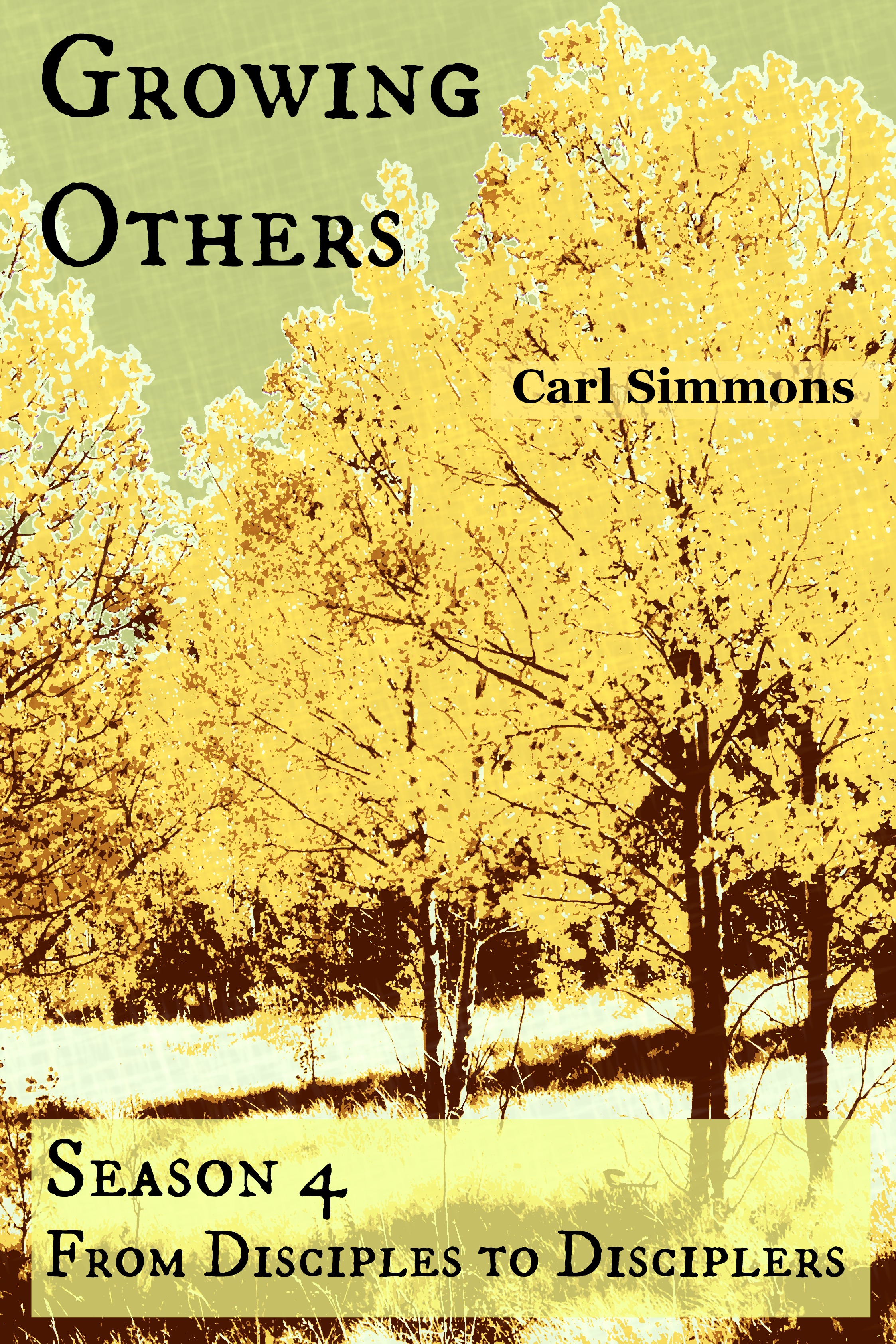
From Disciples to Disciplers: reunited and ready for your consideration


And so here we are. Just as 16 months ago, Seasons 4-6 of the From Disciples to Disciplers series officially went out of print, and the rights reverted back to me, so now Seasons 1-3 have done the same. But as mentioned last week, the problem of nondiscipleship hasn’t disappeared. And thus, I’ve been spending some time editing and reworking these for the day where the series would be reunited.

Season 1 coverAnd today is that day.

Season 1: Growing in Jesus — book here, Kindle version here
Season 2: Growing in Character — book here, Kindle version here 
Season 3: Growing in Your Gifts — book here, Kindle version here

Season 2 coverAnd as always, feel free to look here to get the overview of the entire series (or to, you know, just get the series itself :)) Again, no curriculum solves the problem—that’s our job as the Body of Christ—but I believe the issues we all deal with are represented here, and more or less in the order we deal with them as we mature. By all means, pull over and dig into any of the resources recommended at the end of each session, once you’ve identified the plateaus you need to get past, but this series will help both to process where you’re at and to remember some things you shouldn’t’ve forgotten in the first place.

And again, I can’t think of a single small-group resource that covers how to become a discipler (Season 4: Growing Others ), or which walks us through how to develop a God-given vision (Season 6: Growing in Your Mission ). Thus, this still needs to be out there.

Season 3 coverAlso: If you’ve ever used these—or just got inspired to do so—spread the word. Tell your buds; start a group in your own church (I’m starting one of those next week, in fact); go put up a review on Amazon or elsewhere; and help get the ball re-rolling here.

From there… well, I guess that’s as much up to you as anyone.

In the weeks to come, I’ll be breaking down each of the six seasons a bit more. Stay tuned, and take what you can from it.

As always, thanks. This series means a lot to me, and so does your help. — Carl

Posted in Uncategorized | Tagged , , , , , , , , , | Leave a comment

Bringing the D-Word out of the Dark


Every Christian is a “small-p” pastor, whether they’re gifted shepherds or not. (“[Y]ou yourselves like living stones are being built up as a spiritual house, to be a holy priesthood,” (1 Pet. 2:5), remember?) The Spirit has equipped every one of us so that the Word becomes flesh in our lives, as well as in the lives of those God is calling us to serve. But often, we just don’t know how to do it. So how do we make the reality of Christ in our lives… real?

And I have to confess, this is where it now gets personal and/or self-promotional. But I also hope it helps illustrate what I’m talking about, and (especially next week) gives you some tools to work with. So roll with me here….

Several years ago, my own journey in discipleship turned outward. Nearly ten years ago, I moved from Jersey to Colorado in order to, in my own words, “put my worlds together” (ministerially & editorially), and thus went from being a gratis assistant pastor (who also as elder, knew we couldn’t pay me) / paid administrator for the editorial database for lawyers.com (see what I mean about different worlds?) to becoming an editor of adult and small-group resources for the church.

A few years after getting out here, I’d been talking with my then-boss and still-friend about what we felt the church needed most. Without too much effort at all, we both landed on the lack of discipleship in the church, and she encouraged me to try to think of a resource to address that. And a couple weeks later, while on vacation in Santa Fe and not really thinking about our conversation at all, the whole thing came to me with a startling clarity—the entire scope-and-sequence, six books, each covering a different season of growth. And it’d be called From Disciples to Disciplers. Because again, that’s the missing link in the church today.

At the same time, Willow Creek Community Church (likely best known for its “seeker-sensitive” approach to church growth), published the results of its REVEAL survey of hundreds of churches, confirming this gaping hole of nondiscipleship in the church—and making it clear that while “seeker-sensitivity” was great at bringing people into church, it had two devastating consequences: 1) those seekers weren’t maturing; and 2) those older Christians who wanted to mature in Christ were “stalled” and/or exiting out the back door. (The other “revelation” from this survey: Regular time in God’s Word was the one common denominator in every “growth step” believers experienced.)

I’ll confess that my first response was “well, duh.” Several subsequent responses, too. I have my own pride issues to deal with, after all.

But really, the sad truth is that these two consequences went more hand-in-hand than the creators of REVEAL knew (or at least seemed to acknowledge). Specifically: 1) Those people walking out the door were the very people who should have been discipling the seekers walking in; and yet conversely and hopelessly connected to that, 2) the fact that these mature Christians weren’t actively engaged in discipling others was what made them stagnant, and kept them from maturing any further.

Let me add one more illustration from this same time period. I debated whether to keep it, but honestly it illustrates the problem far better than I ever could—and it serves as a nice transition to the rest of this entry and beyond….

Declaredly in response to REVEAL, the owner of the company I worked for at the time announced an idea for a resource that could only be described as “hyper-seeker-sensitive”—in short, the exact opposite of what REVEAL appeared to be advocating. Shortly thereafter, I attended an informational meeting with about twenty others, and when question-and-answer time came I asked about the gaping disconnect in discipleship that REVEAL… well, revealed… and asked, “What are our plans to address those issues?”

His word-for-word response: “Well, you’ll have to come up with that.”

Fortunately, I’d already started. And slowly, that idea found favor in important and unusual places, and mostly independent of my own efforts (and trust me, I had efforts :)). I clearly saw God’s hand guiding this thing around the normal development process—and really, at this point I was going to write the thing no matter what.

And so in the summer and fall of 2010, the From Disciples to Disciplers series (renamed Growing Out—which certainly wasn’t incorrect either) was finally released. And despite circumstances best not rehashed here (but suffice to say, tied to the ongoing failure of the above and other “hyper-seeker-sensitive” projects), more than 12,000 copies of this series have already gotten into peoples’ hands. That’s not nothing, and I’m grateful for the opportunity, however unorthodox the route. I still love hearing stories about how God’s used it to change people and even churches—so if you’ve got one (or get one in the future), please share it.

Still, I don’t feel its work is done. The problem of nondiscipleship hasn’t disappeared, or probably even abated. There’s still plenty of work to do. And that’s where you come in. Next week we’re finally gonna talk about both our contributions to that, and where to go from here. Because From Disciples to Disciplers is back in town, baby….

***********

Season 1 coverAnd on that note, the book version of Season 1, Growing in Jesus, is now up. Go fetch. 🙂 And again, lots more to come next week….

Posted in Uncategorized | Tagged , , , , , , , , , | Leave a comment

The Missing Link in the Church


Let’s return to our discussion of “the “D-word” (discipleship) from last week. If you’ve been around the church for any amount of time, you know that it’s the missing link in the church today, whether you’ve been able to put your finger on it before now or not.

The problem of “nondiscipleship” has troubled me pretty much all of my Christian life (31+ years and counting). Perhaps it was more obvious to me because I didn’t come to Christ in the “normal” way—a much longer story for another time, but it involves re-meeting my dad after 14 years of divorce/exile, and a LOT of Bible reading.

In fact, I didn’t get involved with a church until after I’d come to know Jesus…. In those days, it was what would have passed for a megachurch (and might still). Charismatic pastor, strong worship focus, dozens of people coming up for altar calls every week… everything’s cool, right?

Not so much. Even early on, it was evident that there were as many people going out the back door as coming in the front. People got excited, got the “saved” stamp put on them, and then… nothing. Or worse, stumbling and being summarily abandoned by a church that had so visibly “loved” them months earlier. After a couple years of watching this, my wife (who was one of those who got saved there, after we started dating) were done with the cliques and the aloneness, and found another church… which wasn’t terribly healthy either, and in fact close to dead by the time we left a couple more years later…. It was by more than a little of God’s mercy that we stumbled into a C&MA church plant sometime later, and eventually found ways both to become self-feeding and to help feed others.

But over 30+ years I’ve seen this same pattern over and over, even in emotionally healthy churches (and far too many unhealthy ones). We have programs, services, events, and other “opportunities to connect”… none of which are bad in and of themselves. But actual discipleship? It’s there, but it’s rare, and it’s almost always behind the scenes where people can only hope to stumble into it. And we haven’t made finding it any easier by burying it under all those said programs, services, and events—and calling that “church life.”

And since we so often get it wrong even when we try to address it, I can’t emphasize this enough: Discipleship is not about completing a curriculum (even mine :)), or attending a service, or doing a one-time event. It’s about developing and deepening the most important spiritual relationships you have—first with Jesus, then with those He’s brought you in contact with—because none of those relationships are an accident.

It’s fair to assume that if you’ve read this far, you already care about discipleship. But you may be struggling with actually doing it, and possibly even with being a disciple of Jesus. This blog, my friend, has always been for you. Apply what’s here to yourself, and then apply it to the people God puts in your path. Because that’s what discipleship is. And since this weekly entry—and really, this entire blog—is about helping other Christians grow, let’s talk about you. And let’s do it by reflecting on your own journey so far….

Think of a time where you experienced a huge “growth spurt” in your life. (If you can’t think of a spiritual example off the bat, use an example from your professional life or another personal example. But find one.) Got an example in your head? Good. Now, think about this:

• When did you first realize that you’d somehow taken a giant leap forward? What was different?
• Who helped you most in taking that leap? What did he or she (or they) do to keep you moving forward?

You just reflected about an important time in your life, and the people who helped and maybe even inspired you. It probably felt good just to think about those people again. But as good as those people made us feel, it’s even more rewarding to be that person—to know that God has truly used us to help someone else grow in Christ.

So ask yourself this: How do you take what God’s already revealed to you, turn around, and help someone else walk through those same issues, rather than stamping them with a “saved” sticker and leaving them to drown? To break that down even further, and in a more positive light:

• Who do you know who seems ready to take the next step spiritually—whether he or she’s already growing, a brand-new Christian, or a not-yet Christian?
• If you could help that person understand just one thing right now, what would it be?
• And if you’ve already shared that one thing with him or her, what do you think that person needs to really “get” it? And if you haven’t shared it yet, what’s holding you back?

Then, consider this: How could spending more time with that person help you grow closer to Jesus? Because discipleship is for everyone who needs to go deeper in their faith—that means you, too. As you invest in others, you’ll learn things about Jesus, and yourself, that you hadn’t known before—or at least be reminded of things you’d long forgotten that you need to remember. And you’ll need to start dealing with that.

Some people might hear the words “accountability” or “discipleship” and say, “I’m in. When do we get started?” It’s more likely that many will be intimidated. So don’t bash people over the head with this. Invite them out to lunch or a cup of coffee for starters. Talk about their lives and the things that are most on their minds and hearts right now. Then ask whether he or she might want to make a regular time out of it. Most people will accept if they know you’re serious and don’t feel overwhelmed by the commitment. A weekly time together is best, but if schedules only allow for bi-weekly or monthly, that’s OK. Start there and see where things go.

You can even say something like, “I’ve been reading this blog about discipleship, and I’d like to try out some of the things I’m learning on a real person. You’re a real person—would you mind helping me work through this?” Once they’re done laughing, they’ll probably say yes.

The important thing is to make it happen. Begin to share what Jesus has done in your life. Help people see that a changed life is possible. Starting with yours.

Posted in Uncategorized | Tagged , , , , , | 1 Comment

The D-Word (discipleship): It’s Not Dead, Only Sleeping


“And Jesus came and said to them, ‘All authority in heaven and on earth has been given to me. Go therefore and make disciples of all nations, baptizing them in the name of the Father and of the Son and of the Holy Spirit, teaching them to observe all that I have commanded you. And behold, I am with you always, to the end of the age.’”—Matthew 28:18-20

This isn’t just The Great Commission—it’s Our Great Commission. And we’ve failed to live up to it. It’s time to stop failing.

Dallas Willard, in The Divine Conspiracy, put it this way: “Nondiscipleship is the elephant in the church…. The fundamental negative reality among Christian believers now is their failure to be constantly learning how to live their lives in The Kingdom Among Us. And it is an accepted reality.”

It’s time to stop accepting that reality and begin changing it. But first, because discipleship has fallen into such disuse in our time, we need to go back to basics. Consider these questions for yourself:

• What comes to mind when you think of the word discipleship?
• What do you think a disciple actually looks like?
• How do we actually become disciples?
• And finally, if we are disciples, how do we fulfill Jesus’ command “go therefore and make disciples”?

Now, think about your answers. What thoughts or emotions are you having right now? There’s a pretty good chance they’re not the ones Jesus was having as He gave this commandment.

When we think of discipling others, it’s easy to get caught up in thinking, “I can’t do this” for whatever reason—“I need to learn more first”; “I need to accomplish more first”; “I need to have more credibility with that person before I open my mouth.” And these might well be things we need to work on. But very often, we turn these issues into unnecessary roadblocks. If we’re being honest, it’s mostly only our fear of the unknown that holds us back. We make it about what we think we can do, rather than about what Jesus commands us to do, and what He promises to do as we step out in faith.

Look at that passage again. What does Jesus tell us about Himself? And how would believing and better understanding that help us to keep what we have to do in perspective? How might it change what we’re already doing?

Everything we do, good or bad, potentially has an eternal impact on others. Think about it: How others have loved you—or failed to—is part of the reason you are who you are today.

Therefore, there’s no point in being paralyzed by own inabilities and shortcomings. We’re already weak and incompetent—and we’re already in the deep end of the pool, whether we want to acknowledge it or not. And we’re either swimming, drowning… or, like most of the church today, simply treading water. The question now is: What are we going to do about it?

We need to develop a life and a character and devoted to Jesus—the best teacher any of us have. Then we can talk about the particular skills needed for a particular ministry. But we need to create (and become) disciples, and disciplers, first. Got it? Good.

And really, the first and maybe the biggest step to becoming an effective discipler is simply to show up and make the most of the situations God’s already put you in. God’s brought you through a lot already, hasn’t He? Well, hasn’t He? More than anything, that’s what He wants to reveal to the people around you. Not your perfect answers, your adroit leadership skills, or your unbelievable emotionalism heart, but what God’s done through you—and therefore, what He can do for them, too.

Ready? Let’s begin to dig in.

Posted in Uncategorized | Tagged , , , , , | 1 Comment

Getting Back into the Gap


OK, time to get serious about this again, and with good reason….

Over the next ten weeks, you’ll be seeing a series of posts about discipleship leading into, and then based upon, the re-release of my From Disciples to Disciplers series (nee Growing Out)—the original title has become the title once more, and always has been the central focus. The initial run is wrapping Season 4 coverup, and the rights are reverting to me, and thus I’m reworking the pages and republishing privately. Honestly, just spending time with all this stuff has reminded me: I put three years of my life into writing this, and years before that brooding about this issue (as you’ll see below), and much of which is captured here. It’s not for nothing, and it still deserves a platform.

But before we all get back in the pool, let me tell you a story involving another “Pool”—and trust me, I say this more to my shame than as bragging, as this incident took place nearly 18 years ago….

Still, while sitting in church a few Sundays ago, this memory kinda crept up and whomped me over the head. It struck me as a pretty vivid illustration of where I once was and where I’d like to be again, personally, no matter how the books (re-)do…. And after all, the guy I’m talking about is the guy I’m encouraging all of us to become….

It was October 4, 1997—maybe 2-3 weeks after the launch group that would become (and still is) Living Word Church started meeting in our home. (That, in itself, was both the result of and the beginning of a series of “long obediences,” to quote Eugene Peterson/Nietzsche.) Specifically, it was the day of Stand in the Gap in Washington, DC, where by best estimates nearly a million men met to pray, confess, and lift up a nation and one another. A few dozen guys from our mother church, Cornerstone Chapel, were headed the 200+ miles south from north Jersey, and these were guys I’d been pouring into (via men’s ministry that looked absolutely nothing like Promise Keepers, who put on the event), so I wasn’t gonna let my personal preferences get in the way of being there for them now. But it was what happened when we got there, with a totally different group of guys, that I remember most….

promisekeepersSome of you “men’s guys” might remember the event—as well as the “prayer teepees” that were set up all over the Mall (enough said). The original senior pastor of Living Word (who’d be gone by this time the following year), suggested we go inside one of the teepees and pray for our fledgling church. As a bunch of our prayer partners were there with us we all went in and prayed, I’m thinking for a good 15-20 minutes. But as we started filing out, I could sense God grabbing me by the shoulder and saying, “Wait.” So I did.

And as I waited, more guys came in and out of the teepee, most looking as bewildered by the experience as we probably had been. I just started talking to guys, taking prayer requests, and praying with them—probably for a good hour and a half. Those of you who know me know I’m not real good at initiating conversations (although I got better at it during eight years at Living Word—again, the “long obedience” thing). But it came very naturally that day. Guys were opening up about all kinds of stuff, and more often than not crying by the time we were done praying. Most of them thought I was with PK; I most certainly wasn’t. 🙂 It was Spirit stuff—God working from the inside out—from end to end, and that’s what men’s ministry (or any kind of ministry) should be all about.

But here’s the kicker: I remember especially a couple guys from (I want to say) Wisconsin/Illinois and Massachusetts, who were friends who’d used the event as an opportunity to have a mini-reunion. After we’d shared and prayed and yes, cried, they said to me, and I quote: “I wish there were guys at our church that we could talk and pray with, like we just did with you.” And again, I don’t say that for props—I say it because it was one of the saddest things I’d ever heard.

This is why I do what I do—when I do it, at least… and why it’s so stinking important regardless.

Next week, I’ll start talking about that importance on a broader scale. But for now, I have work to do….

Posted in Uncategorized | Tagged , , , , , , , | Leave a comment

For Writers… mostly…


There’s a more global announcement on the way, but in the meantime I thought this kinda long post might nonetheless be useful to some…. you know, since ALL of you are writers to one degree or another….

As most of you know, I’ve spent the last 10 months working on a mega character curriculum for pre-K through adult, and all based on living out of our identity in Christ. As I’ve told any number of people, I don’t know who else could have been the guy for this. And I don’t say that as an ego thing (well, maybe a little, but…)—rather as a “you could count on one hand the people that God has taken down this particularly circuitous route” thing. The pastoral AND curricular backgrounds, the immersion in gospel-centered materials in the three years after said curriculum department got toasted, the background with startups (from businesses to applications to churches to my own writing), the uncanny ability to get an inordinate amount of work done in a stupid-short period of time…. Heck, throw in the fact that I got hired in response to a job posting for the wrong job (but with the right job description)… and you can see God’s hand (and His sense of humor) in it all.

Anyway, over the course of reviewing and editing 700+ assignments (so far — ’bout 200 more to go) of 3,000 words apiece (give or take), needless to say there’s been a lot of coaching going on. (As a handful of those writers also subscribe to this blog, they might substitute “haranguing,” “harassing,” “lecturing,” “browbeating,” or “nitpicking.” I’m gonna stick with “coaching.” :)) Much of that has been product-specific, obviously, but there’s also been a goodly amount of philosophizing and quality-pushing that, really, I think could be useful to anyone who wants to reach and reassure others for Christ in a way that they might actually hear it.

So while we wait to talk about other stuff here, I thought I’d share some of the more global advice here, edited below as needed. (And hey, since half of the remaining writers are here maybe I’ll be able to save myself another round of “coaching” by putting it here, too. :)). Enjoy, or at least chew on it and see what you think, and I’ll see you soon….

• Remember your audience. Some may have an extensive knowledge of the Bible; many won’t. Likewise, avoid theological/”churchy” terms. Not that you can’t/shouldn’t discuss deeper stuff—just make sure you use words that anyone could understand as you do it.

• There’s a lot of crazy, and very visible, stuff that takes place in the Bible. What’s it like to be in the middle of that? We get wrapped up in bigger-than-life news events all the time; what’s going on in these passages is often far bigger than that. Leverage it.

• Obviously we want to stay true to what the Bible says, but the goal here isn’t to unearth biblical facts; our goal is to explore the tension in the biblical narrative and apply it to the tension in which we’re living. We can have all our “theological points” right, and still miss God’s point for our lives. Write out of your life—don’t just reflect God’s Word but also how He who is the Word has been dwelling and living through you. If you do the latter, you’ll nail the former.

• Don’t just write questions that need answering—write questions that spark discussion, and maybe even inspire some “iron sharpens iron” sessions among your teachers and students. If you wouldn’t ask your question to a person sitting across from you, don’t ask it here. Think: How would you ask this question to someone else—or maybe even to yourself? That’s how you want to ask it here. Don’t just write it—live it. And watch what God gives you when you do.

• Be sure to emphasize God’s mercy and grace over and above “your sin,” or “Jesus saved me—now I have to….” Remember, character isn’t about behavior modification; it’s what we hold deep inside. It’s not about how God’s gonna drop the hammer on us if we [INSERT SIN HERE]—it’s about “God’s power to do the right thing.” Show them the Jesus they’d (and that we already do) want to follow, rather than one who’s ready to lay down the hammer and/or make a ton of demands of you at every step (see also Matt. 11:29-30).

• Dig into the struggle. Don’t go for “Bible answers”; God certainly didn’t with the Bible. Show us how He’s with us in the struggle, just as He did with those He first gave these words to. The original protagonists of the Bible needed a Living Word—and so do we.

• Self-application starts with ourselves. Introduce people to Jesus—not to how much better we (and our circumstances) are as Christians, and how we can make everyone else know that too. Because again, we know that’s not how God dealt—and continues to deal—with us. And that “continues” is everything. Again, it’s about all of us growing in the struggles God takes us through, not about having all the answers. Jesus has all the answers (and is the answer); we don’t (and aren’t).

• Finally, consider Hebrews 4:12: “For the word of God is alive and active. Sharper than any double-edged sword, it penetrates even to dividing soul and spirit, joints and marrow; it judges the thoughts and attitudes of the heart.” If this is true, then you have plenty to write about.  So, “stay true,” keep your “focus,” and “do the right thing.” 🙂


Posted in Uncategorized | Tagged , , , , , , | Leave a comment

How I Spent My All-Too-Extended Vacation: Final Chapter


Let’s get the disclaimer out of the way pronto: I edited these very different books last fall/winter (one while starting the new job), and they’re finally in my hands. Now, let’s see if I can get them into yours….

But first, a word: Long-time followers will recall that New Growth Press was a lifeline to me and my family during the “locust years” from January 2011 until this past February. In addition to enabling us to somehow hang onto our home during all that time, it gave me a proper schooling in “gospel-centered” products that would serve me well in my present position (just as, admittedly, a proper schooling in active learning and children’s curriculum from my former employer did as well). AND, it gave me the opportunity to re-create THIS, which I still insist you should go to your nearest Internet and snatch up right away — right after you buy this, mind you :)). They do good work, and I got to do good work for them (and still might, as I find breaks in the chaos). So consider well, and check out their catalogue regardless, if you haven’t already.

That said and again, these are two very different books. Even if you want them both, you’ll want them for very different reasons. So let’s dive in….

MindscapeTimothy Z. Witmer. Mindscape: What to Think about Instead of Worrying. 188p., $17.99.

Even though it takes a different passage for its cue, Tim Witmer’s book is all about the renewing of our minds (Rom. 12:2), and of finding ways to pull out the “worry weeds” of our lives and find new ways of thinking. Thus, after the two introductory chapters addressing our thought life and the more general subject of worry respectively, Tim spends the rest of the book breaking down the content of Philippians 4:8 for us, area by area (being true, noble, right, etc.) and showing us how we can better and more consistently “think about these things” (also the title of the last chapter).

The tone of Mindscape is clear, conversational, and pastoral, even as it helps us to better understand each of Paul’s terms. There are plenty of life illustrations to help us identify with and apply what Tim’s explaining. I also appreciated its advice near the end: “If you’ve walked with the Lord for some time, find someone you can help with their mindscape. You’ll not only be amazed at what a difference this can make in the life of the person you help, but also in yours.” Renewing our minds isn’t just for us, after all.

To further help us apply these ideas, each chapter closes with two sections: “From Mindscape to Lifescape,” where readers get more hands-on ideas to make being true, noble, etc., a reality in their lives; and “Food for Thought” reflection questions that will carry the reader deeper into the ideas being presented here. Thus, this book not only works for individuals but could easily be used in a small-group setting.

If being “excellent” and “praiseworthy”—or even being able to think about it—has proven elusive, Mindscape can help you get there.

Our second book may have a more restricted scope, but it’s an important one. It’s a shame Deepak Reju needed to write it at all, but it’s incredibly relevant to the church today. Given the current state of our society today, it’s an admonition for churches and especially children’s ministries to “be wise as serpents and innocent as doves” (Matt. 10:16) and to take the precautions needed to protect our children from predators inside the church, or those trying to get inside.

On_GuardDeepak Reju. On Guard: Preventing at Responding to Child Abuse at Church. 212p., $19.99.

An “a-ha” moment also comes as Deepak points out that it’s the church’s trusting nature that makes them a perfect landing place for predators—a point that, sadly, has been amply illustrated in recent years. As he puts it even more expressively, “In general, Christians are less inclined to be skeptical about people because of our redemptive desires for them.” Thus, churches need to be additionally careful in who they allow to come in contact with children, lest we not only are too trusting but betray the trust that’s been placed in us by parents.

Deepak walks churches/children’s ministries through each of the areas where they need to be “on guard.” Section One of the book explains the problem itself, as well as the different types of predators and differing assumptions/stereotypes we need to get past in order to see the situation clearly. Section Two is the most hands-on section, as it deals with issues such as how to create and implement a child-protection policy, a useful check-in/checkout process, screening and training of volunteers, etc. Just implementing these ideas and having a plan, he points out, are enough to deter most predators, who are just looking for an easy “in.”

Deepak even addresses the issue of how to deal with recovering predators who now have a genuine relationship with Christ: “If the church does allow the offender to come to services, the leadership must ensure that proper precautions will be taken for the sake of the kids. Even if he is a believer, and even if the offense occurred before he became a Christian, the sexual offender should be permanently barred from children’s ministry. We  don’t put alcoholics in bars after they are recovered.”

But again, no system is foolproof, and therefore the final section addresses the issue of how to address abuse that has occurred, including reporting, church accountability, and how to help victims find healing.

So: Equip and protect your mind, or equip and protect your church. Both of these books have their place.

Posted in Uncategorized | Tagged , , , , , , , | Leave a comment

More Cries from the Desert


win·now
1. remove (chaff) from grain
2. literary: (of the wind) blow. “the autumn wind winnowing its way through the grass”

“Now faith is the assurance of things hoped for, the conviction of things not seen” (Hebrews 11:1 ESV).

Weariness at the outset; elegy at the end; hope-on-wry in the middle; and loss, dignity, tattered faith, and Rickenbackers from end to end. Yep kids, it’s another Bill Mallonee album. 🙂 And no-one else’s. Which is what, time and time again, makes it so stinking necessary.

winnowingBill Mallonee (& the Darkling Planes). Winnowing. CD $20 ; download $12; both available here.

To be clear, and even in relation to recent releases such as The Power and the Glory and Amber Waves, this is an album you’ll need to slow yourself down for. But as you do—and especially if you’re a lyrics guy like me—things’ll begin to pop up and slap you on a regular basis. Which is just as it should be. So let’s get on with this, and remind you why you should join the few, the rabid, the Bill Mallonee fans….

For the acoustic opener “Dover Beach” (and a couple other places here), Bill drops into his “ladies and gentlemen” voice (if you see him live, you’ll understand). It’s a desert song, but not just about the physical deserts of New Mexico he now resides in:

every conviction that i lived by, every truth that i was taught
every sermon that i heard; well, it was all for naught
i was always pretty bad at carryin’ my cross
out in the cold….

No, i am not a scoffer withholding his thanks
my purse? It may be empty, but my heart overflowed its banks
heard a different melody swelling from ragged angelic ranks
out in the cold

Was that your voice cascading through all that is unseen?
I sorted through the implications, till i don’t know what it means
Caught between a heart that’s all at once both holy & obscene
out in the cold

From the doors that never opened by prayer or skeleton key
aren’t our feet are only searching for a home we’ve never seen?
I have glimpsed it once or twice, but it could have been a dream
out in the cold

To have travel for these many years knocked on many doors
i got tired of tryin’ to bend an ear; i got tired of keepin’ score
sometimes a son of heaven; but a son of hell even more
out in the cold

We’ve all been there, and while I wish (on a personal level) Bill didn’t have to walk this stuff out so regularly I’m glad he’s there to meet us when it’s our turn. Likewise, “Those Locust Years” returns to a old theme (see Slow Dark Trainand then buy it and treasure it as much as I have): “And the locust years / are coming to your town /  they don’t ask an invite / they just roll on in / locust years / living under your skin.”

“Old Beat-Up Ford” and especially “Got Some Explaining to Do (Gotta Give the Devil His Due)” start to crank up the amps, even as Bill wanders into socio-political territory:

the whole nation is weeping
how much longer can it last?
goodwill & trust are thing
of the past…

as soon as you pledge allegiance
they’re out to steal your joy
maybe it’s the new corporate terror
seducing the government
maybe it’s the war machine
maybe the 1%
time for banishing darkness
time to do what’s right
time for loving the planet
time for stepping into the light

And yet there’s a bit of playfulness in the verse “now, i don’t buy the right records / but i know just what i like / and if you’re high & lonesome / i know what’ll get you through the night.” Whereas “Dew Drop Inn” brings the wry: “Spring of Hope /  summer of Love /  It ain’t never without a Fall / some dreams get born / most get beaten’ out / some folks forget how to dream at all.”

“Blame It on the Desert (Whispering),” might be my favorite here, as 1) it’s no doubt the most upbeat thing here, and 2) there’s a colliding of loss and hope that’s quintessential Bill: “what the mystic knows / what the Good Book does proclaim / you only ever own
what you give away /  blame it on the spirit / blame it on the wine, but then again /
blame it on the desert… whisperin’.” (By the way, no matter which format you go for, definitely snag the acoustic + piano demo version of this song that comes with the download version of this album. Just sayin’.)

Between its title and subtitle, “In the New Dark Age (The Only Lamp Burning Bright Is You)” is almost self-explanatory, and yet it’s a bit more expansive musically than the rest of the album, no doubt due to the Mellotron going on here, and the extended string coda is an especially nice touch. Also, big-time props for the line: “We’re all mystics & freaks / With the spirit beneath.”

As we near the end, Bill especially gets his Byrds on for “Hall of Mirrors / Room Full of Woes.” But for the “official” closer, “Now You Know,” wife Muriah Rose’s piano comes to the fore, as Bill brings the elegy hard. This one is becoming a big-time grower for me, and gets just a little sadder every time I hear it:

Well, the first thing that you’ll notice
is the sadness of this place
deserts speak in whispers
but she rarely shows her face
they say that you get use to it
ah, but I’ve not found that to be the case
now you know…now you know…now you know…

Caesar sat upon a steed
and waited till the dawn
without a word the die is cast
across a Rubicon
history’s muddy, bloody boots
are ever marching on
now you know…now you know…now you know

I can feel it all disintegrate
like paper in the flame
now you know…now you know…now you know…

Both versions have their bonus songs. Both CD and download include “Tap Your Heart on the Shoulder (& See If She’s Still Awake).” And then there’s the download-only “Comes Tumbling Down,” which again comes heavy on the wry (self-pity?) with its closing verse: “‘honey, we’re all resplendent’ / said some folk-singer that i knew*** / use to hang on his words / maybe, i still do / i wonder how he’s doing / but he’s nowhere to be found.” [*** And if you don’t know what he’s talking about, yeesh, take care of that, people.]

We’ve all had our desert periods (and Lord knows we’ve had ours the last few years). Especially if you’re there now, Winnowing serves a late-night soundtrack. And even if not, buy it now and thank me later.

Posted in Uncategorized | Tagged , , , | 2 Comments

Separation Anxiety


Been awhile since I wrote something… you know… as just writing. So here goes…. roll with the rambling—there is a point to it, even if I’m still trying to fully nail it down myself….

That said, a lot of the reason for both the recent lack and this current post would be that I’m still processing and/or trying to live into what I’m dealing with. In fact, there’s a quote in Lay It Down (buy it now, kids) that seems as prophetic now as it seemed just plain-old relevant then:

“Each of our lives need to move from being of Christ to being in Christ—and finally to the point where our life “is Christ” (Philippians 1:21, et al.).”

The fact, I’m still trying to live up to my own words. (What? I’m not really that shining an example of Christianity as you thought? Who knew?) But seriously: Those last words in particular have been my wrestling match for quite some time, and especially in the last several months. Not to mention the repeated assertions/convictions throughout 1 John:

Whoever says “I know him” but does not keep his commandments is a liar, and the truth is not in him, but whoever keeps his word, in him truly the love of God is perfected…. God is love, and whoever abides in love abides in God, and God abides in him. By this is love perfected with us, so that we may have confidence for the day of judgment, because as he is so also are we in this world. There is no fear in love, but perfect love casts out fear. For fear has to do with punishment, and whoever fears has not been perfected in love (1 John 2:4-5; 4:16-18).

And yet, Jesus also tells us, “You shall love your neighbor as yourself” (Matthew 22:37-39). That’s harder than it sounds—including the implication that we already truly “love ourselves.” Because here’s the thing: God’s best is also my best. When I live in that truth, I am truly loving myself, far more than I am when I’m indulging/enabling/abusing myself.

Only that which is pure can conquer death. Jesus proved that. And we are in Him. I don’t need patience, restraint, humility—I need Christ. He is my patience, restraint, humility. If I am dead in Christ, then He is the only life I have.  The same, therefore, is true for my neighbor.

We do not have to separate ourselves from the world—God has separated us from the world, and we need to live out of that—in the way that God has separated us. We’ve gotten it backwards. And yet, I am becoming increasingly convinced that God is powerful enough to change even a Christian. “You are not your own, for you were bought with a price” (1 Cor. 6:19b-20a).

So where do we go from here, Lord?

Posted in Uncategorized | Tagged , , | 2 Comments

The Lost Art of Discipleship


The process of discipleship isn’t difficult—the commitment is. In fact, it’s what’s most missing in the church today. (“It” being discipleship, or commitment? Exactly.) Still, because discipleship has become such a lost art in the church, many don’t even understand the process anymore, even if they have the desire. After reading John Thompson’s book, you’ll no longer have that as an excuse.

thompson_web_front_cover_v4John L. Thompson. Changing the Landscape of Eternity: Transforming Believers into Disciples. 256p., $13.99, Deep River Books.

The opening section, “Laying a Firm Foundation” is just that, and deals more with the theological/”why” questions. If you don’t need as much convincing, you can likely jump to Part 2 (the other two-thirds of the book), “Building an Effective Discipleship Ministry”—but not before at least reading Chapter 5, “Jesus’ Requirements: Are You a True Disciple?” As well as being a gut-check before getting into the “work” section of the book, the chapter also recounts some of John’s own story—and in short, amply illustrates why learning to following Jesus is worth the cost.

Part 2, again, is the more nuts-and-bolts part of the book, as well as the warmer, more personal section in general. Because, after all, discipleship is about relationship. There’s also some good advice here for disciplers on how to approach the process:

There are a number of cautions to consider as you prayerfully watch for a person to disciple…. First, God does not necessarily direct you to disciple every person who approaches you. Most young believers have not learned how to determine God’s will. They are, and often prove to be, insincere when asked for a solid commitment to being discipled. It is up to us, as disciplers, to determine if these people are indeed ones who God is directing us to disciple.

John uses the acronym FATHER (or MOTHER, for women) to describe the process; I’ll let you discover the meaning of each for yourself. From there, we’re walked through the basics of how to establish a discipleship ministry, as well as how to deal with issues such as obstacles to growth, as well as how to tailor discipleship ministries to small groups and children’s ministries and/or parenting.

Chapters 10 and 11 are the heart of the book, as they walk us through the goal (heart transformation) and through the discipleship process itself. Here, and really throughout the book, John reminds us, “The truth is that God transforms believers’ lives, not us; we are only tools he uses in the process… Discipleship is not rocket science, but it requires thought and prayer. Since we must combat our old nature, transformation takes time, effort, and of course, God’s transforming work…. Discipleship is a lifelong process.”

Changing the Landscape of Eternity is, simply, a solid book on discipleship from end to end. If you care at all about discipleship (and you’d better), but don’t know where to start… start here.

(Disclaimer: And yes, I was editor for this book. And durned proud of it. :))

Posted in Uncategorized | Tagged , , , | 1 Comment