Getting Back into the Gap


OK, time to get serious about this again, and with good reason….

Over the next ten weeks, you’ll be seeing a series of posts about discipleship leading into, and then based upon, the re-release of my From Disciples to Disciplers series (nee Growing Out)—the original title has become the title once more, and always has been the central focus. The initial run is wrapping Season 4 coverup, and the rights are reverting to me, and thus I’m reworking the pages and republishing privately. Honestly, just spending time with all this stuff has reminded me: I put three years of my life into writing this, and years before that brooding about this issue (as you’ll see below), and much of which is captured here. It’s not for nothing, and it still deserves a platform.
But before we all get back in the pool, let me tell you a story involving another “Pool”—and trust me, I say this more to my shame than as bragging, as this incident took place nearly 18 years ago….

Still, while sitting in church a few Sundays ago, this memory kinda crept up and whomped me over the head. It struck me as a pretty vivid illustration of where I once was and where I’d like to be again, personally, no matter how the books (re-)do…. And after all, the guy I’m talking about is the guy I’m encouraging all of us to become….

It was October 4, 1997—maybe 2-3 weeks after the launch group that would become (and still is) Living Word Church started meeting in our home. (That, in itself, was both the result of and the beginning of a series of “long obediences,” to quote Eugene Peterson/Nietzsche.) Specifically, it was the day of Stand in the Gap in Washington, DC, where by best estimates nearly a million men met to pray, confess, and lift up a nation and one another. A few dozen guys from our mother church, Cornerstone Chapel, were headed the 200+ miles south from north Jersey, and these were guys I’d been pouring into (via men’s ministry that looked absolutely nothing like Promise Keepers, who put on the event), so I wasn’t gonna let my personal preferences get in the way of being there for them now. But it was what happened when we got there, with a totally different group of guys, that I remember most….

promisekeepersSome of you “men’s guys” might remember the event—as well as the “prayer teepees” that were set up all over the Mall (enough said). The original senior pastor of Living Word (who’d be gone by this time the following year), suggested we go inside one of the teepees and pray for our fledgling church. As a bunch of our prayer partners were there with us we all went in and prayed, I’m thinking for a good 15-20 minutes. But as we started filing out, I could sense God grabbing me by the shoulder and saying, “Wait.” So I did.

And as I waited, more guys came in and out of the teepee, most looking as bewildered by the experience as we probably had been. I just started talking to guys, taking prayer requests, and praying with them—probably for a good hour and a half. Those of you who know me know I’m not real good at initiating conversations (although I got better at it during eight years at Living Word—again, the “long obedience” thing). But it came very naturally that day. Guys were opening up about all kinds of stuff, and more often than not crying by the time we were done praying. Most of them thought I was with PK; I most certainly wasn’t. 🙂 It was Spirit stuff—God working from the inside out—from end to end, and that’s what men’s ministry (or any kind of ministry) should be all about.

But here’s the kicker: I remember especially a couple guys from (I want to say) Wisconsin/Illinois and Massachusetts, who were friends who’d used the event as an opportunity to have a mini-reunion. After we’d shared and prayed and yes, cried, they said to me, and I quote: “I wish there were guys at our church that we could talk and pray with, like we just did with you.” And again, I don’t say that for props—I say it because it was one of the saddest things I’d ever heard.

This is why I do what I do—when I do it, at least… and why it’s so stinking important regardless.

Next week, I’ll start talking about that importance on a broader scale. But for now, I have work to do….

Posted in Uncategorized | Tagged , , , , , , , | Leave a comment

For Writers… mostly…


There’s a more global announcement on the way, but in the meantime I thought this kinda long post might nonetheless be useful to some…. you know, since ALL of you are writers to one degree or another….

As most of you know, I’ve spent the last 10 months working on a mega character curriculum for pre-K through adult, and all based on living out of our identity in Christ. As I’ve told any number of people, I don’t know who else could have been the guy for this. And I don’t say that as an ego thing (well, maybe a little, but…)—rather as a “you could count on one hand the people that God has taken down this particularly circuitous route” thing. The pastoral AND curricular backgrounds, the immersion in gospel-centered materials in the three years after said curriculum department got toasted, the background with startups (from businesses to applications to churches to my own writing), the uncanny ability to get an inordinate amount of work done in a stupid-short period of time…. Heck, throw in the fact that I got hired in response to a job posting for the wrong job (but with the right job description)… and you can see God’s hand (and His sense of humor) in it all.

Anyway, over the course of reviewing and editing 700+ assignments (so far — ’bout 200 more to go) of 3,000 words apiece (give or take), needless to say there’s been a lot of coaching going on. (As a handful of those writers also subscribe to this blog, they might substitute “haranguing,” “harassing,” “lecturing,” “browbeating,” or “nitpicking.” I’m gonna stick with “coaching.” :)) Much of that has been product-specific, obviously, but there’s also been a goodly amount of philosophizing and quality-pushing that, really, I think could be useful to anyone who wants to reach and reassure others for Christ in a way that they might actually hear it.

So while we wait to talk about other stuff here, I thought I’d share some of the more global advice here, edited below as needed. (And hey, since half of the remaining writers are here maybe I’ll be able to save myself another round of “coaching” by putting it here, too. :)). Enjoy, or at least chew on it and see what you think, and I’ll see you soon….

• Remember your audience. Some may have an extensive knowledge of the Bible; many won’t. Likewise, avoid theological/”churchy” terms. Not that you can’t/shouldn’t discuss deeper stuff—just make sure you use words that anyone could understand as you do it.

• There’s a lot of crazy, and very visible, stuff that takes place in the Bible. What’s it like to be in the middle of that? We get wrapped up in bigger-than-life news events all the time; what’s going on in these passages is often far bigger than that. Leverage it.

• Obviously we want to stay true to what the Bible says, but the goal here isn’t to unearth biblical facts; our goal is to explore the tension in the biblical narrative and apply it to the tension in which we’re living. We can have all our “theological points” right, and still miss God’s point for our lives. Write out of your life—don’t just reflect God’s Word but also how He who is the Word has been dwelling and living through you. If you do the latter, you’ll nail the former.

• Don’t just write questions that need answering—write questions that spark discussion, and maybe even inspire some “iron sharpens iron” sessions among your teachers and students. If you wouldn’t ask your question to a person sitting across from you, don’t ask it here. Think: How would you ask this question to someone else—or maybe even to yourself? That’s how you want to ask it here. Don’t just write it—live it. And watch what God gives you when you do.

• Be sure to emphasize God’s mercy and grace over and above “your sin,” or “Jesus saved me—now I have to….” Remember, character isn’t about behavior modification; it’s what we hold deep inside. It’s not about how God’s gonna drop the hammer on us if we [INSERT SIN HERE]—it’s about “God’s power to do the right thing.” Show them the Jesus they’d (and that we already do) want to follow, rather than one who’s ready to lay down the hammer and/or make a ton of demands of you at every step (see also Matt. 11:29-30).

• Dig into the struggle. Don’t go for “Bible answers”; God certainly didn’t with the Bible. Show us how He’s with us in the struggle, just as He did with those He first gave these words to. The original protagonists of the Bible needed a Living Word—and so do we.

• Self-application starts with ourselves. Introduce people to Jesus—not to how much better we (and our circumstances) are as Christians, and how we can make everyone else know that too. Because again, we know that’s not how God dealt—and continues to deal—with us. And that “continues” is everything. Again, it’s about all of us growing in the struggles God takes us through, not about having all the answers. Jesus has all the answers (and is the answer); we don’t (and aren’t).

• Finally, consider Hebrews 4:12: “For the word of God is alive and active. Sharper than any double-edged sword, it penetrates even to dividing soul and spirit, joints and marrow; it judges the thoughts and attitudes of the heart.” If this is true, then you have plenty to write about.  So, “stay true,” keep your “focus,” and “do the right thing.” 🙂


Posted in Uncategorized | Tagged , , , , , , | Leave a comment

How I Spent My All-Too-Extended Vacation: Final Chapter


Let’s get the disclaimer out of the way pronto: I edited these very different books last fall/winter (one while starting the new job), and they’re finally in my hands. Now, let’s see if I can get them into yours….

But first, a word: Long-time followers will recall that New Growth Press was a lifeline to me and my family during the “locust years” from January 2011 until this past February. In addition to enabling us to somehow hang onto our home during all that time, it gave me a proper schooling in “gospel-centered” products that would serve me well in my present position (just as, admittedly, a proper schooling in active learning and children’s curriculum from my former employer did as well). AND, it gave me the opportunity to re-create THIS, which I still insist you should go to your nearest Internet and snatch up right away — right after you buy this, mind you :)). They do good work, and I got to do good work for them (and still might, as I find breaks in the chaos). So consider well, and check out their catalogue regardless, if you haven’t already.

That said and again, these are two very different books. Even if you want them both, you’ll want them for very different reasons. So let’s dive in….

MindscapeTimothy Z. Witmer. Mindscape: What to Think about Instead of Worrying. 188p., $17.99.

Even though it takes a different passage for its cue, Tim Witmer’s book is all about the renewing of our minds (Rom. 12:2), and of finding ways to pull out the “worry weeds” of our lives and find new ways of thinking. Thus, after the two introductory chapters addressing our thought life and the more general subject of worry respectively, Tim spends the rest of the book breaking down the content of Philippians 4:8 for us, area by area (being true, noble, right, etc.) and showing us how we can better and more consistently “think about these things” (also the title of the last chapter).

The tone of Mindscape is clear, conversational, and pastoral, even as it helps us to better understand each of Paul’s terms. There are plenty of life illustrations to help us identify with and apply what Tim’s explaining. I also appreciated its advice near the end: “If you’ve walked with the Lord for some time, find someone you can help with their mindscape. You’ll not only be amazed at what a difference this can make in the life of the person you help, but also in yours.” Renewing our minds isn’t just for us, after all.

To further help us apply these ideas, each chapter closes with two sections: “From Mindscape to Lifescape,” where readers get more hands-on ideas to make being true, noble, etc., a reality in their lives; and “Food for Thought” reflection questions that will carry the reader deeper into the ideas being presented here. Thus, this book not only works for individuals but could easily be used in a small-group setting.

If being “excellent” and “praiseworthy”—or even being able to think about it—has proven elusive, Mindscape can help you get there.

Our second book may have a more restricted scope, but it’s an important one. It’s a shame Deepak Reju needed to write it at all, but it’s incredibly relevant to the church today. Given the current state of our society today, it’s an admonition for churches and especially children’s ministries to “be wise as serpents and innocent as doves” (Matt. 10:16) and to take the precautions needed to protect our children from predators inside the church, or those trying to get inside.

On_GuardDeepak Reju. On Guard: Preventing at Responding to Child Abuse at Church. 212p., $19.99.

An “a-ha” moment also comes as Deepak points out that it’s the church’s trusting nature that makes them a perfect landing place for predators—a point that, sadly, has been amply illustrated in recent years. As he puts it even more expressively, “In general, Christians are less inclined to be skeptical about people because of our redemptive desires for them.” Thus, churches need to be additionally careful in who they allow to come in contact with children, lest we not only are too trusting but betray the trust that’s been placed in us by parents.

Deepak walks churches/children’s ministries through each of the areas where they need to be “on guard.” Section One of the book explains the problem itself, as well as the different types of predators and differing assumptions/stereotypes we need to get past in order to see the situation clearly. Section Two is the most hands-on section, as it deals with issues such as how to create and implement a child-protection policy, a useful check-in/checkout process, screening and training of volunteers, etc. Just implementing these ideas and having a plan, he points out, are enough to deter most predators, who are just looking for an easy “in.”

Deepak even addresses the issue of how to deal with recovering predators who now have a genuine relationship with Christ: “If the church does allow the offender to come to services, the leadership must ensure that proper precautions will be taken for the sake of the kids. Even if he is a believer, and even if the offense occurred before he became a Christian, the sexual offender should be permanently barred from children’s ministry. We  don’t put alcoholics in bars after they are recovered.”

But again, no system is foolproof, and therefore the final section addresses the issue of how to address abuse that has occurred, including reporting, church accountability, and how to help victims find healing.

So: Equip and protect your mind, or equip and protect your church. Both of these books have their place.

Posted in Uncategorized | Tagged , , , , , , , | Leave a comment

More Cries from the Desert


win·now
1. remove (chaff) from grain
2. literary: (of the wind) blow. “the autumn wind winnowing its way through the grass”

“Now faith is the assurance of things hoped for, the conviction of things not seen” (Hebrews 11:1 ESV).

Weariness at the outset; elegy at the end; hope-on-wry in the middle; and loss, dignity, tattered faith, and Rickenbackers from end to end. Yep kids, it’s another Bill Mallonee album. 🙂 And no-one else’s. Which is what, time and time again, makes it so stinking necessary.

winnowingBill Mallonee (& the Darkling Planes). Winnowing. CD $20 ; download $12; both available here.

To be clear, and even in relation to recent releases such as The Power and the Glory and Amber Waves, this is an album you’ll need to slow yourself down for. But as you do—and especially if you’re a lyrics guy like me—things’ll begin to pop up and slap you on a regular basis. Which is just as it should be. So let’s get on with this, and remind you why you should join the few, the rabid, the Bill Mallonee fans….

For the acoustic opener “Dover Beach” (and a couple other places here), Bill drops into his “ladies and gentlemen” voice (if you see him live, you’ll understand). It’s a desert song, but not just about the physical deserts of New Mexico he now resides in:

every conviction that i lived by, every truth that i was taught
every sermon that i heard; well, it was all for naught
i was always pretty bad at carryin’ my cross
out in the cold….

No, i am not a scoffer withholding his thanks
my purse? It may be empty, but my heart overflowed its banks
heard a different melody swelling from ragged angelic ranks
out in the cold

Was that your voice cascading through all that is unseen?
I sorted through the implications, till i don’t know what it means
Caught between a heart that’s all at once both holy & obscene
out in the cold

From the doors that never opened by prayer or skeleton key
aren’t our feet are only searching for a home we’ve never seen?
I have glimpsed it once or twice, but it could have been a dream
out in the cold

To have travel for these many years knocked on many doors
i got tired of tryin’ to bend an ear; i got tired of keepin’ score
sometimes a son of heaven; but a son of hell even more
out in the cold

We’ve all been there, and while I wish (on a personal level) Bill didn’t have to walk this stuff out so regularly I’m glad he’s there to meet us when it’s our turn. Likewise, “Those Locust Years” returns to a old theme (see Slow Dark Train—and then buy it and treasure it as much as I have): “And the locust years / are coming to your town /  they don’t ask an invite / they just roll on in / locust years / living under your skin.”

“Old Beat-Up Ford” and especially “Got Some Explaining to Do (Gotta Give the Devil His Due)” start to crank up the amps, even as Bill wanders into socio-political territory:

the whole nation is weeping
how much longer can it last?
goodwill & trust are thing
of the past…

as soon as you pledge allegiance
they’re out to steal your joy
maybe it’s the new corporate terror
seducing the government
maybe it’s the war machine
maybe the 1%
time for banishing darkness
time to do what’s right
time for loving the planet
time for stepping into the light

And yet there’s a bit of playfulness in the verse “now, i don’t buy the right records / but i know just what i like / and if you’re high & lonesome / i know what’ll get you through the night.” Whereas “Dew Drop Inn” brings the wry: “Spring of Hope /  summer of Love /  It ain’t never without a Fall / some dreams get born / most get beaten’ out / some folks forget how to dream at all.”

“Blame It on the Desert (Whispering),” might be my favorite here, as 1) it’s no doubt the most upbeat thing here, and 2) there’s a colliding of loss and hope that’s quintessential Bill: “what the mystic knows / what the Good Book does proclaim / you only ever own
what you give away /  blame it on the spirit / blame it on the wine, but then again /
blame it on the desert… whisperin’.” (By the way, no matter which format you go for, definitely snag the acoustic + piano demo version of this song that comes with the download version of this album. Just sayin’.)

Between its title and subtitle, “In the New Dark Age (The Only Lamp Burning Bright Is You)” is almost self-explanatory, and yet it’s a bit more expansive musically than the rest of the album, no doubt due to the Mellotron going on here, and the extended string coda is an especially nice touch. Also, big-time props for the line: “We’re all mystics & freaks / With the spirit beneath.”

As we near the end, Bill especially gets his Byrds on for “Hall of Mirrors / Room Full of Woes.” But for the “official” closer, “Now You Know,” wife Muriah Rose’s piano comes to the fore, as Bill brings the elegy hard. This one is becoming a big-time grower for me, and gets just a little sadder every time I hear it:

Well, the first thing that you’ll notice
is the sadness of this place
deserts speak in whispers
but she rarely shows her face
they say that you get use to it
ah, but I’ve not found that to be the case
now you know…now you know…now you know…

Caesar sat upon a steed
and waited till the dawn
without a word the die is cast
across a Rubicon
history’s muddy, bloody boots
are ever marching on
now you know…now you know…now you know

I can feel it all disintegrate
like paper in the flame
now you know…now you know…now you know…

Both versions have their bonus songs. Both CD and download include “Tap Your Heart on the Shoulder (& See If She’s Still Awake).” And then there’s the download-only “Comes Tumbling Down,” which again comes heavy on the wry (self-pity?) with its closing verse: “‘honey, we’re all resplendent’ / said some folk-singer that i knew*** / use to hang on his words / maybe, i still do / i wonder how he’s doing / but he’s nowhere to be found.” [*** And if you don’t know what he’s talking about, yeesh, take care of that, people.]

We’ve all had our desert periods (and Lord knows we’ve had ours the last few years). Especially if you’re there now, Winnowing serves a late-night soundtrack. And even if not, buy it now and thank me later.

Posted in Uncategorized | Tagged , , , | 2 Comments

Separation Anxiety


Been awhile since I wrote something… you know… as just writing. So here goes…. roll with the rambling—there is a point to it, even if I’m still trying to fully nail it down myself….

That said, a lot of the reason for both the recent lack and this current post would be that I’m still processing and/or trying to live into what I’m dealing with. In fact, there’s a quote in Lay It Down (buy it now, kids) that seems as prophetic now as it seemed just plain-old relevant then:

“Each of our lives need to move from being of Christ to being in Christ—and finally to the point where our life “is Christ” (Philippians 1:21, et al.).”

The fact, I’m still trying to live up to my own words. (What? I’m not really that shining an example of Christianity as you thought? Who knew?) But seriously: Those last words in particular have been my wrestling match for quite some time, and especially in the last several months. Not to mention the repeated assertions/convictions throughout 1 John:

Whoever says “I know him” but does not keep his commandments is a liar, and the truth is not in him, but whoever keeps his word, in him truly the love of God is perfected…. God is love, and whoever abides in love abides in God, and God abides in him. By this is love perfected with us, so that we may have confidence for the day of judgment, because as he is so also are we in this world. There is no fear in love, but perfect love casts out fear. For fear has to do with punishment, and whoever fears has not been perfected in love (1 John 2:4-5; 4:16-18).

And yet, Jesus also tells us, “You shall love your neighbor as yourself” (Matthew 22:37-39). That’s harder than it sounds—including the implication that we already truly “love ourselves.” Because here’s the thing: God’s best is also my best. When I live in that truth, I am truly loving myself, far more than I am when I’m indulging/enabling/abusing myself.

Only that which is pure can conquer death. Jesus proved that. And we are in Him. I don’t need patience, restraint, humility—I need Christ. He is my patience, restraint, humility. If I am dead in Christ, then He is the only life I have.  The same, therefore, is true for my neighbor.

We do not have to separate ourselves from the world—God has separated us from the world, and we need to live out of that—in the way that God has separated us. We’ve gotten it backwards. And yet, I am becoming increasingly convinced that God is powerful enough to change even a Christian. “You are not your own, for you were bought with a price” (1 Cor. 6:19b-20a).

So where do we go from here, Lord?

Posted in Uncategorized | Tagged , , | 2 Comments

The Lost Art of Discipleship


The process of discipleship isn’t difficult—the commitment is. In fact, it’s what’s most missing in the church today. (“It” being discipleship, or commitment? Exactly.) Still, because discipleship has become such a lost art in the church, many don’t even understand the process anymore, even if they have the desire. After reading John Thompson’s book, you’ll no longer have that as an excuse.

thompson_web_front_cover_v4John L. Thompson. Changing the Landscape of Eternity: Transforming Believers into Disciples. 256p., $13.99, Deep River Books.

The opening section, “Laying a Firm Foundation” is just that, and deals more with the theological/”why” questions. If you don’t need as much convincing, you can likely jump to Part 2 (the other two-thirds of the book), “Building an Effective Discipleship Ministry”—but not before at least reading Chapter 5, “Jesus’ Requirements: Are You a True Disciple?” As well as being a gut-check before getting into the “work” section of the book, the chapter also recounts some of John’s own story—and in short, amply illustrates why learning to following Jesus is worth the cost.

Part 2, again, is the more nuts-and-bolts part of the book, as well as the warmer, more personal section in general. Because, after all, discipleship is about relationship. There’s also some good advice here for disciplers on how to approach the process:

There are a number of cautions to consider as you prayerfully watch for a person to disciple…. First, God does not necessarily direct you to disciple every person who approaches you. Most young believers have not learned how to determine God’s will. They are, and often prove to be, insincere when asked for a solid commitment to being discipled. It is up to us, as disciplers, to determine if these people are indeed ones who God is directing us to disciple.

John uses the acronym FATHER (or MOTHER, for women) to describe the process; I’ll let you discover the meaning of each for yourself. From there, we’re walked through the basics of how to establish a discipleship ministry, as well as how to deal with issues such as obstacles to growth, as well as how to tailor discipleship ministries to small groups and children’s ministries and/or parenting.

Chapters 10 and 11 are the heart of the book, as they walk us through the goal (heart transformation) and through the discipleship process itself. Here, and really throughout the book, John reminds us, “The truth is that God transforms believers’ lives, not us; we are only tools he uses in the process… Discipleship is not rocket science, but it requires thought and prayer. Since we must combat our old nature, transformation takes time, effort, and of course, God’s transforming work…. Discipleship is a lifelong process.”

Changing the Landscape of Eternity is, simply, a solid book on discipleship from end to end. If you care at all about discipleship (and you’d better), but don’t know where to start… start here.

(Disclaimer: And yes, I was editor for this book. And durned proud of it. :))

Posted in Uncategorized | Tagged , , , | 1 Comment

What Would Jesus Write?


As much as we either shy away from—or, get way too obsessed with—the book of Revelation, there’s pieces we don’t dare ignore, and the authors have focused on one of those pieces: the seven letters of Jesus to churches in Asia Minor in chapters 2-3. And through those letters, they point out, we might just learn a lot about our own churches.

8th letterMark Barnard and Kenneth Quick. The Eighth Letter: What Is Jesus Saying to Your Church? 224p, $12.00, ChurchSmart Resources.

One interesting insight the authors give us, and regularly hammer home over the course of the book, is that when Jesus addresses each church it’s in the single-person singular. Meaning: When He’s talking to “you,” He’s talking to the church as a single body of believers. Thus, we’re again reminded that church is not just some individual journey, let alone a “commercial” preference that we can take as seriously as we choose; we are in this together.

As the authors remind us, “The local church is a body, and as such becomes subject to all kinds of illnesses and infections,” as we often see with the churches cited in Revelation. Thus, for the bulk of the book, we’re walked through each of Jesus’ letters—credentials, commendation, criticism, counsel, and Jesus’ conditional promise—and invited us to put ourselves in each church’s shoes. This, in turn, puts us in good stead for the book’s conclusion, when we’re invited to envision Jesus’ “eighth letter” to our own churches, and examine the “illnesses and infections” we have, or still have lingering effects from even years later.

The biblical texts are analyzed well without feeling like some intellectual/ “theological” exercise, removed from our own experience. We know these churches. In fact, it’s tempting (and I daresay fun) to draw some denominational parallels to some of the churches here, and we wouldn’t be completely wrong to do so. But this book isn’t about that; it’s about drawing those parallels to the condition of our own (churches’) heart—which is brought out especially in the “Ponder This” sections at the end of each letter-chapter.

As Jesus addressed the church as a whole, so He calls it to discern and repent as a whole. The authors delve more into this in the book’s final section, as well as in the appendices—and make it clear that this process starts with the leadership. As they say in that final section: “Christ’s message to your church is not something to fear but to seek.” This book will get your church in a position to hear that message.

Posted in Uncategorized | Tagged , , , , , , , | Leave a comment

The Bride of Christ —NOT the Bride of Frankenstein


I’ve been waiting for this book a long time — not only because it’s the first one by My Buddy Rob®, but because, for a change, it’s an unapologetic apologetic for the church. Instead of yet another indictment of the failures of the modern church (and granted, we’ve got more than our share), it’s an impassioned call to start treating the Bride of Christ like the Bride of Christ instead of like the Bride of Frankenstein, and I couldn’t be more thrilled that Rob was the one to write it.

unfinished churchRob Bentz. The Unfinished Church: God’s Broken and Redeemed Work-in-Progress. 176p., $14.99, Crossway.

And clearly, we need to relearn this truth all over again, and so Rob starts us from the beginning:

God calls the poor, the wounded, the opinionated, the nosey, the caring, the broken, the seemingly unlovable. He calls them his own…. If it were up to us to choose. God’s church would look a whole lot like you and a whole lot like me. The Church of the Mirror…. The diversity that we see among the unique community of people that God is building called his church is something we should run toward—not run away from.”

As such, Rob calls in a bunch of sources from throughout the church, both modern and historical, to reinforce his point (and the chapter-closing sections, juxtaposing sections from historical creeds/catechisms with modern worship songs, are a nice touch). That said, I’m happiest when Rob dispenses with the “cloud of witnesses” and writes in his own voice, and we see that most obviously in the last third of the book.

We see this, first of all, in the challenge to the “me and Jesus” mentality of a lot of church dropouts, and I had to laugh at the incredulous reaction of, “Really? This is biblical faith? This is a faith lived out according to the Scriptures?”

I see it also in my favorite chapter, the penultimate and delightfully subtly snarkily titled “Dwell in Unity: Jesus Loves His Church, So You Should Too.” But I also see it in the call to forgiveness in that chapter that both those inside and “outside” the church need to extend to one another. In the end, I’m reminded, I need to respond to church-bashing Christians the way Christ calls me to, not return it double. Because whether we’re willing to admit it to each other or not, we’re all in this together.

In fact, as Rob goes on to argue in the final chapter, “Jesus Finishes His Building Project,” the church is Jesus’ method for personal sanctification—through our repeated dealings with a bunch of fellow justified sinners. We cannot avoid the people God places in our path, because they are our path.

So let’s get on with it. Pick up The Unfinished Church, and get yourself a little further down that path.

Posted in Uncategorized | Tagged , , | Leave a comment

Letting the Elders Lead


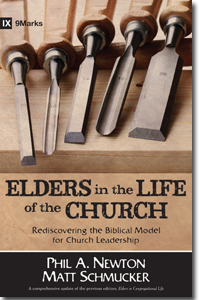
In a sense, I’m not the target audience for this book, as it’s designed to convince a Baptist audience of the need for eldership in the church (vs. a congregational model). As a non-Baptist and a past elder, I’ve never needed convincing of the importance of this. At the same time—and because it has to start fresh in order to make its arguments—it gives any reader a fresh perspective on eldership, even those us who didn’t need convincing.

eldersPhil A. Newton and Matt Schmucker. Elders in the Life of the Church: Rediscovering the Biblical Model for Church Leadership. Foreword by Mark Dever. 256p., $16.99, Kregel Ministry.

The first of the book’s three sections lay down the basic arguments for a model of eldership, both from the New Testament as well as from early Baptist history. It’s also worth noting that throughout the book, the authors also share quite a bit about their own personal journeys (especially in Matt Schmucker’s sections), in discovering both the biblical basis and the practical usefulness of eldership in their own lives and churches.  It’s not all nuts-and-bolts and theology here.

That said, in the second section Phil Newton very deliberately works through four biblical texts on eldership (Acts 20:17-31; 1 Tim. 3:1-7; Heb. 13:17-19; and 1 Peter 5:1-5) and some of the resulting issues that can be expected in transitioning to an elder model of leadership—disagreements, resistance, distrust, and fear of the unknown. Those who don’t need convincing but still need a groundwork (think: elders in training) could likely start here to strengthen their biblical perspective on eldership.

The final section moves into implementation—and more specifically, for this book’s purposes, in navigating the transition from a congregational model to an eldership model. Again, Schmucker’s chapter “What You Will Feel” puts some flesh on what that will actually look like. (Short version: You’ll feel a lot of seemingly conflicting emotions. But God will get you through, if you make it about him instead of you.)

Each chapter also includes reflection questions, so leadership can process the ideas here and (hopefully) discover how to implement them as well.

Posted in Uncategorized | Tagged , , , , , , , | Leave a comment

Living Out of Our Identity—for Kids


(Let’s lead with the obligatory disclaimer: I was editor for this book. What of it? 🙂 Especially since….)

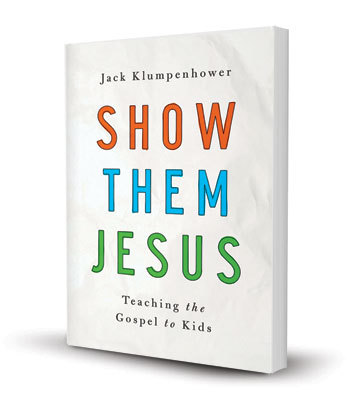
It’s more than a little interesting that, more than a year after working on this, I’d be transitioning from being Adult/Small-Group Boy to assuming responsibility for a PreK-12 character curriculum based squarely on our identity in Christ. And thus, I needed to read this book all over, as a reader/leader—because Jack Klumpenhower is all over this idea. And now you can be, too.

show_them_jesus_thumbnail__26699_1394152933_451_416Jack Klumpenhower. Show Them Jesus: Teaching the Gospel to Kids. 224p., $17.99, Serge/New Growth Press.

The concepts here shouldn’t be revolutionary, but unfortunately they are. As Jack puts it (and made me laugh as I read it, as I recalled a former life):

If I can’t get little ones excited about Sunday school without pretending we’re jungle explorers or astronauts, or if I need carnival games to keep the youth group together, I’ve already lost.  The subtle message of those gimmicks is that jungles and space stations and carnivals are more exciting than Jesus. If Jesus were more exciting, wouldn’t he be the selling point?

To flesh this out even further, here are just a few of the general concepts that guide this book:

• Our lessons—and really, not just for kids but for adults as well—should be out of what God does for us, not what we do for Him. We can certainly explore the latter, just not put the cart before the horse. After all, “We love because he first loved us” (1 John 4:19).
• “The cross of Christ applies to the entire Christian.” We don’t get to compartmentalize, and neither do our kids.
• Faith in the message comes from God, not us. Our job is to stay faithful to that message.
• In short, our goal is not to “teach the Bible”—it’s to teach the good news of Jesus. (And we will need the Bible to teach that well, after all.)

The first half of the book, therefore, explores the above “whys” (and more) of teaching to the good news. The second half moves us into the hows, as well as the difference between true heart change and behavior modification (which we, as the church, all too often fall victim to). Instead of simply addressing “bad behavior,” Jack pushes us to examine the “sharks” the lurk underneath our (and our kids’) surface sins—i.e., the fears/desires/idols that are really driving us to turn our backs on God’s desires for us. Several dozen simple but effective Bible lessons are also scattered throughout the book (and indexed in the back for easy reference).

Each chapter contains a section of “Questions You Might Be Asking,” which addresses queries/concerns teachers might have as they begin to apply this paradigm shift to their own teaching/instruction. Likewise, each chapter closes with a “Show Them Jesus Right Away” section, containing plenty of practical takeaways that teachers, parents, and others can use to show Jesus to their kids… well, right away.

To again quote Jack, “To Jesus, the work of proclaiming God’s kingdom is dangerous. It takes courage. It demands earnest prayer. It isn’t about giftedness as much as faith, and it requires no resources except those God will provide. It’s a high-stakes, spiritual battle with supernatural weapons. Anyone willing to engage the fight on this level is needed for the cause. Such an adventurer will reap a rare mix of power, humility, and wide-eyed joy.”

And after all, isn’t that what we want for our kids?

Posted in Uncategorized | Tagged , , , , , | 1 Comment