What Would Jesus Write?


As much as we either shy away from—or, get way too obsessed with—the book of Revelation, there’s pieces we don’t dare ignore, and the authors have focused on one of those pieces: the seven letters of Jesus to churches in Asia Minor in chapters 2-3. And through those letters, they point out, we might just learn a lot about our own churches.

8th letterMark Barnard and Kenneth Quick. The Eighth Letter: What Is Jesus Saying to Your Church? 224p, $12.00, ChurchSmart Resources.

One interesting insight the authors give us, and regularly hammer home over the course of the book, is that when Jesus addresses each church it’s in the single-person singular. Meaning: When He’s talking to “you,” He’s talking to the church as a single body of believers. Thus, we’re again reminded that church is not just some individual journey, let alone a “commercial” preference that we can take as seriously as we choose; we are in this together.

As the authors remind us, “The local church is a body, and as such becomes subject to all kinds of illnesses and infections,” as we often see with the churches cited in Revelation. Thus, for the bulk of the book, we’re walked through each of Jesus’ letters—credentials, commendation, criticism, counsel, and Jesus’ conditional promise—and invited us to put ourselves in each church’s shoes. This, in turn, puts us in good stead for the book’s conclusion, when we’re invited to envision Jesus’ “eighth letter” to our own churches, and examine the “illnesses and infections” we have, or still have lingering effects from even years later.

The biblical texts are analyzed well without feeling like some intellectual/ “theological” exercise, removed from our own experience. We know these churches. In fact, it’s tempting (and I daresay fun) to draw some denominational parallels to some of the churches here, and we wouldn’t be completely wrong to do so. But this book isn’t about that; it’s about drawing those parallels to the condition of our own (churches’) heart—which is brought out especially in the “Ponder This” sections at the end of each letter-chapter.

As Jesus addressed the church as a whole, so He calls it to discern and repent as a whole. The authors delve more into this in the book’s final section, as well as in the appendices—and make it clear that this process starts with the leadership. As they say in that final section: “Christ’s message to your church is not something to fear but to seek.” This book will get your church in a position to hear that message.

Posted in Uncategorized | Tagged , , , , , , , | Leave a comment

The Bride of Christ —NOT the Bride of Frankenstein


I’ve been waiting for this book a long time — not only because it’s the first one by My Buddy Rob®, but because, for a change, it’s an unapologetic apologetic for the church. Instead of yet another indictment of the failures of the modern church (and granted, we’ve got more than our share), it’s an impassioned call to start treating the Bride of Christ like the Bride of Christ instead of like the Bride of Frankenstein, and I couldn’t be more thrilled that Rob was the one to write it.

unfinished churchRob Bentz. The Unfinished Church: God’s Broken and Redeemed Work-in-Progress. 176p., $14.99, Crossway.

And clearly, we need to relearn this truth all over again, and so Rob starts us from the beginning:

God calls the poor, the wounded, the opinionated, the nosey, the caring, the broken, the seemingly unlovable. He calls them his own…. If it were up to us to choose. God’s church would look a whole lot like you and a whole lot like me. The Church of the Mirror…. The diversity that we see among the unique community of people that God is building called his church is something we should run toward—not run away from.”

As such, Rob calls in a bunch of sources from throughout the church, both modern and historical, to reinforce his point (and the chapter-closing sections, juxtaposing sections from historical creeds/catechisms with modern worship songs, are a nice touch). That said, I’m happiest when Rob dispenses with the “cloud of witnesses” and writes in his own voice, and we see that most obviously in the last third of the book.

We see this, first of all, in the challenge to the “me and Jesus” mentality of a lot of church dropouts, and I had to laugh at the incredulous reaction of, “Really? This is biblical faith? This is a faith lived out according to the Scriptures?”

I see it also in my favorite chapter, the penultimate and delightfully subtly snarkily titled “Dwell in Unity: Jesus Loves His Church, So You Should Too.” But I also see it in the call to forgiveness in that chapter that both those inside and “outside” the church need to extend to one another. In the end, I’m reminded, I need to respond to church-bashing Christians the way Christ calls me to, not return it double. Because whether we’re willing to admit it to each other or not, we’re all in this together.

In fact, as Rob goes on to argue in the final chapter, “Jesus Finishes His Building Project,” the church is Jesus’ method for personal sanctification—through our repeated dealings with a bunch of fellow justified sinners. We cannot avoid the people God places in our path, because they are our path.

So let’s get on with it. Pick up The Unfinished Church, and get yourself a little further down that path.

Posted in Uncategorized | Tagged , , | Leave a comment

Letting the Elders Lead


In a sense, I’m not the target audience for this book, as it’s designed to convince a Baptist audience of the need for eldership in the church (vs. a congregational model). As a non-Baptist and a past elder, I’ve never needed convincing of the importance of this. At the same time—and because it has to start fresh in order to make its arguments—it gives any reader a fresh perspective on eldership, even those us who didn’t need convincing.

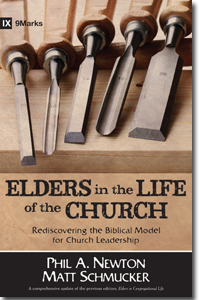
eldersPhil A. Newton and Matt Schmucker. Elders in the Life of the Church: Rediscovering the Biblical Model for Church Leadership. Foreword by Mark Dever. 256p., $16.99, Kregel Ministry.

The first of the book’s three sections lay down the basic arguments for a model of eldership, both from the New Testament as well as from early Baptist history. It’s also worth noting that throughout the book, the authors also share quite a bit about their own personal journeys (especially in Matt Schmucker’s sections), in discovering both the biblical basis and the practical usefulness of eldership in their own lives and churches.  It’s not all nuts-and-bolts and theology here.

That said, in the second section Phil Newton very deliberately works through four biblical texts on eldership (Acts 20:17-31; 1 Tim. 3:1-7; Heb. 13:17-19; and 1 Peter 5:1-5) and some of the resulting issues that can be expected in transitioning to an elder model of leadership—disagreements, resistance, distrust, and fear of the unknown. Those who don’t need convincing but still need a groundwork (think: elders in training) could likely start here to strengthen their biblical perspective on eldership.

The final section moves into implementation—and more specifically, for this book’s purposes, in navigating the transition from a congregational model to an eldership model. Again, Schmucker’s chapter “What You Will Feel” puts some flesh on what that will actually look like. (Short version: You’ll feel a lot of seemingly conflicting emotions. But God will get you through, if you make it about him instead of you.)

Each chapter also includes reflection questions, so leadership can process the ideas here and (hopefully) discover how to implement them as well.

Posted in Uncategorized | Tagged , , , , , , , | Leave a comment

Living Out of Our Identity—for Kids


(Let’s lead with the obligatory disclaimer: I was editor for this book. What of it? 🙂 Especially since….)

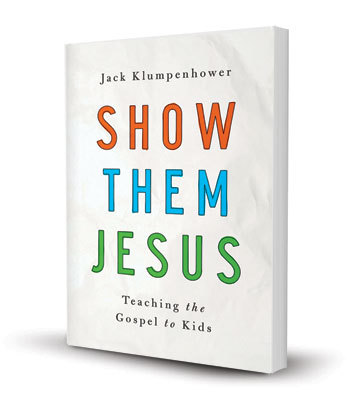
It’s more than a little interesting that, more than a year after working on this, I’d be transitioning from being Adult/Small-Group Boy to assuming responsibility for a PreK-12 character curriculum based squarely on our identity in Christ. And thus, I needed to read this book all over, as a reader/leader—because Jack Klumpenhower is all over this idea. And now you can be, too.

show_them_jesus_thumbnail__26699_1394152933_451_416Jack Klumpenhower. Show Them Jesus: Teaching the Gospel to Kids. 224p., $17.99, Serge/New Growth Press.

The concepts here shouldn’t be revolutionary, but unfortunately they are. As Jack puts it (and made me laugh as I read it, as I recalled a former life):

If I can’t get little ones excited about Sunday school without pretending we’re jungle explorers or astronauts, or if I need carnival games to keep the youth group together, I’ve already lost.  The subtle message of those gimmicks is that jungles and space stations and carnivals are more exciting than Jesus. If Jesus were more exciting, wouldn’t he be the selling point?

To flesh this out even further, here are just a few of the general concepts that guide this book:

• Our lessons—and really, not just for kids but for adults as well—should be out of what God does for us, not what we do for Him. We can certainly explore the latter, just not put the cart before the horse. After all, “We love because he first loved us” (1 John 4:19).
• “The cross of Christ applies to the entire Christian.” We don’t get to compartmentalize, and neither do our kids.
• Faith in the message comes from God, not us. Our job is to stay faithful to that message.
• In short, our goal is not to “teach the Bible”—it’s to teach the good news of Jesus. (And we will need the Bible to teach that well, after all.)

The first half of the book, therefore, explores the above “whys” (and more) of teaching to the good news. The second half moves us into the hows, as well as the difference between true heart change and behavior modification (which we, as the church, all too often fall victim to). Instead of simply addressing “bad behavior,” Jack pushes us to examine the “sharks” the lurk underneath our (and our kids’) surface sins—i.e., the fears/desires/idols that are really driving us to turn our backs on God’s desires for us. Several dozen simple but effective Bible lessons are also scattered throughout the book (and indexed in the back for easy reference).

Each chapter contains a section of “Questions You Might Be Asking,” which addresses queries/concerns teachers might have as they begin to apply this paradigm shift to their own teaching/instruction. Likewise, each chapter closes with a “Show Them Jesus Right Away” section, containing plenty of practical takeaways that teachers, parents, and others can use to show Jesus to their kids… well, right away.

To again quote Jack, “To Jesus, the work of proclaiming God’s kingdom is dangerous. It takes courage. It demands earnest prayer. It isn’t about giftedness as much as faith, and it requires no resources except those God will provide. It’s a high-stakes, spiritual battle with supernatural weapons. Anyone willing to engage the fight on this level is needed for the cause. Such an adventurer will reap a rare mix of power, humility, and wide-eyed joy.”

And after all, isn’t that what we want for our kids?

Posted in Uncategorized | Tagged , , , , , | 1 Comment

Bringing New Life into Old Churches


If you’ve been in a church long enough, you’ve observed that it goes through life stages just like anything else. However, every congregation belongs to a living Savior. Churches don’t need to die—but sometimes they need to be resurrected. That’s where this book comes in.

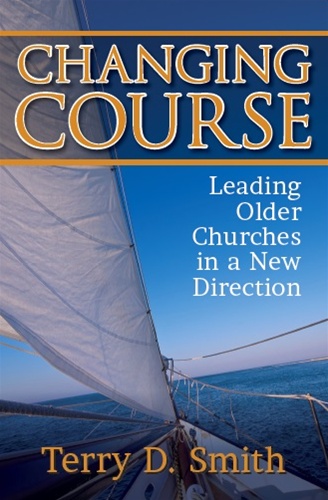
changing courseTerry D. Smith. Changing Course: Leading Older Churches in a New Direction. 216p., $12.00, ChurchSmart Resources.

Regardless of the reasons for decline (and it’s usually many reasons working hand in hand), Terry Smith makes it clear that reviving an older church begins with God, in prayer, and is manifested by leadership that is will to embrace, then promote, then facilitate change. It doesn’t “just happen” (as the much of the entropy/”historical drift” that put the church in this position in the first place did).

The second half of the book does a better job of dealing with the particulars of being a course-change church. Chapter 7, “Keeping the Remnant Connected,” is particularly useful, as it recognizes 1) that there can be spiritually vital people within a dying church, and 2) because they’ve stuck it out, these are the people who are critical to turning a church around. By caring for these people and getting them to embrace the change that needs to happen, change can truly begin.

Likewise, the chapter on interim pastors (often a critical piece for a turnaround church) was enlightening, as it points out the irony of utilizing retired pastors to help old churches to transition: “So they implemented their 1960s ministry philosophy in a 1990s setting. And many people loved it.” (He does hasten to add that not all interim pastors fit this mold, and that there are many more, better-trained, and sometimes even vocationally called “intentional interim pastors” these days.)

Smith has been involved with his share of “course-change churches,” including two separate stints at his current church in Mechanicsburg, Pennsylvania. “I suppose this book is a memoir and a manual,” he says. “[I]f God can do it for a 110+ year old church in precipitous decline, a dying church if we are honest, He can do it for your church as well.”

Posted in Uncategorized | Tagged , , , | 3 Comments

Looking Ahead by Getting Back to Basics


Although this book is built for those seeking a vision for their church (especially those in leadership)—and is quite helpful in that—the heart of this book is decidedly simple: Commit to actually living out the gospel, and just watch where God takes your congregation from there.

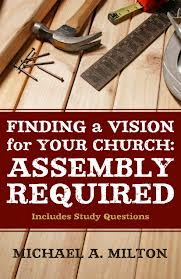
milton visionMichael A. Milton. Finding a Vision for Your Church: Assembly Required. 256p., $14.99, P&R Publishing.

As Michael Milton puts it elsewhere: “[T]his book is not just for ministers and lay leaders. This book is about the church is for all of us who are believers in Christ, who are members of that holy bride that Christ is perfecting. Now, more than ever, we need to think biblically about the church.”

And think biblically we do. And yet this is about vision, and as Milton points out, vision starts with a burden. What has God placed this group of believers together for, at this time? This book will help you and your church to process that together.

Although the book isn’t broken out into sections, there’s clearly a flow to it, as it moves very specifically (in both chapter titles and content) from values to “seeing” (souls saved and Christ triumphant, respectively); to the more outward stages of gathering, growing, and sending; then finally to more nuts-and-bolts issues such as preaching, worship, fellowship, outreach, and prayer. The implementation phase is explored further in the book’s two appendices.

That said, the part that resonates with me most here is the belief that a biblical approach to church is possible. (I know, I set the bar high, but that’s kind of what we’ve come to at this point.) Perhaps the most intriguing and illuminating piece comes near the middle as Milton equates today’s American church with the Jesus approaching the woman at the well in John 4. I’ll let you discover for yourself how the analogy unfolds, but suffice to say that in contrast to many of the postmodern/appeasing approaches today, he reminds us, “You need to see that harvest time is right now, that the post-Christian mind-set of our neighbors does not intimidate almighty God.” Likewise, it serves as a slap in the face to us: Never — write off — anyone. Because God hasn’t: “If you become spiritually desensitized to the plight of the lost in your community, if you possess just a little unbelief about what God can do, then confess it, get rid of it, and wake up to the glory of the gospel.”

Finding a Vision for Your Church, hopefully, can help to serve as part of that wake-up call for churches, as well as the individuals who populate them.

Posted in Uncategorized | Tagged , , , , | Leave a comment

Turning Your Chronos into Kairos


I’m gonna lead with the good part here: At its best—specifically, throughout its exercises here—Daniel Henderson gives us some practical tools to work with, to indeed turn our chronos (measured time) into kairos (time truly engaged with God, and others).

And with that, the bad: It takes an awful lot of chronos to get to the payoff here.

deeper lifeDaniel Henderson. The Deeper Life: Satisfying the 8 Vital Longings of Your Soul. 272p., $15.99, Bethany House.

I can almost hear the publisher discussion here: “Hey Daniel, you’ve got some great training tools here. D’ya ever consider writing a book?” (To be fair, the conversation could’ve gone the other way around, and the publisher took this pretty much solely because of the tools herein.) Bottom line: The exercises that are the real meat here are only 40 pages of this book (with 165 pages of intro/”book content,” and an additional 65 pages of appendices of fairly familiar stuff).

To be fair, for someone whose light just came on and has realized that there is a deeper life in Jesus to be had, this could be a very useful book. At a certain point, though, I found myself flipping quickly.

I finally did stop flipping at Chapter 7 (of 8), “When Shall I Do It?” where the chronos/kairos issue is explored. Really, the book could have started right here (although it’ve only been 80 pages if it had). Here, for me, was the point of the whole book: “Every seemingly mundane minute, when spent with another person, carries the potential of a kairos moment.”

The exercises that follow not long after connect us better with God and give us a deeper knowledge of ourselves, and thus equip us to better spend those kairos moments with others. I’ve used something similar to the opening exercise (which admittedly I lifted from Blackaby’s Discovering God), where the reader charts life experiences with God and looks for the patterns therein. I also liked the exercise that connects our life struggles with the attributes of God we need to become more aware of, as well as the exercise designed to point out the gap between our “declared” values and our “demonstrated” values. And so on. The whole section’s pretty useful.

In fact, I suspect this book would have been much more useful/readable if the exercises had been somehow directly wrapped into the chapters—or just had new chapters written that did directly tie to the exercises.

All in all, there’s definitely some bang to this book. Whether it’s enough for your buck, though, is a whole ‘nother matter.

Posted in Uncategorized | Tagged , , , , | Leave a comment

Aging with Grace — at Any Age


A.W. Tozer once said, “Here’s a test to see if your mission in life is finished—if you’re still alive, it’s not.” That quote doesn’t appear in this book, but it easily could have.

I’m getting to that age where I have to at least start thinking about many of the specific issues in this book—and most of my friends are even closer. Even without my own daily reminders, though, Ecclesiastes 7:2 reminds us, “It is better to go to the house of mourning than to go to the house of feasting, for this is the end of all mankind, and the living will lay it to heart.” Thus this book serves as a reminder to all of us, regardless of age, to “lay it to heart”—and more importantly, do something with it—while we still can. And, that “while we still can” extends far longer than we often think.

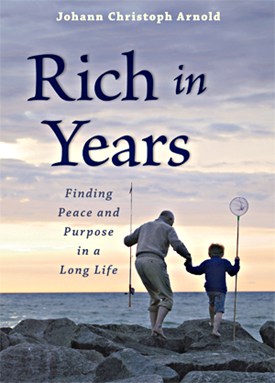
richinyearsENJohann Christoph Arnold. Rich in Years: Finding Peace and Purpose in a Long Life. 192p., $12.00, Plough Publishing House.

Arnold, grandson of Bruderhof founder Eberhard Arnold and now well into his 70s himself, writes with the grace, clarity and energy he demands of his readers. Despite the physical and sometimes mental limitations aging can bring, Arnold asserts that everyone has a purpose that can be lived out until our last day on earth, and encourages each of us to forget about what we can no longer do and get on with what we can do:

Just as we fear getting old, we also fear dying. But we will never fully conquer these fears until we realize that we were not just made for this world, but for something greater. If we see death as a stepping stone into another world – as part of a continuum of the human experience and not as the end of it – we can better deal with it.

Although the individual chapters would be considered topical—addressing such issues as loneliness, dementia, accepting the increasing lack of independence/mobility, finding reconciliation and peace with friends and family, and of course “saying goodbye”—they thankfully don’t read that way. The feel is actually quite warm and meditative, and regularly illustrated with stories or friends and relatives who’ve lived out, and through, the ideas and issues being dealt with here.

In short, and to end with the author’s own words: “Growing older can be a gift, but only if we surrender ourselves to God’s plan. Then we can stop complaining about things we can’t do any more and realize that God is finding new ways to use us.”

Posted in Uncategorized | Tagged , , , , , | Leave a comment

FINALLY.


Let’s keep this one short but personal….

I haven’t talked about this at length on this blog, but as many of you know (or at least have deduced), I’ve been the better part of unemployed for more than three years now. Between freelance gigs, unemployment (then, federal unemployment — which, as you probably know, expired for 1.7 million of us [and growing] a couple months back), and temporary gigs we’ve been able to hang on, but the plane could see the ground/side of the mountain/[insert metaphor of choice here] looming close.

That changed last night.

After four months of interviews/talks/what have you — not to mention the 500+ resumes and dozens of interviews before that — the job offer finally arrived. And, needless to say, I accepted it. 🙂

Thus, starting probably sometime next week (pending background check and myriad other paperwork/”onboarding”), I’ll be serving as Coordinator and Editor for The Christian Character Project, a K-12 curriculum being created for charter and Christian schools. This next year oughta be more than a little chaotic, but I’ve done chaotic — in fact, I’m pretty sure I created the roadmap for it (don’t tell anyone; it makes me look better if we keep it a secret). Another start-up project, and obviously this one has a payoff close to my heart.

(Phew.)

By the way, if any of you are Christian-curriculum writers, I could probably use your services going forward. (And for what it’s worth and from what I already know: The curriculum is very question/inquiry-based, with a decent amount of Scripture/commentary in addition.) Lemme know.

In the meantime: Onward….

Posted in Uncategorized | Tagged , , , , , , | 4 Comments

You No Longer Have ANY Excuses :)


(aka, carlsimmonslive is now also Carl Simmons FREE….)

I know, I know, I’ve been talking a lot about my books lately. Well, I’m not done just yet.

Those of you who, like me, are avid music fans have probably discovered NoiseTrade by now, where musicians (especially of the alt-acoustic and/or alt-Christian variety) offer their albums as free downloads, although one can also leave a tip and/or pay the proper price if they so choose. The music gets a chance to be heard, the artist gets (somewhat) paid, the “buyer” gets to learn about new music with minimum financial risk, everybody wins.

Well, now they’re branching into books—and for once in my life I’m an early adapter by choice. Click HERE and discover for yourself. (FWIW, there’s also books by John Piper, Matt Chandler and Dave Ramsey, and there’s only two pages of nonfiction books so far. See, I really am an early adapter this time.)

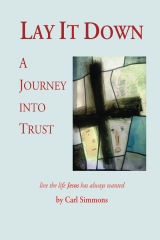
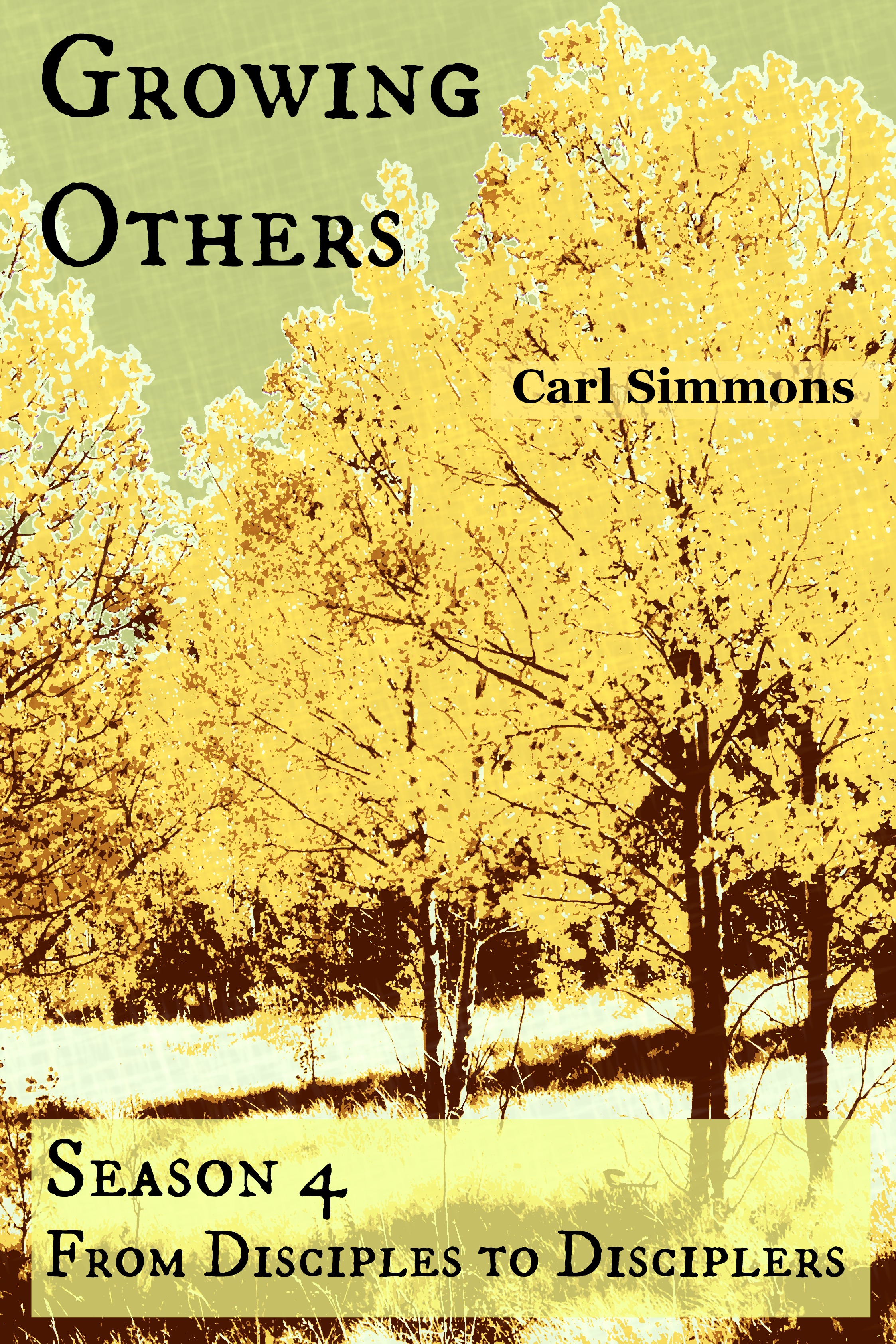
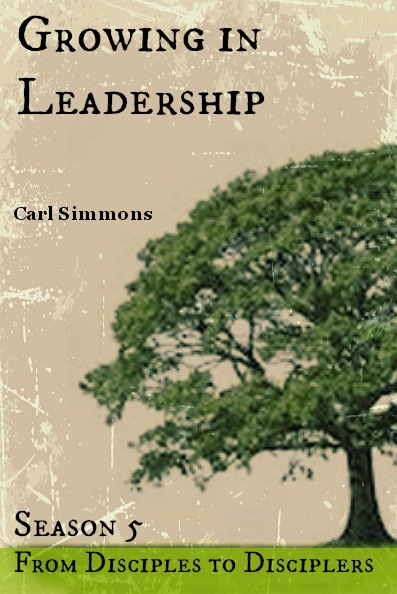
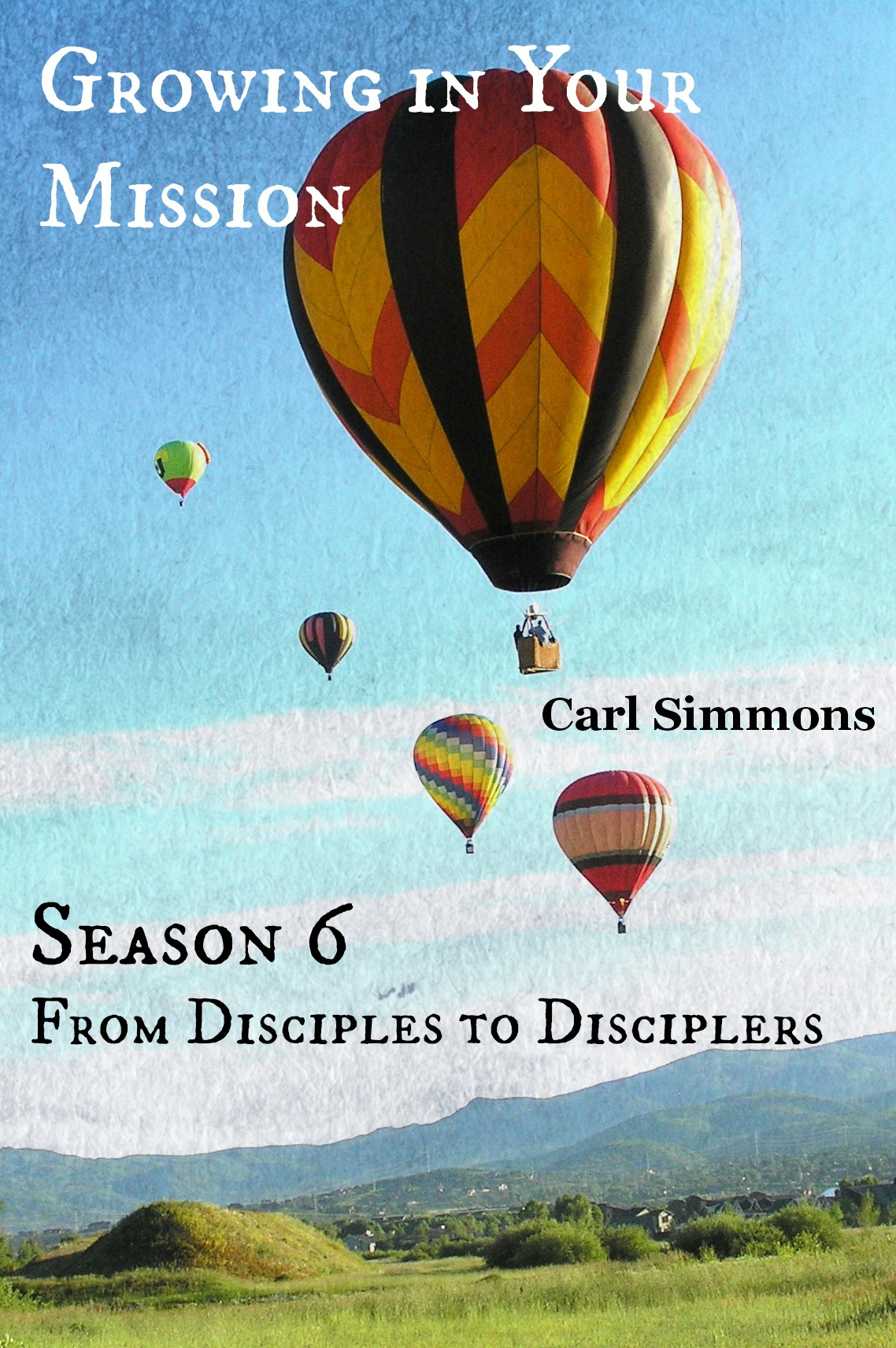
What you’ll find are the four out of seven books I’ve written (and specifically, the ones I currently own the rights to): Lay It Down (which is still awaiting news from elsewhere, so get it while you can), and the recently “out of print” Seasons 4-6 of the From Disciples to Disciplers series (Growing Others, Growing in Leadership, and Growing in Your Mission). And again, they’re yours for FREE, if you like (although a tip would be cool, too).

createspace coverSeason 4 coverSeason 5 coverOLYMPUS DIGITAL CAMERA

If you’re ever had an interest in my writing… and the fact that you’re here kinda suggests that… this is your big chance. You no longer have any excuse to at least not try each of them. And I’m willing to bet you’ll get something out of them when you do. After all, that’s why I’m still pushing them. You’ve got five years of my creative life/God-wrasslin’ in writing, and I refuse to believe it’s all for nothing.

So there it is. Now, GO FETCH. 🙂

And then spread the word. ‘Cause other people like good cheap stuff, too, you know.

And thanks.

Posted in Uncategorized | Tagged , , , , , , , , | Leave a comment