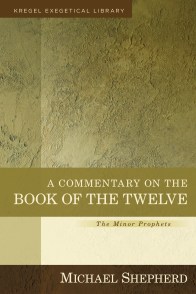
A Commentary on the Book of the Twelve


Aka more commentary about the Minor Prophets than you can shake a stick at. . . .

Book of Twelve.jpgMichael Shepherd. A Commentary on the Book of the Twelve: The Minor Prophets. 528p., $38.99, Kregel Academic.

The books of the twelve Minor Prophets are some of the least studied by Christians today, but they contain some of the great themes of Scripture, such as God’s mercy and judgment, His covenant with Israel, the day of the Lord, and the coming of the Messiah. Arguing for a canonical unity that recognizes the Minor Prophets as one cohesive composition, Michael Shepherd explains the historical meaning of each verse of the twelve books and also provides guidance for application and preaching. Pastors, teachers, and serious students of Scripture will find a wealth of insights for understanding the Minor Prophets.

Posted in Uncategorized | Tagged , | Leave a comment

 Lay Down Your Shame (Part 1)


“Go away from me, Lord; I am a sinful man!” (Luke 5:8, NIV)

One of the very first things Peter says to Jesus captures a huge issue for many of us. After a night of fishing and catching nothing, Jesus blesses Peter, James, and John with more fish than they can handle—and all Peter can see is how short he’s fallen of God’s perfection.

Which, in itself, isn’t a bad thing. It’s not unusual for us, either, to react this way when we first encounter Jesus; and we always need to remember the truth in Peter’s words. But Jesus didn’t come just so he could “go away.” Instead, he calls us to lay down a life that’s often consumed by shame over who we are or what we’ve done.

The things we’ve done—and the evils done to us—are done. We can’t undo what happened, but we can undo the hold of those things upon us. We can own our sin without it owning us. Jesus’ response to Peter, James and John confirms this: “Do not be afraid; from now on you will be catching men.” (Luke 5:10). Jesus calls each of us to lay down our shame, and follow him forward instead.

If we continue to base our identity in our past instead of allowing it to die, we will never approach God—or more to the point, we’ll never let him in; God is already approaching us. Instead, we’ll do just about anything to fill the hole that the Spirit should be occupying. We believe we need to be successful, popular, powerful, constantly entertained, or occupied, because what we are and what we have isn’t good enough. That’s where the power of temptation lies: in the idea that who God created us to be, and what he’s created us for, isn’t good enough. That God got it—and us—wrong.

This brings us full circle: Letting go of this old, false self, and embracing who we were truly meant to be in Jesus, is what this laying-down process is all about. We’re called to acknowledge our guilt and move on, not to take up permanent residence in our shame and hurt.

In a (hopefully not blasphemous) sense, Jesus has carried and shared in our guilt all the way back to the garden of Eden. The fall could have been prevented—but it wasn’t. Like the first Adam, Jesus chose to look on instead of stopping those events from occurring. But let’s not forget another incident, in another garden several thousand years later, which Jesus also could have stopped from happening but didn’t. Jesus stopped in Gethsemane—and saw through at Calvary—what began in Eden.

The cross removes our guilt. All of it. However, it leaves responsibility. Jesus says to us, just as he did the woman caught in adultery, “Neither do I condemn you; go, and from now on sin no more” (John 8:11). And, to “take up the cross, and follow me” (Mark 10:21, KJV).

Posted in Uncategorized | Tagged , | 1 Comment

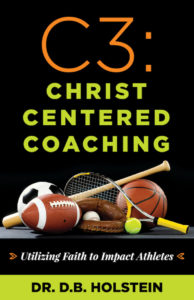
C3: Christ Centered Coaching


While we’re on the subject of athletes, here’s a book to help you coaches out there to not only develop your students as athletes, but more importantly as followers of Christ:

C3: Christ Centered Coaching by D.B. Holstein | Deep River Books

Dr. D. B. Holstein. C3: Christ Centered CoachingUtilizing Faith to Impact Athletes. 128p., $13.99, Deep River Books.

In an environment that is highly emotional and sometimes volatile, it’s critical to have core principles that promote centering yourself for balance, leading through intrapersonal skill development, and recognizing what your athletes are looking for in a coach. C3: Christ Centered Coaching presents just these principles, drawing from the Christian way of life and sport. . . .

The uniqueness of C3 is that the author is one of those everyday, ordinary people that immersed himself for four decades into the two-year college athletic world. This book encourages and equips all coaches, whether they coach elite athletes or young beginners. . . .

C3 additionally aligns scriptural analogies with the intent of bringing the reader down a path of daily self-reflection and evaluation. . . . 

Finally, C3 discusses how Christian living can promote an environment of trustworthiness, valuing the individuals in your group and recognizing each for the gifts they bring, and create an atmosphere of sustainability and open dialogue, thus promoting core group values.

Posted in Uncategorized | Tagged , , , | Leave a comment

Lay Down Your Sin


No matter where you are in relation to Jesus, “sin” is an ugly word. Just saying the word causes problems, so let’s get on the same page before moving forward. In the  weeks to come we’ll break this down into much smaller pieces. Today is about defining our terms—and our solution.

sin-picturePeople define sin any number of ways, even within Christianity, and tend to subject it to their own ideology rather than the other way around. We like to name particular sins and highlight them—especially if they bear no resemblance to ours. We would much rather confess other people’s sins than confess our own.

We also often like to draw the line at “Well, I thought about it but I didn’t actually do it,” or “Hey, at least I’m not hurting anyone else.” But look at Jesus’ “but I say to you”s in the Sermon on the Mount (Matthew 5:21–48)—or just read the entire sermon in chapters 5–7. It’s pretty clear that Jesus doesn’t draw a line anywhere. All sin is condemned by God.

I would define it this way, then: Sin is the inability to respond to God. In every form. Totally expressed or barely conceived. Period. Any sins we commit are the result of sin we already have within us. I did not become rebellious; I was born rebellious. And that still gives me no excuse.

At the same time, each of us is a victim of the sin around us—not just in vague, general ways but in specific, often lousy, and sometimes truly horrific ways. Sin is both within us and around us, and it’s that “around us” that we pick up on and adopt as our own—or respond to by taking judgment out of God’s hands and into our own; or by reveling in our victim status, because at least it gives us some kind of identity.

That’s why I need Jesus. The gospel is not about tolerance of sin, or condemnation of sin—and it’s certainly not about wiping out my own personal enemies. It’s about victory over sin—starting with me. With you. It’s a victory we have to receive from Jesus, before we can live it out.

So when we talk about laying down your sin, it’s not just, “Hey you, stop doing things God says are wrong.” That’s part of the package, to be sure, but it’s only a part. It’s also laying down the sin you want to openly express but don’t. It’s laying down the sin that has been expressed upon you, by others—even the sin that hasn’t been expressed but you know is there. It’s saying Jesus died for all of it, and beginning to live in that truth. Otherwise, perhaps we should just stop wasting our time even pretending to follow Jesus.

I have been crucified with Christ. It is no longer I who live, but Christ who lives in me. And the life I now live in the flesh I live by faith in the Son of God, who loved me and gave himself for me. I do not nullify the grace of God, for if righteousness were through the law, then Christ died for no purpose. (Galatians 2:20–21)

Because of the hardness of our hearts, we will never totally be immune from the sin around us, or within us. However, we no longer need to be slaves to it, or victims of it. Jesus calls us to a different life. Let’s start living it. Today.

Lay It Down Today

In past weeks, you reflected on your “life passage,” as well as questions including, “What’s the one thing that most needs transforming in my life—that God wants me to lay down right now?” Let’s take that further today.

Identify someone you can share openly about your “one thing” with, and commit to getting with him or her on a weekly basis for the duration of this study—and maybe beyond. If you’re working through this with a small group, you’ll get the opportunity to find a partner there—but you can start thinking about whom you want to get with right now. Otherwise, find a friend you can share with, and who cares enough to keep you accountable—someone who won’t let you off the hook but won’t judge you either. If you truly don’t know who to turn to, ask God for guidance, and let him lead you to someone, even if you don’t know that person well yet. May God bless and grow your spiritual friendship as you pursue it together.

Posted in Uncategorized | Tagged , , , | 1 Comment

Listen Up


Need a preschool-through-middle school curriculum? Well, in that case. . . .

listen upMarty Machowski. Listen Up: Jesus’s Parables for Sunday School. Includes DVD of curriculum text + music CD, $159.99, New Growth Press.

Everyone, including children, loves a good story, and who better to tell those stories than Jesus? This curriculum and music album, based on Jesus’s parables, helps children to understand the gospel and the kingdom of God through Bible reading, discussion questions, object lessons, puppet skits, fun activities, and songs for families from the Listen Up music CD. . . .
This twelve-week curriculum includes three learning levels—preschool–kindergarten (ages 4–6), elementary (ages 6–11), and middle school (ages 11–14)—and includes object lessons, crafts, and drama skits for each age group. . . .

  • Another transformational, gospel-centered resource from best-selling author Marty Machowski for children ages 4–11.
  • Each week children will learn simple stories each containing a surprising truth that illuminates the gospel and the kingdom of God.
  • Fun activities, object lessons, discussion questions, and songs teach the gospel through the parables in memorable ways.
  • The companion family devotional, Listen Up: Ten-Minute Family Devotions on the Parables, reinforces the stories at home.
Posted in Uncategorized | Tagged , , | Leave a comment

Lay Down Your Pride (Part 2)


Doing better? Good. So let’s revisit Romans 12:2. I have to confess, as a guy who readily enjoys being in his head, it’s a pretty easy verse to fall in love with. (That said, I dare suggest that extroverts are in their heads every bit as much as us introverts are—they just want the rest of us in there, too.) Here’s the problem—and the solution: I forget all too easily that Romans 12:2 is preceded by Romans 12:1: “I appeal to you therefore, brothers, by the mercies of God, to present your bodies as a living sacrifice, holy and acceptable to God, which is your spiritual worship” (emphasis mine).

We’ll explore the outward part of sacrifice more in the weeks to come, but suffice to say, nothing kills pride faster than having to sacrifice our outward selves. It’s probably very little coincidence that Romans 12:3 begins, “For by the grace given to me I say to everyone among you not to think of himself more highly than he ought to think. . . .”

What does this sacrifice look like? Again, it starts on the inside. “The sacrifices of God are a broken spirit; a broken and contrite heart, O God, you will not despise (Psalm 51:17). Repentance is not just turning back. More importantly, it is starting over.

If change is only in our heads, it’s short-lived at best. However, when our hearts and spirits change, our bodies—and heads—follow. Our “sacrifice” becomes something we do joyfully instead of grudgingly. When we lay down our pride and become willing to change, our desire to put ourselves above others drops. Through humility, we put ourselves in the same boat as those we used to separate ourselves from—and because of that, we no longer desire to see that boat sink.

Lay It Down Today

Find a mirror, and take at least a couple minutes to look at it—or rather, at you. Don’t fix anything. Don’t primp. And don’t make faces. Just look. At you. Spend enough time looking that you’re no longer comfortable with what you see. Or go the other way: If you already hate looking at yourself, spend enough time that you’re able to see the person God created—the person behind what you see. Either way, take the time to see yourself differently—from God’s perspective.

Then, pray. Ask God to help you not to forget the person you are in his eyes. Ask him to give you the strength to lay down your pride and to live out the word he’s given you. Take some time tonight (or tomorrow night, if it’s already evening) to “reflect” on how God uses you in the next twenty-four hours. May God bless you as you live out his life today.

Posted in Uncategorized | Tagged , , | Leave a comment

The Biggest Win


Figured I’d better get this one posted now, while the NFL playoffs are still ongoing and (some of) the heroes of our book are still on another miracle run. . . .  Fans of Paul David Tripp will also no doubt enjoy this, as he’d featured these players prominently in a event last spring.

In any case, sports fans of all types should find this book inspirational, as it’s about a group of players who truly take their faith seriously, and played through their share of adversity to reach the highest level of success in their sport: the first-ever Philadelphia Eagles Super Bowl win. And yet, it’s clear that their success on the field has not been their “biggest win”. . . .

biggest winJoshua Cooley. The Biggest Win: Pro Football Players Tackle Faith. 192p., $15.99, New Growth Press.

The Biggest Win gives athletes and sports fans of all ages a unique, insider’s look into the lives and faith of six Christian NFL players from the 2017 Philadelphia Eagles Super Bowl team—Carson Wentz, Nick Foles, Zach Ertz, Trey Burton, Jordan Hicks, and Chris Maragos. Through the ups and downs of their experiences, author Joshua Cooley shows how these high-profile athletes remain committed to God’s Word, genuine Christian discipleship, and sharing their faith. Using their voices and stories, The Biggest Win gives sports-minded readers hope and direction for living out their faith while competing. . . .

The Biggest Win combines biblical truths with practical direction on issues that every Christian faces—including dealing with adversity, competition, change, success, failure, and how to thrive by faith in a pressurized world. Encouraging male and female athletes in any sport, The Biggest Win guides them in finding their ultimate identity in Christ, not their athletic achievements, and assures them that their greatest prize is eternal life.

Posted in Uncategorized | Tagged , , , | Leave a comment

Lay Down Your Pride (Part 1)


Now that we know who we are in Christ and have our heads on straight, now we can begin to deal with the process of laying down our sin. We’ll explore this more broadly in the weeks to come, but today let’s start with one sin in particular, and arguably the most basic: Pride.

Every act of pride is an act of rebellion. We’re not talking about taking pride in your work or being proud of your kids—we’re talking about the kind of pride that says, “This is mine and only mine. I am right. I, and I alone, deserve this.”

Or it might fly the other way: We might be so filled with self-hatred that we say to God, “You can’t help me. You can’t love me. No-one can. I am alone and I will stay that way. Because at least that’s mine.”

Now, most of us don’t actually talk this way—we don’t want to seem proud, after all—but think about your last angry or bitter reaction, whether anyone saw it or not. How does it stack up against our thoughts above? How did you say or think it?

For that matter, think about why we shy away from discussions on religion or politics—or, bully our way right through. Because our way, our beliefs, are threatened. God, however, is not threatened or intimidated. God can take care of himself—and us. But we must lay down our pride and let him.

But be doers of the word, and not hearers only, deceiving yourselves. For if anyone is a hearer of the word and not a doer, he is like a man who looks intently at his natural face in a mirror. For he looks at himself and goes away and at once forgets what he was like (James 1:22–24).

ghost-mirrorOver the previous couple weeks, we looked at laying down our thought lives—how to be transformed by the renewing of our minds. Probably all of us have experienced an a-ha moment, when God revealed something brand new to us. Honestly, it’s a pretty . . . well, head-y feeling when the Spirit helps us see God’s will in a new way, whether it’s through the Word, circumstances, or when you’re just sitting there and this revelation suddenly . . . hits you.

However, here’s what we often forget in that moment: Insight is just that. It’s insight. At the point we receive it, that’s all it is. It’s a good thing, but it’s a comparatively small thing unless we put it into action. We have an epiphany; we’re inspired by a book or someone’s personal story; we’re moved to tears by a thought—but that’s only a beginning. It’s a seed of something bigger, not the bigger thing itself. What we do with that seed is what matters.

If we do nothing, the moment passes. Nothing changes. That’s one possibility, and we do it often enough. It’s a shame, but it could be worse. For instance….

If we share about this incredible thing God’s shown us and then do nothing with it, we’re like our James 1 “man in the mirror.” We’re actually worse than when we started—because we’ve taken a gift from God and made it about us. We’ve probably primped in that mirror more than a few times; maybe we’ve even flexed our muscles to prove to ourselves what powerful spiritual warriors we are. We’re kidding no one, especially God.

Yet, because God has allowed us this experience, we’ve allowed ourselves to feel superior about it. If we’re not brought to a place of humility and response, we actually allow something given to us by God to be used by the enemy instead. That thought should stop us in our tracks and ask forgiveness right now.

In fact, if that’s where you’re at, stop right now and deal with it. We’ll pick this back up next week; I’ll be here. Getting right with God is more important. . . .

Posted in Uncategorized | Tagged , , | 3 Comments

Middle Knowledge: Human Freedom in Divine Sovereignty


Calvinist? Arminian? If you can roll with the headiness, you might just enjoy this book espousing a position that’s, as one friend once described his own position (and as I’ve pretty much described mine since — and we originally came from opposite poles of the argument), “Calminian”:

Middle KnowledgeJohn D. Laing. Middle Knowledge: Human Freedom in Divine Sovereignty. 368p., $27.99, Kregel Academic.

Most Christians believe God is in control, but they are unsure of how to reconcile that control with their struggles with sin, the command to evangelize, and the immense suffering in the world and their own lives.

Laing offers an introduction to the doctrine of providence based on the theory of middle knowledge, first articulated in the sixteenth century. This view describes how creatures have true free will and God has perfect knowledge of what each creature could and would do in any circumstance. Middle knowledge helps answer the most perplexing theological questions: predestination and salvation, the existence of evil, divine and human authorship of Scripture, and science and the Christian faith. Laing provides extensive biblical support as well as practical applications for this theology.

Posted in Uncategorized | Tagged , , , | Leave a comment

Lay Down Your “Head” (Part 2)


True story: Romans 12:2 was my life verse even before I came to know Jesus. Here’s the King James version I first read it in more than thirty years ago: “And be not conformed to this world: but be ye transformed by the renewing of your mind, that ye may prove what is that good, and acceptable, and perfect, will of God.” There’s so much packed into that verse, and space doesn’t allow us to fully unpack it here. Maybe my own pre-Christian experience with it will help illustrate, though.

When I first read this passage as an I-believe-in-God-but-I’ll-be-anything-but-a-Christian, I immediately sat down and wrote an essay on the power of saying “no.” There was truth to that response—but it wasn’t the whole truth. I had locked squarely into “And be not conformed to this world,” and was on board with “but be ye transformed by the renewing of your mind,” but “that ye may prove what is that good, and acceptable, and perfect, will of God”? Who cared? I didn’t. Not yet. However, without it the little truth I genuinely knew was as good as a lie.

Our lives are no longer our own. The key to a renewed mind is the willingness to lay down our thoughts in order to learn God’s. As we let go of what’s “ours” and take hold of what we know to be God’s, our minds begin to be purified. The Spirit begins to untangle truth from untruth, the wheat from the weeds. God’s will becomes less of a mystery, even as God himself remains an ever-deepening mystery. Even when we can’t immediately see or understand where God is leading us, he honors the spirit of submission he’s given us—and our resolve to stay in submission—and leads us there anyway.

yes, if you call out for insight
and raise your voice for understanding,
if you seek it like silver
and search for it as for hidden treasures,
then you will understand the fear of the LORD
and find the knowledge of God.
For the LORD gives wisdom;
from his mouth come knowledge and understanding….

Then you will understand righteousness and justice
and equity, every good path;
for wisdom will come into your heart,
and knowledge will be pleasant to your soul (Proverbs 2:3–6, 9–10).

To know yourself better only makes you more like you. To know Jesus more is to become more like Jesus. That’s what God has desired for us since the day of creation. So lay down your head, and be transformed.

Lay It Down Today

What’s your “life passage”—or at least a passage from God’s Word that’s spoken to you recently? Take fifteen minutes now, and let it speak to you some more. Sit quietly before the Lord and simply meditate on your passage, then close your time in prayer. Here are a few guiding questions to help you process:

  • Why is God bringing this passage to my mind? Why now?
  • What’s the one thing that most needs transforming in my life—that God wants me to lay down right now?
  • How can I invite God deeper into that part of my life and let him work?
Posted in Uncategorized | Tagged , , | Leave a comment