Lay Down Your Ambition     


We’ve already explored how we build ourselves up through our “doing.” This week is more about the “triggers” that lure us into that kind of thinking. Our circumstances are one such set of triggers. Our own passions, and personal ambitions, are another.

First, let’s make one thing clear: God has given us hopes and dreams and ambitions to pursue. Not all of the “good things” we do are bad. Not by a long shot. The struggle is in who gets the credit, and in who’s really being served by what we do.

Again, and for probably not the last time: Laying it down is about taking our selves out of the equation and focusing on what God wants, rather than how we benefit from what we do. What we get out of it is the blessing, not the goal.

More often than not, we make even good things about our work and our accomplishments, as if we’re somehow made superior by them because we’ve accomplished them. We may give God lip service, and maybe even some sincere acknowledgement, but we know who really stepped up to the plate and got it done.

In The Spiritual Man, Watchman Nee points out, “The enemy well knows how we need our mind to attend the spirit so that we may walk by the spirit. Thus he frequently induces us to overuse it that it may be rendered unfit to function normally and hence be powerless to reinforce the spirit in time of weakness.” A more modern way of putting that is, “If Satan can’t make you bad, he’ll make you busy.” But Nee hints at an even more significant truth: Satan is more than willing to use our busyness and our ambition to, slowly but steadily, make us bad. As we drift from the leading of the Spirit, we leave ourselves increasingly open to things that aren’t of God.

We’ve seen this far too many times in recent church history, but it’s far from a new problem. People often start off sincerely at first and experience success, but soon it become more and more about the success and less and less about serving God. Eventually success becomes “the spirit” of the thing, rather than being something that’s measured by our obedience to the Spirit. “Spiritual leadership” that isn’t leading others closer to Jesus isn’t spiritual leadership at all.

Jesus calls us to a different work: “If anyone would come after me, let him deny himself and take up his cross and follow me” (Matthew 16:24). It is a challenge so difficult that only one man has ever done it entirely successfully—the One who’s calling us to it right now. And he is the one who will make true success happen, in his way and in his time. So lay down your ambition, and begin following Jesus into something far bigger than yourself.

Lay It Down Today

What gets you excited, and makes you want to get up in the morning—or at least has you looking forward to getting back home? Let’s keep relationships off the table, as we’ve already touched on those. For now, think of something that isn’t necessarily life-giving in itself but is life-giving to you—a hobby or activity, or something that benefits others. It might even be your work. Got that in your mind? Good.

Now: How can you invite Jesus (or invite him further) into that activity? It might be as simple as adding prayer throughout your activity (and notice I said “throughout,” not just before or after). Maybe it’s tweaking that activity so your actions are more directly giving God glory rather than just about you “taking a break.” Whatever you come up with, begin making it a regular part of that activity—then see how God begins changing things up as you do.

Also—and here’s the deeper part—consider how this attitude can be brought into the more “serious” parts of your life. Where are you striving to accomplish something, and how much of that is you? How can you begin taking your hands off and letting Jesus guide those things—and when success comes, give him the glory instead of taking the credit? This will obviously take longer to develop, but start working on it today.

Posted in Uncategorized | Tagged , | Leave a comment

When Words Fail: Practical Ministry to People with Dementia and Their Caregivers


Dementia and its symptoms are tough on everyone involved—the persons involved and arguably even more so, their caregivers. This book will give you the wisdom and info you need to cope—as well as to minister. . . .

When Words FailKathy Fogg Berry. When Words Fail: Practical Ministry to People with Dementia and Their Caregivers. 160p., $16.99, Kregel Ministry.

Millions of Christians suffer from dementia diseases such as Alzheimer’s, making ministry to them difficult as they lose memories and the ability to communicate. Drawing on her years of experience as a long-term care chaplain, Kathy Berry provides practical information and tools to equip ministers and lay leaders to meet the spiritual and pastoral needs of those living with dementia.

Chapters cover vital topics, including these:

  • Identifying those who may be showing signs of dementia and learning how to support them as they seek a diagnosis
  • Communicating with dementia patients as their language skills decline
  • Meeting the emotional, spiritual, and physical needs of people with dementia–and the needs of their caregivers

An invaluable resource to meet a growing need for congregations around the country, When Words Fail equips readers to answer Christ’s call to minister to “the least of these.”

Posted in Uncategorized | Tagged , , , | Leave a comment

Lay Down Your Circumstances


I have to admit, I’ve always been perplexed by people who talk about the “comfort” of the Christian life, especially in terms of it being the primary reason for believing in Christ. To be sure, there’s “comfort and joy” to be had in knowing Christ, and “a peace that passes all understanding.” But humanly speaking, there’s still life to be lived. And life can be painful—so much so that it cuts through the veneer of all that joy and peace that people both inside and outside of Christianity think we’re supposed to be exuding 24/7.

The good news is: God’s OK with that. In fact, he’s the one who’s allowed those circumstances to happen. And a big reason he allows them is this: Our circumstances reveal who we are and what we really trust. The situations we face each day—especially the bad ones—tend to bring out what we’re made of, whether we want them to or not. We may be shocked by what our circumstances reveal about us, but God isn’t—and he wants us to stop being shocked as well, so that we trust him rather than ourselves to get through those circumstances.

However, we often don’t approach it that way. We think that if God cared about us, he’d change our situation. In fact, that was pretty much the serpent’s argument in the garden, and it worked. Even paradise wasn’t good enough for us.

On the other hand, when we lay our circumstances before God, he provides a way through them, even when we think things might be impossible—or probably closer to our real issue: even when we have no control over our circumstances. I already have the control, God reminds us; are you going let me do what I need to do, or are you going to continue to fight me?

The Exodus account is a great example of laying down our circumstances. After the second plague out of ten (frogs, by the way), Pharaoh asks Moses to remove this lousy set of circumstances. Moses’ response in Exodus 8:9 is worth noting: He actually gives Pharaoh, the enslaver and persecutor of his people, permission to set the dates for this plague to be removed. Yet by doing this, he’s acknowledging that no matter what Pharaoh decides, God is still in control and ultimately will deliver Israel.

In contrast to this attitude is the well-known (and overargued) hardening of Pharaoh’s heart (Exodus 8:14, etc.). The best definition I’ve seen of this “hardening” is “the continuation of a prior condition.” Put another way: God was pressing Pharaoh’s buttons and revealing his heart, already knowing how he would respond to his circumstances:

For by now I could have put out my hand and struck you and your people with pestilence, and you would have been cut off from the earth. But for this purpose I have raised you up, to show you my power, so that my name may be proclaimed in all the earth. You are still exalting yourself against my people and will not let them go (Exodus 9:15–17).

Sometimes, parting the Red Sea is easier than opening up a human heart.

And that brings us back to . . . us. We want to change our outer circumstances; God is more concerned with changing our inner circumstances—the very ones we seemingly should have more control over but don’t. (Read Romans 7 if you don’t believe me, or even if you do.) When that happens, our outer circumstances begin to change as well. So give it all to God, and let him accomplish his will through your circumstances.

Lay It Down Today

Let’s spend some more time with a question you hopefully began addressing in last week’s small-group session: What circumstances are you facing right now that seem impossible to you—and maybe, therefore, also seem impossible for God?

Ask God to open the way for you to walk through your circumstances—not asking for a solution (though he may well provide one), but to see clearly how to follow him through whatever it is you’re facing right now. Resolve to wait for God’s answer, and ask him for the strength to wait. Start that waiting right now. Don’t just throw up a prayer and stop reading, but spend time waiting. Give God the chance to speak—and give yourself the chance to hear.

Posted in Uncategorized | Tagged , , | 1 Comment

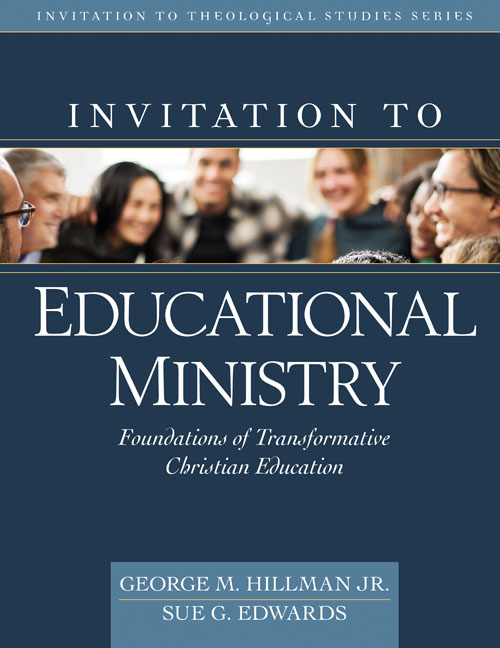
Invitation to Educational Ministry


Everything you want to know about educational ministry—no matter what size your venue—but was afraid to ask. . . .

Invitation to Educational MinistryGeorge M. Hillman, Jr. & Sue Edwards. Invitation to Educational Ministry: Foundations of Transformational Christian Education. 512p., $42.99, Kregel Academic.

Because teaching is at the heart of Christian ministry, the editors of Invitation to Educational Ministry have assembled a team of seasoned experts to present a comprehensive plan of Christian education. This volume will help church staff, parachurch leaders, and small-group teachers become more effective, influential, and creative.

After laying a biblical and practical foundation for Christian education, the contributors provide specific guidance on teaching a variety of individuals and groups, including children, adults, singles, seniors, and non-Christians.

The final section shares valuable insights on leading small groups, teaching innovatively, and overseeing a healthy educational ministry, among other topics. Each chapter is designed to equip educators with the most relevant information, and includes many useful features:

  • Real-life case studies
  • Scriptural support
  • Explanations of key terms and concepts
  • Practical suggestions
  • Resources for additional study
  • Sidebars illustrating best principles and practices
Posted in Uncategorized | Tagged , , , | Leave a comment

Lay Down Your Kingdom: a small-group session


For this session, you’ll need….

  • enough name tags for everyone
  • pens/markers for writing

Laying Down Your Day (15 minutes)

Make sure everyone has a name tag and something to write with. Then say something like: Think of something you’re especially proud of—for example, an accomplishment, an award you won, a title or position at work that you earned, or that major purchase you could finally make. Write it down on your name tag, but don’t show anyone else yet.

Give everyone up to a minute to write, and then say something like: Now, very quickly, slap your name tags over your hearts where everyone can see them. Then, let’s talk.

1. Why did you choose that particular thing? Why are you so proud of it?

2. Looking back now, where was (or wasn’t) God as you worked toward obtaining or achieving that thing?

God has given us great gifts throughout our lives. But we need to remember that that’s what they are—gifts. Even our greatest accomplishments are the result of how God has gifted us, and how faithful we’ve been to that gifting. That’s why this week has been all about laying down our kingdoms—which, after all, are only the kingdoms God’s let us have. As we lay down our kingdoms, we open ourselves further to God’s kingdom work in our lives. Let’s dig more into that right now.

Laying Down the Word (25 minutes)

Read the following passage from Day 3, and then discuss the questions afterward.

“[O]ne of the biggest reasons that God calls us to lay down our reputations… is [that it’s] a way of securing and encasing ourselves in a human love that, even when genuine, is less than God’s love for us. Thomas Merton, in New Seeds of Contemplation, described this as “winding experiences around myself . . . like bandages in order to make myself perceptible to myself and to the world, as if I were an invisible body that could only become visible when something visible covered its surface.”

3. When have you seen a person or group get too wrapped in his/her/their reputation? (No bashing permitted; just explain the situation, from your perspective.)

4. When have you been guilty of getting wrapped up in how others see you—or on the other hand, felt like “an invisible body”? How did (or does) focusing on that separate you from God and how he sees you?

In “Lay Down Your Strength,” we examined the example of Abraham. We observed how God had to deal with Abraham’s natural strength—and the image he tried to maintain—before Abraham could receive the even greater gifts God wanted to give him. We’re not going to re-read Abraham’s story today, but let’s reflect on it as we discuss these questions:

5. Why do we rely on our own strength instead of God’s, when it comes to the challenges we face? Put another way: Why do we so often go the “Ishmael route” rather than the “Isaac route”?

6. Share a recent example that illustrates the above question. How have you responded so far to that situation, both positively and negatively? What still needs to be laid down before God in that situation?

Read Matthew 19:25–30, and then discuss:

7. Think again about the situation(s) you’re facing right now. What seems impossible to you right now—and maybe, therefore, seems like it must be also impossible to God?

8. How do Jesus’ promises assure you otherwise? How can you live in those promises, rather than in what you believe?

Laying Down Your Life (20 minutes)

Have group members get into subgroups of three or four.

Have someone read the quote from “Lay Down Your Possessions” below, then talk about your “Lay It Down Today” assignments from this past week. Which assignments did you best connect with? Which ones, not so much? In each case, why? Afterward, discuss the questions below. Take fifteen minutes to talk together in your subgroups, and then take a few more minutes to pray together about what you’ve shared. Once you’re done, remain quiet until everyone else is finished. May God bless you as you submit your lives even further to Jesus, and discover his love and freedom as you do.

“We do not serve a God of either/or, but a God of both/and—if we’re willing to surrender all of our tiny little kingdoms and properties and belongings to Him. God must rule over the things He’s given us, and be the one who determines how they’re used.”

9. Which part of your kingdom—your independence, strength, reputation, possessions, relationships—is hardest for you to lay down before Jesus? Why?

10. What would laying it down look like, in your case? What could Jesus do with that? What are you afraid he might (or might not) do if you took that step of faith?


Posted in Uncategorized | Tagged , , , , , | Leave a comment

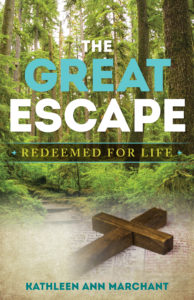
The Great Escape


Need a study on healing and deliverance—especially for someone who’s literally imprisoned? Look no further. . . .

Kathleen Ann Marchant. The Great Escape: Redeemed for Life. 336p., $14.99, Deep River Books.

In this thoughtful Bible study guide, find ways you can experience healing and be released from the shackles of sin, addiction, abuse, and life circumstances. . . . This 8-week Bible study follows a faith progression, starting with an introduction of the Trinity. Readers travel gently through the basics of Christianity, going a little deeper each week. Each lesson starts with a prayer and offers challenges to aid the reader in repair of brokenness, idleness, and destructive behaviors.

The Great Escape: Redeemed for Life Bible study guide provides encouraging inspiration and insight into what life can be like after the release of chains. In a society riddled with distractions—sin, abuse, addictions, being prisoners in our circumstances and even our own minds—this study offers the reader freedom. Readers will learn of the hope available by truly surrendering their hearts to Jesus. Over the course of the study, the reader progresses to a place of not only survival, but purpose and joy. The study wraps up with an entire week devoted to support for life after the study, providing the reader with tools to incorporate what they have learned into everyday life.  Experiencing freedom to inquire, to change, to surrender, to forgive, and to move on to live a life that is Christ-centered will leave them truly redeemed for life.

Each week contains five lesson plans. Every lesson plan starts with a welcome and prayer. The body of the lesson is filled with Scripture and encouragement. At the end of each lesson plan is a Reader Challenge to apply the day’s lesson to their circumstances, followed by an Incarcerated Challenge written specifically for a reader that is incarcerated.


Posted in Uncategorized | Tagged , , , , , | Leave a comment

Lay Down Your Relationships


Let’s pick up where we left off last week: “And everyone who has left houses or brothers or sisters or father or mother or children or lands, for my name’s sake, will receive a hundredfold and will inherit eternal life” (Matthew 19:29).

Is Jesus always trying to separate us from friends and family? Is that what he really wants?

I don’t think you can make a rule out of this. I think the real point is: We’re always to choose Jesus first. Whatever their proximity, Jesus’ brother and sister and mother are those who choose to do God’s will (Matthew 12:50).

That said, Jesus is warning us of the division his presence, and our allegiance, may cause. We may indeed be forced to choose a side. But Jesus promises that no matter whatever, and whoever, we leave behind for his sake, we “will receive a hundredfold and will inherit eternal life.”

Since we’re already considering this, let’s look at it from a couple other angles:

  • Is the abundant life Jesus promises us simply a pleasant existence among a bunch of “Christian friends”? To be honest, I think that’s the way most American Christians live it out. Jesus addresses that too here. We may not have to leave our churches behind, but we’ll almost certainly need to step outside of the human comfort of them, in order to fully follow Jesus.
  • A perhaps lesser-acknowledged yet much larger fact is: We are never alone in our relationships. Jesus is always there, in our midst, whether we acknowledge him or not. To believe anything different is to cultivate the kind of relationship Jesus says we need to lay down. Conversely, the friendships where we know Jesus is ever-present, and where we put him first, are the richest friendships we will ever have. If you’ve ever experienced this, you know this to be true.

The Bible repeatedly tells us that this world is only temporary, that everything in it will pass. That doesn’t just go for the present world system and its evils, but even the people and things we love. This is a tough truth to accept. We’re being prepared for an eternity with Jesus. We must learn to love him first. Will we be reunited with those we love in heaven? One could make biblical arguments in both directions. But Jesus makes it clear that our ultimate priority must be him.

The good news behind this tough fact is that loving Jesus doesn’t obliterate our love for those here on earth—rather, it transforms it. Remember, “laying it down” is really about laying our selves down. Much of our love for others is about what we get out of the relationship. We love others, or are attracted to them, because they make us feel good, special, important, worth something. That’s not a bad thing. The problem occurs when we base our lives upon those feelings, and rely on those around us to constantly replenish those feelings. When those people or feelings fail us, we’re devastated in more ways than we’re even aware—because when that happens we also begin to feel, however vaguely, how far we’ve let ourselves drift from God.

No matter what our worth to others, we’re worth so much more to Jesus. Likewise, no matter what others are worth to us, Jesus should be worth so much more. As we learn to live out of that reality, we not only enter further into the presence of that infinitely greater love but can now truly share that love with those we love.

Yes, I’m talking very loftily here. It’s true, we seldom live in this place. But I fear that many of us have given up even trying to pursue Jesus’ love because of this—that we have found even his “easy yoke” of obedience too restraining. The fact that we have given up is the principal reason why we settle for something—or in today’s case, someone—less than Jesus.

As one of my favorite songwriters, Bill Mallonee, phrases it: “Love is just a plea / Deepest point of need / We take a reasonable facsimile, most of the time.” We desire to feel something, and Jesus just seems too far away, so we unwittingly (or bitterly) turn away from the One who’s right next to us—the One whom we’d see if we’d only truly desired him long enough to see past the troubles we’re facing right now.

Blessed is the man who remains steadfast under trial, for when he has stood the test he will receive the crown of life, which God has promised to those who love him…. Do not be deceived, my beloved brothers. Every good gift and every perfect gift is from above, coming down from the Father of lights with whom there is no variation or shadow due to change. Of his own will he brought us forth by the word of truth, that we should be a kind of firstfruits of his creatures (James 1:12, 16–18).

So let’s start living as “firstfruits.” Let’s begin cultivating the deepest and most satisfying relationship we can ever have—our relationship with Jesus—and allow him to transform our earthly relationships into what he desires. Let’s lay it all down, and move on to receiving his life and living it out day by day.

Lay It Down Today

Later on we’ll present an “interlude”—a retreat time you can either do on your own, or better yet, with your group. (You can find previous versions of it here, here, here, and here.) But let’s begin preparing for that today. Take a fifteen-minute mini-retreat, as soon as you’re able to do so.

For the first ten minutes: Quietly reflect on that time when you first drew close to Jesus. Whether you focus on one specific moment or that general season of your life, try to really reflect and recapture the sense of what that time was like. Who was with you (or who were you close to, at that time)? Where were you? What were some of the sights, sounds, and smells you associate with that time? What were you thinking and feeling? Replay all of it in your mind and heart.

Then: Take another five minutes to quietly reflect on where you are right now in your relationship with Jesus. Where you are in comparison to those first days, and why?

Finally, think about Jesus coming alongside you right now. What’s different from before? What’s better? What do you miss from that first time you drew close to Jesus?

Close by thanking Jesus for the brief time you’ve spent with him, and how your relationship with him has grown over the years. Ask him also to begin preparing you for the longer time you’ll be spending with him in a couple weeks. Also, if there are places where you feel you’ve “lost your first love,” ask Jesus to restore and rekindle your heart toward him.

Posted in Uncategorized | Tagged , , | Leave a comment

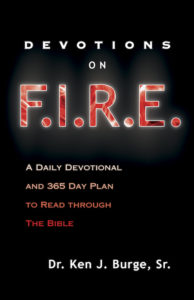
Devotions on F.I.R.E.


I’ve worked on several of Ken’s books of commentaries, and with this one he brings his inductive F.I.R.E. format to a year-long devotional form. Enjoy. . . .

front cover of Devotions on F.I.R.E. by Dr. Ken J. Burge Sr.Ken Burge. Devotions on F.I.R.E. 384p., $14.99, Deep River Books.

Readers of Devotions on F.I.R.E. will journey through the complete Bible in one year by reading assigned daily Scriptures from both the Old and New Testaments. Each day also includes a short devotion based on Dr. Ken Burge’s F.I.R.E. method of Bible study. F.I.R.E. stands for:

Familiarity. Learn to ask probing questions and become acquainted with each passage.

Interpretation. Determine the intended meaning of the text.

Relationship. Consider the passage within its context of the book and beyond, to the whole Scripture.

Employment. Consider how God can employ you to do His will through your new understanding of the text.

The F.I.R.E. method and the daily devotions will help readers remember and apply what they read as they fuel the fire in their hearts for God’s Word.

Posted in Uncategorized | Tagged , | Leave a comment

Lay Down Your Possessions    


Now the rubber starts hitting the road even more violently. Not that it’s been easy at all to deal with all this internal stuff so far, but let’s face it: At some point, all that inner conviction has to begin manifesting itself as outward fruit. As Jesus’ half-brother James said, “What good is it, my brothers, if someone says he has faith but does not have works? Can that faith save him? If a brother or sister is poorly clothed and lacking in daily food, and one of you says to them, ‘Go in peace, be warmed and filled,’ without giving them the things needed for the body, what good is that? So also faith by itself, if it does not have works, is dead” (James 2:14–17). Or, even more pointedly:

[B]ehold, a man came up to him, saying, “Teacher, what good deed must I do to have eternal life?” And he said to him, “Why do you ask me about what is good? There is only one who is good. If you would enter life, keep the commandments.” He said to him, “Which ones?” And Jesus said, “You shall not murder, You shall not commit adultery, You shall not steal, You shall not bear false witness, Honor your father and mother, and, You shall love your neighbor as yourself.” The young man said to him, “All these I have kept. What do I still lack?” Jesus said to him, “If you would be perfect, go, sell what you possess and give to the poor, and you will have treasure in heaven; and come, follow me.” When the young man heard this he went away sorrowful, for he had great possessions (Matthew 19:16–22).

It’s easy to distance ourselves from this story. After all, we’re part of “the 99 percent,” right? We’re not really rich. Many of us have trouble meeting our bills on a day-to-day basis.

But consider this: The money you spend on a book (like this one) is more than the daily income of more than a third of the world’s population. Still feel like a 99-percenter?

Ultimately, it’s not about what we have or don’t have. We can be rich and hold our riches loosely. Likewise, one can be genuinely poor and still greedy. It’s all about our incessant need to have. Are we willing to put everything we have at Jesus’ disposal—or, if called upon like the rich young ruler, dispose of it altogether—in order to follow him the way he calls us to?

I think we know the answer, if we’re honest. In fact, I think the real “one-percenters” are those who can answer “yes” to that last question—and mean it.

And yet, Jesus calls every one of us to lay down our possessions—or more specifically, our possessing. As Americans, we are all too accustomed to spending beyond our means. As Christians, we are called to give beyond our means (2 Corinthians 8:3). What do we hang on to more than Jesus—and for that matter, what do we consider to be more important than the people he puts in front of us to serve? Whatever that is, it’s time to release our grips on those things.

Then Peter said in reply, “See, we have left everything and followed you. What then will we have?” Jesus said to them, “Truly, I say to you, in the new world, when the Son of Man will sit on his glorious throne, you who have followed me will also sit on twelve thrones, judging the twelve tribes of Israel. And everyone who has left houses or brothers or sisters or father or mother or children or lands, for my name’s sake, will receive a hundredfold and will inherit eternal life” (Matthew 19:27–29).

We do not serve a God of either/or, but a God of both/and—if we’re willing to surrender all of our tiny little kingdoms and properties and belongings to him. God must rule over the things he’s given us, and be the one who determines how they’re used. As John Piper says in Desiring God, “It is better to love than to live in luxury!” Are we willing to put that to the test?

Lay It Down Today

I can’t tell you what to do here. But if you’re honest with yourself and willing to let God address this, you’re going to come up with things to lay down in a hurry. So that’s your assignment. Spend time together, just you and God. Ask him to point out those things that you’ve let possess you. Scream and cry about having to let them go, if you must, but resolve to follow Jesus, no matter what the temporary cost. Trust that he will provide what you truly need. And remember: He may not be providing it only for you.

Posted in Uncategorized | Tagged , | Leave a comment

New Growth Press minibooks


I’ve worked on (and still am working on) too many of these to list out here, but trust me, there’s probably a minibook for any counseling situation you or someone you know is facing. And you’ll likely recognize some of the authors (Paul David Tripp, David Powlison, Ed Welch, etc.) and organizations involved (CCEF, Joni and Friends, etc.). So dig in and find out what works for you. . . .

NGP-minibooks-2017-02

Various authors. New Growth Press minibooks. Usually 24p., $4.99 or less apiece (5-packs, full displays, and subscriptions also available), New Growth Press.

These minibook titles address a wide range of everyday issues like marriage, parenting, mental health, and much more. Each minibook is small enough for the average reader to finish in less than thirty minutes and filled with the practical Gospel-centered counsel that pastors, counselors, and believers around the world have come to trust. Minibook displays are frequently used by churches, counseling ministries, and ministry organizations to quickly provide counsel that meets people where they are.

Posted in Uncategorized | Tagged , , , , | Leave a comment