Lay Down Like a Lion


He crouched, he lay down like a lion
and like a lioness; who will rouse him up?
Blessed are those who bless you,
and cursed are those who curse you. (Numbers 24:9)

As I first pulled together the ideas for this book, I came across this passage from Numbers, which is part of Balaam’s prophecy over the nation of Israel. (By the way, it’s also a reprise of the man Israel’s [Jacob’s] prophecy over Judah in Genesis 49:9.) It’s a curious phrase, and that’s part of the reason why I’ve held off digging into it until now. But now’s the time. O Lord, is it the time. . . . I am so wrestling alongside you all with this one. . . .

What does it mean to “lay down like a lion,” and how does that fit into this week’s exploration of walking in the Spirit? Let me come at this sideways and then work my way in, because God’s been spending this past week (and especially today) spelling it out for me. . . .

So far, we’ve considered not only taking our sin seriously, and taking God seriously, but also to take his promises about us seriously. So today, let’s enjoy a brief respite from self-denial, and focus instead on receiving what the Spirit has for us—and resting in it.

In his book of the same name, Watchman Nee speaks of “the normal Christian life.” Think about that phrase for a moment. What comes to your mind when you hear that? I’m betting it looks nothing like what came to Watchman’s. Sadly, what we usually consider a “normal Christian life” goes something like, “go to church, serve others when we can, try to be a good person, and attend a prayer vigil when we’re feeling really spiritual.”

However, and as anyone who truly takes Jesus’ words to heart should already know, the truly normal Christian is nothing like that. The truly normal Christian is the one who’s following Christ—who’s following the Spirit’s lead in everything. We are, as the King James Version puts it repeatedly, “a peculiar people” (1 Peter 2:9, et al.). And much as it might pain some to admit, following where the Spirit leads will only make us more peculiar.

We will resemble the world’s definition of “normal” less and less. But we will resemble Jesus’ definition of “normal” more and more. Isn’t that what we want?

I think the idea of “laying down like a lion” is part of that. It captures what the normal Christian life should look like—to us.

The wicked flee when no one pursues,
but the righteous are bold as a lion. (Proverbs 28:1)

lion-and-the-lambLook at the lion, and how he lays down. There’s intent. There’s vigilance. There isn’t hesitation. There’s confidence and boldness, and yet no arrogance—because there’s no fear.

Too often, we settle for something less than what God wants for us, and fill in the gaps with ambition, anxiety, uncertainty, and discontent. How can we become as “bold as a lion,” with the confidence and boldness God wants for us?

It will happen when God’s desires become our desires.

God wants us to remain in his will, but that’s not all he wants. He wants us to want his will. Ultimately, we can’t accomplish this on our own. We’re just too selfish. But as the Spirit trains us, guides us, rebukes us, consoles us—or more bluntly: kicks our butts, pulls us back up again, then gives us a shoulder hug for good measure—then our hearts become more conformed to his. We become more peculiar, and we also become more OK with that.

We are truly children of the King. For all the things we’ve dealt with—including all the things we’ve dealt with throughout these devotionals—we are still children of the King. As we walk in the guidance and confidence in the Spirit, we increasingly lose our fears. That’s certainly not to say it’s easy—again, think of all the things we’ve dealt with here—but that doesn’t make it any less true. As children of the King, we are becoming more and more like our Father—and like our “fellow-son” Jesus.

And remember: There will come a day when the lion will lay down with the lamb. Not only that, but the lion is The Lamb:

And I saw a mighty angel proclaiming with a loud voice, “Who is worthy to open the scroll and break its seals?” And no one in heaven or on earth or under the earth was able to open the scroll or to look into it, and I began to weep loudly because no one was found worthy to open the scroll or to look into it. And one of the elders said to me, “Weep no more; behold, the Lion of the tribe of Judah, the Root of David, has conquered, so that he can open the scroll and its seven seals.”

And between the throne and the four living creatures and among the elders I saw a Lamb standing, as though it had been slain, with seven horns and with seven eyes, which are the seven spirits of God sent out into all the earth.  And he went and took the scroll from the right hand of him who was seated on the throne. And when he had taken the scroll, the four living creatures and the twenty-four elders fell down before the Lamb, each holding a harp, and golden bowls full of incense, which are the prayers of the saints. And they sang a new song, saying,

“Worthy are you to take the scroll
and to open its seals,
for you were slain, and by your blood you ransomed people for God
from every tribe and language and people and nation,
and you have made them a kingdom and priests to our God,
and they shall reign on the earth.”

Then I looked, and I heard around the throne and the living creatures and the elders the voice of many angels, numbering myriads of myriads and thousands of thousands, saying with a loud voice,

“Worthy is the Lamb who was slain,
to receive power and wealth and wisdom and might
and honor and glory and blessing!”

And I heard every creature in heaven and on earth and under the earth and in the sea, and all that is in them, saying,

“To him who sits on the throne and to the Lamb
be blessing and honor and glory and might forever and ever!” (Revelation 5:2–13)

One day, it will all make sense. One day, all will be as it was meant to be. So take heart. Be strengthened. Learn to lay down like a lion, because it truly is the normal Christian life.

Lay It Down Today

Presumably you’re reading this at the end of the week. Good. Use a day this weekend to take a full sabbath. Don’t be concerned about which day it is; just use it to be still before God and honor him. Don’t work (or get ready for work). Use the day in a way that’s most conducive to relaxing in Christ. Spend the day in your favorite chair (and tell your spouse I said it’s OK). Spend the day in nature. But spend it intentionally with God.

While you’re doing that, spend some time meditating again on this question: What do you know God has called you to? Where have you felt the tug of the Spirit—and therefore, where is your obedience actually being requested? Pray over these things. Resolve to put all your energies into them, and beg God to give you the time and energy to do them with all your heart.

Posted in Uncategorized | Tagged , , , , | Leave a comment

Offerings


A daily encouragement through adversity. . . .

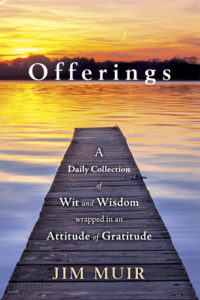
OfferingsCoverJim Muir. Offerings: A Daily Collection of Wit and Wisdom Wrapped in an Attitude of Gratitude. 288p., $14.99, Deep River Books.

Every person, regardless of who they are or where they live, goes through difficult times. But it’s what we do with those difficult times that shows our character and resolve and determines the roads we choose in life. Offerings is a yearlong guide to help deal with the inevitable adversity in life.

Signs of struggle are all around us, and negativity is not hard to come by. Everyone needs hope, and Offerings provides that hope, one day at a time, all year long. It only takes a few minutes to read each offering, and there is one for each day of the year, allowing the reader to start each new day with a positive outlook on life.

Posted in Uncategorized | Tagged , | Leave a comment

Lay Down in Peace  


We can get so worked up whenever someone criticizes God or Christians. We want to run to God’s defense—or honestly, much of the time, our own—and say just the right thing that will shut that other person up (in love, of course). But God can defend himself far better than we can. We are called to stand and deliver, then take what comes—just as Jesus did.

anti-christian protestLet’s consider that for a few more moments. Take off the table the idea that Jesus was the Son of God—that Jesus is God. Look, for a few moments, purely at the human Jesus of the Gospels. Look at how much he loved God, and how he presented the kingdom of God and defended it—including, very often, from those who claimed to speak for God and clearly did not. Here was someone who actually knew the right answers. How do you think Jesus felt during when he was assaulted verbally—and later physically—by those who didn’t want to hear those answers?
But how did he respond? Certainly there are examples of anger—pretty much reserved for those who insisted they could represent God better than Jesus could—but there was also patience. Love. A desire that the people he responded to somehow did hear it. If that’s the model of a Christian response, who are we—a hopeless jumble of spirit and flesh being perpetually sorted out through this process called sanctification—to respond any more pridefully?

Jesus is clear about our response: “[D]o not be anxious beforehand what you are to say, but say whatever is given you in that hour, for it is not you who speak, but the Holy Spirit” (Mark 13:11). Somehow, we are to seek the best for the other person, even when the feeling isn’t mutual. Only by remaining under the guidance of the Spirit do we have any hope of responding correctly.

There is therefore now no condemnation for those who are in Christ Jesus. For the law of the Spirit of life has set you free in Christ Jesus from the law of sin and death. For God has done what the law, weakened by the flesh, could not do. By sending his own Son in the likeness of sinful flesh and for sin, he condemned sin in the flesh, in order that the righteous requirement of the law might be fulfilled in us, who walk not according to the flesh but according to the Spirit. For those who live according to the flesh set their minds on the things of the flesh, but those who live according to the Spirit set their minds on the things of the Spirit. For to set the mind on the flesh is death, but to set the mind on the Spirit is life and peace. (Romans 8:1–6)

Those who live according to the flesh stand before us. In fact, some of them may be Christians. And lest we forget, they have been us—maybe more recently than we’d like to admit. By remaining in the Spirit, we’re carried from condemnation and suffering to life and peace, and it is only by God’s grace that we can maintain that peace he’s given us. So lay down in that peace, and let the Spirit do his work through you—and despite you.

Lay It Down Today

Today, you get to practice your silence in public. Don’t be rude, mind you, but commit to keeping your verbal responses—either spoken or typed—to a minimum. Commit to not defending yourself, explaining yourself (except when asked), “expressing your concern,” or pointing out what a good thing you’ve just done.

“Let what you say be simply ‘Yes’ or ‘No’; anything more than this comes from evil…. Beware of practicing your righteousness before other people in order to be seen by them, for then you will have no reward from your Father who is in heaven.” (Matthew 5:37, 6:1)

Then, watch what the Spirit does that you couldn’t. And rejoice in it.

Posted in Uncategorized | Tagged , , | Leave a comment

Beautiful Interference


Learning to live like our Teacher. . . .

Beautiful Interference CoverTim Hall. Beautiful Interference: Learning to Love God with All Your Heart, Soul, Mind, and Strength. 112p., $13.99, Deep River Books.

The teachings of Jesus have the profound ability to be abundantly clear, and yet leave us with equally abundant questions. In Mark’s account, we are told to love God with all our heartsoulmind, and strength, and to love our neighbor as ourselves. As his creation, we are called to give him our everything. Being a disciple means emulating what our teacher does: being like him, acting like him, and living like him. Yet despite the clarity of the teachings of Jesus, we consistently question its practical application in the many layers of our lives, neglecting actual obedience to his teaching.

Beautiful Interference uses storytelling to bring clarity to what God is calling us as his disciples to do as we live a life aiming to look like Jesus Christ. Hilarious stories and challenging biblical truths walk readers through each of the four areas with which we are called to love God respectively—heartsoulmind, and strength. Exploring how we are to love others as God love us, this book is sure to benefit Christian readers from all age groups.

Posted in Uncategorized | Tagged , , | Leave a comment

Lay Down in Safety


As we walk according to the Spirit, we do not fully know where we he is taking us. But we do know that the Spirit is in front of us, leading us, and ready to guide and protect us as we travel in his wake. If we don’t expect to find freedom and protection within the kingdom of God, where would we expect to find it?

However, as we’re sent we’re also very much, in a human sense, taking the lead. We’re leaving the security of the known, the tangible, the familiar, and heading “to the land that I will show you” (Genesis 12:1). Anyone who’s followed the Spirit’s leading into a new work knows how scary it can be. If you don’t know how scary it is at first, you will, once the excitement wears off and the difficulties come head-on. In fact, it’s often far more terrifying once it’s too late to turn back. Yet, it’s an all-too-common experience for those who follow the Spirit’s leading. We’re taken past the point of no return before the lights are turned on—and it’s there that we discover who we’re really depending on.

The prophet Jeremiah certainly experienced this. To the uninitiated, Jeremiah chapter 20 reads like an exercise in schizophrenia. However, to those who have followed God into a holy but a humanly difficult place, it will ring all too familiar. Read the whole chapter on your own time, but here are just a few samples of how far Jeremiah swings in the context of just one chapter:

O Lord, you have deceived me,
and I was deceived;
you are stronger than I,
and you have prevailed.
I have become a laughingstock all the day;
everyone mocks me. . . .

If I say, “I will not mention him,
or speak any more in his name,”
there is in my heart as it were a burning fire
shut up in my bones,
and I am weary with holding it in,
and I cannot. . . .

But the Lord is with me as a dread warrior;
therefore my persecutors will stumble;
they will not overcome me.
They will be greatly shamed,
for they will not succeed.
Their eternal dishonor
will never be forgotten.
O Lord of hosts, who tests the righteous,
who sees the heart and the mind,
let me see your vengeance upon them,
for to you have I committed my cause.

Sing to the Lord;
praise the Lord!
For he has delivered the life of the needy
from the hand of evildoers.

Cursed be the day
on which I was born!
The day when my mother bore me,
let it not be blessed!…

Why did I come out from the womb
to see toil and sorrow,
and spend my days in shame? (Jeremiah 20:7, 9, 11–14, 18)

It is difficult to be overcome by God, and led into places where human safety doesn’t seem to exist. But ultimately, even in the worst of human circumstances, there is no better place to walk than in God’s care.

The Bible certainly contains plenty of tales of difficulty that end in God’s glory; hopefully you have some of your own stories as well. Consider Jesus’ commissioning of the seventy-two. He sent them out ahead to proclaim the kingdom, and tells them up front, “Behold, I am sending you out as lambs in the midst of wolves” (Luke 10:3). In no uncertain terms, Jesus is telling them: You’re in great danger here. What’s more, I’m not going to let you have any props to depend on—only me. “Carry no moneybag, no knapsack, no sandals, and greet no one on the road” (Luke 10:4). No money, no provisions, no human companionship besides the one person travelling with you.

But we also know the ending: “The seventy-two returned with joy, saying, ‘Lord, even the demons are subject to us in your name!’ And he said to them, ‘I saw Satan fall like lightning from heaven. Behold, I have given you authority to tread on serpents and scorpions, and over all the power of the enemy, and nothing shall hurt you” (Luke 10:17–19).

Jesus gave the apostles a power they could not have imagined when they set out. Yet he reminded them that even this spiritual power is not what they should rest and rejoice in, but “that your names are written in heaven” (Luke 10:20).

Our true safety is who we are in Jesus. When we believe this, we’re able to go wherever the Spirit leads, no matter what man might—and likely will—do. We can know that our eternal security far exceeds any earthly security we could ever hope for.

It’s probably far less than coincidental that the next two pieces of Luke 10 are a parable addressing self-preservation (the Good Samaritan) and an account where Jesus gently rebukes an attempt at self-reputation (Mary and Martha). Again, following the lead of the Spirit is scary—especially when we think it’s all up to us. We don’t want to do anything to “unnecessarily” put ourselves in harm’s way; we’d much rather stay in our comfort zones and overexert ourselves there, in an attempt to prove to Jesus how much we love him. But that has nothing to do with following Jesus.

We too have a direct commission, and it too comes with an assurance of security: “All authority in heaven and on earth has been given to me. Go therefore and make disciples of all nations, baptizing them in the name of the Father and of the Son and of the Holy Spirit, teaching them to observe all that I have commanded you. And behold, I am with you always, to the end of the age” (Matthew 28:19–20). Are we ready to walk this out, to the degree Jesus calls us—in the knowledge that he does have all authority and that he is with us?

Lay down your lives in the eternal safety Jesus offers, and let the chips fall. Whatever we lose here on earth is nothing compared to the glory that lies ahead—if we’re only willing to trust Jesus and walk.

Lay It Down Today

We not only need to silence our lips, but quiet our souls. And as next week’s activities focus on prayer, this would be a good time to
(re-)introduce the discipline of fasting. Nothing reveals what we’re relying on—and how badly—faster than abstaining from it.

Therefore, you have some freedom in choosing what you’ll fast from in the next twenty-four hours. I would definitely make food one of those things. It doesn’t have to be an all-day (or twenty-four-hour) fast if you’re not ready. Do abstain from one meal you take regularly. (Skipping breakfast yet again doesn’t count.) Spend your meal time in prayer, thanking Jesus that he is “the bread of life” and asking for more of his kind of nourishment.

Try also abstaining from one additional thing—your answer to the following question, “What do I feel I have to do today, even though no-one else is asking me to do it?” (If you need to continue your media fast from yesterday in response to this, by all means do so.) Use your fast time to consider why you’re so dependent on that activity; ask Jesus to help you repent of your neediness, and to rely on him to address the real need behind it.

Posted in Uncategorized | Tagged , , , | 1 Comment

Talk the Walk


Sharing your faith is hard—especially when you consider the flawed vessel sharing it. Steve Brown’s book can help you get past that. . . .

Talk the Walk: How to Be Right without Being InsufferableSteve Brown. Talk the Walk: How to Be Right without Being Insufferable. 160p., $15.99, New Growth Press.
This attitude-altering book invites Christians to cultivate boldness and humility in communicating gospel truth. By uncovering self-righteousness and spiritual arrogance, Talk the Walk by pastor and author Steve Brown shatters stereotypes and helps believers consider how they present the good news without watering it down.

The Christian faith is true, and while we may be right on issues of salvation and theology, we may miss the less articulated truths of humility, love, and forgiveness. We live in a culture that is increasingly hostile to Christians and their faith. Talk the Walk unpacks the call to “go out into the world” and share faith by being truthful and winsome. By helping men and women love others out of a deeper love in Christ—the one who first loved us—Talk the Walk helps Christians present the gospel clearly and with compassion.

Take a step back and look at others’ perceptions. Explore the tools necessary to accomplish an attitude change of confidence and humility, repentance and truth. Share the message of Christ without distorting it. Speak confidently without being cold. By operating out of humble gratitude for the gospel, begin to talk the walk of Christian faith, reflecting the love and truth of Jesus.


Posted in Uncategorized | Tagged , , , | Leave a comment

Lay Down in Silence


As we examined last week, we’re often slaves to our own agendas without even realizing it. We can become so paralyzed by self-analysis and self-inflicted hurry that we forget how to simply be obedient in the things God’s already called us to—and to realize that is all God asks of us.

As yesterday’s assignment suggested—and you’re doing it, right?—we’re going to spend much of this week practicing the discipline of silence, and in a variety of venues. Because there’s a variety of venues where we need to begin practicing it. We need to be prepared for what God truly wants us to be doing, in every part of our lives.

I charge you in the presence of God and of Christ Jesus, who is to judge the living and the dead, and by his appearing and his kingdom:  preach the word; be ready in season and out of season; reprove, rebuke, and exhort, with complete patience and teaching.  For the time is coming when people will not endure sound teaching, but having itching ears they will accumulate for themselves teachers to suit their own passions, and will turn away from listening to the truth and wander off into myths (2 Timothy 4:1–5).

Our ears are itchy, and arguably at a level never before seen in history. As a society, and on a personal level, we’re addicted to news media, social media, sports, games, music, movies… anything that will get our adrenaline flowing and make us feel more alive. If we’re being honest, this is also a testimony about the state of our real lives. We want to be distracted from other things, from responsibilities, from the grind of work, from the pain of dealing with other people, with life itself. And just as clearly, we’re looking to derive our (self-)satisfaction from something other than God. And once we become distracted from God, it becomes impossible to obey him in the moment.

Again, I say all this as a fellow sinner who’s increasingly shocked by his own shortcomings and hypocrisy. Most of us love having at least an aura of drama in our lives—especially if that drama is more vicarious than personal (although some of us love the personal drama as well). As I write this, a 7,500-acre forest fire is raging about fifteen miles northwest of here; in fact, we can both see and smell the smoke from here. (Fortunately, it’s in a national forest area and no homes have been destroyed.) Yet, there’s some part of me that wants to see those numbers get even bigger, even while the logical part of my brain reminds me that by doing so I’m assenting to the destruction of God’s creation (which I love hiking in, for that matter). You’ve likely felt that kind of rush (and conflict), too.

And as a native New Jerseyan, don’t think I haven’t pulled out our proximity to/experience of 9/11 on occasion to impress my fellow Coloradoans who’ve only heard about it from afar. I say to this my shame, but also again because I’m pretty sure it’s a universal experience. Somehow, for some perverse reason, simply being in the vicinity of a big event makes us—strike that; makes me—feeler bigger, too.

That’s the dirty little secret—let’s go ahead and say it: the satanic lie—behind much of our obsession with instant information, and with much of our busyness: It offers an instant substitute to our God-given desire to become a part of something bigger than ourselves. It gives us the chance to lose ourselves in something—other than God. We’re not willing to wait for God to do his work in his time, and so we turn elsewhere. And we are the lesser for it.

By laying down in silence, we turn back to God. And remember: Turn back means repent. “Because of the Lord’s great love we are not consumed, for his compassions never fail.  They are new every morning; great is your faithfulness” (Lamentations 3:22–23). We must give ourselves the chance to hear God’s voice, and to experience his new compassions, because he’s been offering them all along.

Let’s set aside our distractions—and our egos that have become so deftly intertwined with them—and give God our full attention. The daily surprises that come by walking in the Spirit will beat anything we can try to come up with on our own.

Lay It Down Today

Let’s literally “bring it home” today. Sometimes in the next twenty-four hours, set aside one hour to not only be silent but completely media-free. No Web, no radio, no TV, no reading, no nothin’. Within those parameters, how you use the time is completely up to you. Take a long walk, or lay in bed and do absolutely nothing, but do it silently yet mindfully before God. Unplug from the world and plug into God’s presence.

It might be uncomfortable at first—and don’t be surprised if all sorts of thoughts start flying around—but remain intentional toward God. Give those distractions the chance to die down. You might actually enjoy it. You’ll certainly have a deeper sense of how constantly distracted you are from God—and what those distractions are. If you enjoy this activity, consider expanding your time to a half-day or even an entire day sometime in the future.

Posted in Uncategorized | Tagged , , | 1 Comment

Biblical Foundations for Baptist Churches


For all you Baptists in the audience. . . .

Biblical Foundations for Baptist ChurchesJohn S. Hammett. Biblical Foundations for Baptist Churches: A Contemporary Ecclesiology. 400p., $25.99, Kregel Academic.

An updated examination of ecclesiology from a Baptist perspective.

In this useful book, professor and former pastor John Hammett helps church leaders think through foundational questions about the nature of the church. Blending biblical teaching and practical ministry experience, Hammett presents a comprehensive ecclesiology from a historic Baptist perspective, examining crucial contemporary issues such as church discipline, the role of elders, and church ministry in a post-Christian culture.

This second edition contains updates throughout, including:

  • substantive changes to chapters on the nature of the church, Baptist church polity, and deacons.
  • an expanded chapter on baptism and the Lord’s Supper.
  • a thoroughly revised chapter on church models like multisite churches and missional churches.
  • a brand-new chapter on meaningful church membership.


Posted in Uncategorized | Tagged , , | Leave a comment

Lay Down Your Agenda  


We’ve had to lay down a lot so far. Some of it has no doubt been difficult; maybe it’s even felt unnecessarily negative to some. But we have a much longer journey ahead, and we need to travel light—especially since our journey takes us even further upward. Therefore, the object of the next several Monday entries is to encourage you to lay down the law—and leave it there.

Now, when I say this, I’m not just asking you to admire my mild attempt at cleverness. What I really intend is to encourage you to live as if you’re not only walking in the Spirit day by day—but ideally, moment to moment.

Something you might have noticed over the course of our journey together so far is we’ve been moving from dealing with our longstanding struggles with sin to addressing daily temptations. Today, we begin condensing the timespan even further, as we begin exploring the things that tempt us to go into some sort of “spiritual autopilot” rather than obey God in the moment. (If you haven’t noticed this sequence before now, that’s OK—I just picked up on God’s strategy here myself.)

This transition from day-by-day to moment-to-moment is equally, if not more, true of the works we claim to do in Jesus’ name. As Andrew Purves puts it in his wonderful book The Crucifixion of Ministry:

Of course we should not exclude asking “What would Jesus do?” There is an appropriate place for the moral influence of Jesus. But it is more important to ask, “Who is Jesus Christ for us today and what is Jesus doing here and now, in this hospital room, during this committee meeting, during this service of worship, in this counseling session and so on?” . . . Wherever Christ is and wherever we are joined to him, there truly is the intentional, disciplined and faithful ministry of the church. It is not our ministries that make Christ present; it is the present, living Christ who makes our ministries possible.

Whatever it is that I truly do for Jesus, he is already there. I’m the one who’s showing up—and arguably late for the party. Not him.

At the same time, we very often want to do the right things, but we don’t know exactly what the right things are. Oddly enough, this is often when our prayers are most effective. There are times where God gives us the confidence to pray for (and then pursue) something, knowing it’s in his will, but usually our best prayers come when we’re empty. When we have no agenda except, “Not my will, but thine.”

But more often, we’re in that “autopilot” mode, bearing ahead without keeping our eyes open to what other things God wants to accomplish right now. We want a stake in the ground, a fixed point, a checklist—because that’s far easier for us than following wherever the Spirit leads—at least in the short term.

Nonetheless, eternal life starts now. To follow is to lay down your control. What could I possibly plan for myself that’s better than God’s plans for me?

In fact, I’m going to pray this for myself right now. Feel free to join me, and we’ll talk again next week:

Lord, help me to rest in the work you’ve already given me, and to always remember that it is your work. Help me to lay down my agenda and hand over control to you, so that I may remain open to the next work you desire me to find Your joy in, in every moment. Amen.

Lay It Down Today

The good news is, you don’t have an assignment—at this very moment. The better news: The following assignment is meant to last all week. (After all, it’s only bad news if you think of it that way.) It does require some work on your part.

For the remainder of this week, commit to getting up at least a half-hour early to spend time with the Lord. Some of you may already get up early for Bible reading and/or prayer, others not; either way, take some extra time at the beginning of each day this week to be in God’s presence, silently. It’s OK to add Bible reading or other spiritual reading during this time, but be sure to leave time to do . . . nothing, in God’s presence. Enjoy him. Relax in him. Take peace in him, before starting your day. Try to be observant this week about how God uses your time with him—even after you’re done.

Posted in Uncategorized | Tagged , , | Leave a comment

The One New Man


For those looking for a somewhat less academic approach to the Israel question than Three Views on Israel and the Church a couple weeks back, here’s another take for you. . . .

OneNewManCoverAriel Laurence Blumenthal. The One New Man: Reconciling Jew & Gentile in One Body of Christ. 272p. $14.99, Deep River Books.

In The One New Man, author Ariel Blumenthal unpacks the “mystery” found in the second and third chapters of the book of Ephesians: God is reconciling Jew and Gentile together “in His flesh” through the cross of Christ. Amazingly, Paul’s vision of the church as the “one-new-man”  preserves the uniqueness of Israel, while simultaneously upholding the God-given identity and calling of every “tribe, tongue, and nation.” This powerful work of Jesus is the fulfillment of the Abrahamic Covenant and is at the heart of God’s redemptive plan for both Jews and Gentiles.

God’s plan to “restore all things” links Israel and the nations together in loving service to one another and has been playing out on the stage of world history over the last 150 years. The gospel for both Jew and Gentile is at work in the world and is reconciling all things and all people to Himself—and to one another.

Posted in Uncategorized | Tagged , , | Leave a comment