Lay Down Your Addiction, part 2


Last Friday, we addressed the need to lay down the things we hold against others. Today, let’s start dealing with the logs in our own eyes—beginning with the things we know we struggle with. We like to compartmentalize the word “addiction,” but the fact is, the mindset that comes with it is actually pretty pervasive in our lives.

There’s another old-fashioned word for what we’re talking about: lust. And it doesn’t have to be the sexual kind (although it might well be). We want what we want and we want it now. And we keep on wanting it—because it wants us, too. That’s the power of lust, or addiction. We believe it will satisfy a need God can’t, or won’t. But if God won’t satisfy it, it’s not a need. We’re the ones who have elevated our desires to that status. When we cease to trust God, we begin to welcome the lusts of our own hearts.

Jesus didn’t fall for that trick. And therefore, Jesus knows the way out. Because He’s been there. “Since the children have flesh and blood, he too shared in their humanity so that by his death he might break the power of him who holds the power of death—that is, the devil—and free those who all their lives were held in slavery by their fear of death… Because he himself suffered when he was tempted, he is able to help those who are being tempted (Hebrews 2:14-15, 18, NIV).

Because Jesus went through temptation for us, came out the other side, and then paid the price for our own failure anyway, He is able to deliver us. “No temptation has overtaken you except what is common to mankind. And God is faithful; he will not let you be tempted beyond what you can bear. But when you are tempted,he will also provide a way out so that you can endure it.” (1 Corinthians 10:13-14, NIV).

Lay It Down Today

In our first installment on addiction, we talked about the usefulness of spiritual discipline. We’re going to practice one of those disciplines right now: Silence. Pulling ourselves away from the world helps us to hear God more clearly. It’s a way to remove ourselves from the constant compulsive flow of the world that pulls us so easily into temptation and addiction. And, it’s a way of telling God (silently, of course), that He takes priority.

Psalm 46:10a is a pretty popular phrase we throw around for this: “Be still, and know that I am God.” (I’ve always like rephrasing that “Shut up—I’m God.”) But I want you to start your time of silence by reading all of Psalm 46. Because it’s all about trust, and the fact that God is worthy of our trust. Then, take at least 10 minutes to close your eyes and be totally silent before God. Your mind will probably keep buzzing for at least the first few minutes. That’s OK. Give the buzzing time to die down. Let God speak, and quiet yourself down enough so that you can hear Him.

Posted in Uncategorized | Tagged , , | Leave a comment

Small Groups, Big Questions


Small-groups megachurch pastor. Author. Encourager. Bill Mallonee fan. He’s all this and more.

This week’s Other Voice shifts back to our blogroll, and to be honest I’m not sure why I haven’t called him out sooner.

My Buddy Rob Bentz® is pastor of small groups  for Woodmen Valley Chapel, which at last glance was the largest church in Colorado Springs not called New Life. 🙂 We first met a couple years back, as we were preparing to revamp the already-long-dormant-but-still-rife-with-content smallgroupministry.com (it’s a long, sad story).  For the less than year it was permitted to finally flourish, Rob served as one of our two bloggers.

And lemme tell you, the boy was a quick study. The proof of this lies in the fact that churchleaders.com (who used a bunch of SGM.com’s material to get their own site started — with our blessing, mind you) picked him up after our untimely demise. You can find him elsewhere as well.

And in the months immediately following The Great Purge, Rob was also quite the encourager, to the point of sending useful job listings from the myriad Christian organizations in the Springs (none of which, unfortunately, panned out). You’ll find that kind of encouragement on Rob’s blog as well, Created for Community. You’ll also find good ideas for small groups, as well as a willingness to deal with the harder questions (his Monday entry is one such post).

Enjoy, and we’ll meet up again tomorrow.

Posted in Uncategorized | Tagged , , , , | Leave a comment

Counting the Gain


We continue our series on God-given vision today. And it’s been awhile since I’ve used a Lord of the Rings clip, so let’s fix that. As you watch, put yourself in this scene and think about the mission you’re feeling called to right now. Then reflect:

• Who in this scene do you most feel like right now? Why?
• What do you think of Bilbo’s words that close this scene? Do they comfort you, unsettle you, or something in between?

Last week, we looked at how we can get caught up in wanting something so badly—even if it seems right to us—that we can talk ourselves into thinking it’s what God wants, too. This week we head in the opposite direction: How can fear and doubt—whether it’s about what God wants, our own motives and capabilities, or something else—cause us to miss, or even run away from, what God wants?

Fear of the unknown—or for that matter, of re-experiencing something painful—is something we all face. And because the future is unknown, it’s easy to make it into something even scarier than it really is.

In his book Love Is an Orientation ,Andrew Marin observes, “Fear of the ‘what-ifs’ tends to have a crippling effect of Christians’ outlook and practice. But we’re not called to live in fear; we’re called to live in faith one day at a time.” Dietrich Bonhoeffer adds,  “The self-tormenting and hopeless question regarding the purity of one’s motives, the suspicious observation of oneself, the glaring and fatiguing light of incessant consciousness, all these have nothing to do with the commandment of God, which grants liberty to live and to act.”

But there’s another spin, too, courtesy of C.S. Lewis, “It is a remarkable fact that on this subject Heaven and Hell speak with one voice…. What matters, what Heaven desires and Hell fears, is precisely that further step, out of our depth, out of our own control.” You never do know where it will take you.

While the future is unknown to us, it’s not unknown to God. You’re reading this because you believe there’s something God wants made known. And for that to happen, the first person he’s going to have to show at least part of that to is you. That thought should frighten you. Therefore, we need to get past our own fears of the unknown and trust that God knows the way he’s taking us. This week is about taking a step forward somehow, and discovering why, despite the fears and uncertainty we might have, that if this is God’s vision, it’s all worth it. So let’s begin.

Since this is our third session on the matter, we’re going to look at three examples this week, so get that additional tab ready. (Don’t worry; no more upping the ante after this.) And since we’ve already put some of our fears on the table, let’s begin to examine the fears we might have about what God’s calling us to, and how we might get past them. And let’s start with an example that few of us would willingly choose. It’s in  Jeremiah 20:7-18.

• What emotions and reactions does Jeremiah experience here?
• Let’s me just ask this: How can one person possibly be feeling all these things at once? How would you explain it?
• Where’s the “fire in [your] bones” right now? In other words: What would you attempt for God even if you knew you’d fail over and over? And where does the vision you’re exploring fit into that?

A big part of recognizing a God-given vision is realizing, “I can’t not do this.” Jeremiah went the distance on a mission that looked like a failure to everyone else, and even to Jeremiah himself. But Jeremiah obeyed God, and even praised God in the midst of his despair, and by doing so he gave an entire nation an opportunity to turn around.

More often, when God gives a vision, He also provides a happier ending, even though there’s often huge obstacles to overcome. So let’s look at a much more successful—but no less scary—example that takes place more than 100 years after Jeremiah’s attempt, in Nehemiah 1:1–2:8/

• How does Nehemiah seek God’s will—and do it—over the course of this passage?
• How strong of an indication is it that the things we’ve “wept… mourned, fasted, and prayed to the God of heaven” about are the things God wants us to do?
• And: What’s tougher for you—to weep, mourn, fast, and pray for God’s will (Nehemiah 1:4), or to wait from “late autumn” to “the following spring” (Nehemiah 1:1 and 2:1) for an answer?

There’s a certain point where it doesn’t matter how hard or impossible something looks—if it’s truly God’s call, then it’s a call we need to answer. We never fully know what God’s getting us into, and that’s often a good thing. Nonetheless, we should make every attempt to understand, as best we can, what God wants, and what it’s going to cost us. But once we’ve counted that cost, we need to say “never mind the cost” and embrace what God wants to accomplish. God wants to put things right in this world He’s created, and He wants us to be a part of that plan.

So, one more passage, this time from the New Testament—John 6:60-71.

• About what in your own life, right now, could you say, “Jesus, couldn’t you have made this a little easier to understand?”
• How would Peter’s response, “Lord to whom would we go?” help you move forward, even as you continue to work through those things you don’t understand?

You might still sorting through whether this vision you’re wrestling with is God’s or not—or, whether you’re meant to be a part of it. So let’s wrestle a little more:

• Which of today’s three passages feels closest to your situation right now? Why?
• If things don’t turn out the way you envisioned, what’s the benefit of following wherever Jesus takes you anyway?

The idea here isn’t to fast-track, or short-circuit, your wrestling process, but to think about and pray about what your next steps are. Because no matter what you decide, the future is still unknown, and you’ll still need step somewhere with God’s help. So, start walking….

Posted in Uncategorized | Tagged , , , | Leave a comment

Born to Lea… SERVE.


Think about a humbling or humiliating situation you’ve faced—for example, a layoff or demotion at work, something big you tried that failed in front of everyone, or even something embarrassing that happened when you were growing up. Besides “humbled” or “humiliated,” how else would you describe how you felt when this event was taking place? What good, if any, do you think came out of it?

Jesus talked about humility a lot. Perhaps surprisingly to some, most of His comments about it came in the context of leadership. But to lead as Jesus did, humility is critical. “One can so easily become too great to be used by God,” Corrie ten Boom once said. “One can never be too small for his service.”

Paul understood this about Jesus, and observed it in the leaders he was developing. Check out these passages from his letter to the church in Philippi:

Do nothing out of selfish ambition or vain conceit. Rather, in humility value others above yourselves, not looking to your own interests but each of you to the interests of the others.

In your relationships with one another, have the same mindset as Christ Jesus:

Who, being in very nature God,
   did not consider equality with God something to be used to his own advantage;
rather, he made himself nothing
   by taking the very nature of a servant,
   being made in human likeness.
And being found in appearance as a man,
   he humbled himself
   by becoming obedient to death—
      even death on a cross!

Therefore God exalted him to the highest place
   and gave him the name that is above every name,
that at the name of Jesus every knee should bow,
   in heaven and on earth and under the earth,
and every tongue acknowledge that Jesus Christ is Lord,
   to the glory of God the Father….

I hope in the Lord Jesus to send Timothy to you soon, that I also may be cheered when I receive news about you. I have no one else like him, who will show genuine concern for your welfare. For everyone looks out for their own interests, not those of Jesus Christ. But you know that Timothy has proved himself, because as a son with his father he has served with me in the work of the gospel. I hope, therefore, to send him as soon as I see how things go with me. And I am confident in the Lord that I myself will come soon.

But I think it is necessary to send back to you Epaphroditus, my brother, co-worker and fellow soldier, who is also your messenger, whom you sent to take care of my needs. For he longs for all of you and is distressed because you heard he was ill.  Indeed he was ill, and almost died. But God had mercy on him, and not on him only but also on me, to spare me sorrow upon sorrow. Therefore I am all the more eager to send him, so that when you see him again you may be glad and I may have less anxiety. So then, welcome him in the Lord with great joy, and honor people like him, because he almost died for the work of Christ. He risked his life to make up for the help you yourselves could not give me (Philippians 2:3-11, 19-30, NIV).

The literal translation of the beginning of verse 7 is “he emptied himself.” Jesus emptied himself. He gave up everything for us. Let’s think about that a bit more, especially if this is the attitude each of us is supposed to have.

• What examples of Jesus’ humility do you see in Timothy and Epaphroditus?
• How do you nonetheless see these two men as leaders? How do you see God (or Paul) honoring their attitude here?
• Do you think we need to be totally emptied of ourselves before God can really work through us? Why or why not?
• If you truly had “the same attitudes that Christ Jesus had” (verse 5), what would look different?

Think about your family, those you work with, and even people you don’t know very well. What are some realistic, practical ways that you can follow Jesus’ example and serve them?

OK, that was a nice mental activity. But let’s take it further:

• Out of all the ideas you just thought of, which ones do you think you’d actually do?
• What makes you uncomfortable or unwilling to serve others? What can help you get past that?

Serving others isn’t always easy or comfortable, but Jesus showed us not only that we can do it, but to have joy while doing it. It can be hard to step out of our comfort zones, but everything Jesus did showed us that it’s worth it to follow His example.

Then the mother of Zebedee’s sons came to Jesus with her sons and, kneeling down, asked a favor of him.

“What is it you want?” he asked.

She said, “Grant that one of these two sons of mine may sit at your right and the other at your left in your kingdom.”

“You don’t know what you are asking,” Jesus said to them. “Can you drink the cup I am going to drink?”

“We can,” they answered.

Jesus said to them, “You will indeed drink from my cup, but to sit at my right or left is not for me to grant. These places belong to those for whom they have been prepared by my Father.”

When the ten heard about this, they were indignant with the two brothers. Jesus called them together and said, “You know that the rulers of the Gentiles lord it over them, and their high officials exercise authority over them. Not so with you. Instead, whoever wants to become great among you must be your servant, and whoever wants to be first must be your slave—just as the Son of Man did not come to be served, but to serve, and to give his life as a ransom for many” (Matthew 20:20-28, NIV)

• Be honest: In what ways are you like “the sons of Zebedee,” James and John (or their mom, for that matter)?
• What’s a situation right now where you’d considering serving more fully… as long as it was on your terms?
• What would take for you to let go of your “rights” and serve God however he wants you serve—in that situation or any other?

Ask God to help you use both your hands and your feet to lead the way He wants us to—by serving those around us—and that you’d not only have  His willingness but also His heart for the people He’s placed around us.

Posted in Uncategorized | Tagged , , , | Leave a comment

Lay Down Your Bitterness — another piece


Let’s circle back to last week’s “transgressors” thoughts and add a little something to them. Something else I’ve been noticing in the gospels recently, which I suspect you have too in some similar way….

The people we’d normally think of as transgressors (or whatever word we’d substitute for that)—those who commit sins of some obvious type of self-indulgence—aren’t let off the hook by Jesus, but are also offered his compassion. He calls them out on the carpet, but at the same time He calls them to something better. He understands these people are only trying to fill a void in their lives, however poorly or self-destructively. Thus, He points to Himself and says, “I’m what you’re looking for. Lay down all the rest of it and come follow Me.”

The people who truly anger Jesus aren’t those people I’ve just described. Rather, it’s the victimizers—those who corrupt others, who take advantage of children, those who hurt and damage others, especially those who do it under a veneer of self-righteousness. These are the people Jesus takes on constantly, who are subject to His anger and pronouncements of judgment. And not surprisingly, it’s these people who ultimately condemn Jesus to death—enabling Him to “be numbered with the transgressors.”

And yet, how does Jesus tell us to respond? “But to you who are listening I say: Love your enemies, do good to those who hate you, bless those who curse you, pray for those who mistreat you. If someone slaps you on one cheek, turn to them the other also. If someone takes your coat, do not withhold your shirt from them. Give to everyone who asks you, and if anyone takes what belongs to you, do not demand it back. Do to others as you would have them do to you.    

“If you love those who love you, what credit is that to you? Even sinners love those who love them. And if you do good to those who are good to you, what credit is that to you? Even sinners do that. And if you lend to those from whom you expect repayment, what credit is that to you? Even sinners lend to sinners, expecting to be repaid in full. But love your enemies, do good to them, and lend to them without expecting to get anything back. Then your reward will be great, and you will be children of the Most High, because he is kind to the ungrateful and wicked. Be merciful, just as your Father is merciful (Luke 6: 27-36).

In short: You don’t get to hold onto your hurt. You don’t get to allow it to fester into bitterness. You don’t get to hold it over their heads. Let Me handle it. You, lay it down.

And eventually, Jesus’ “head disciple” and our repeated example gets it too. First Peter is full of encouragement to live as Jesus told us to, and I’ll close with these for today. See you next week:

Finally, all of you, be like-minded, be sympathetic, love one another, be compassionate and humble. Do not repay evil with evil or insult with insult. On the contrary, repay evil with blessing, because to this you were called so that you may inherit a blessing (3:9-10)

But even if you should suffer for what is right, you are blessed. “Do not fear their threats; do not be frightened.” But in your hearts revere Christ as Lord. Always be prepared to give an answer to everyone who asks you to give the reason for the hope that you have. But do this with gentleness and respect, keeping a clear conscience, so that those who speak maliciously against your good behavior in Christ may be ashamed of their slander (3:14-16)

Therefore, since Christ suffered in his body, arm yourselves also with the same attitude, because whoever suffers in the body is done with sin. As a result, they do not live the rest of their earthly lives for evil human desires, but rather for the will of God (4:1-2)

Above all, love each other deeply, because love covers over a multitude of sins. Offer hospitality to one another without grumbling (4:8-9)

Dear friends, do not be surprised at the fiery ordeal that has come on you to test you, as though something strange were happening to you. But rejoice inasmuch as you participate in the sufferings of Christ, so that you may be overjoyed when his glory is revealed. If you are insulted because of the name of Christ, you are blessed, for the Spirit of glory and of God rests on you (4:12-14)

However, if you suffer as a Christian, do not be ashamed, but praise God that you bear that name. For it is time for judgment to begin with God’s household; and if it begins with us, what will the outcome be for those who do not obey the gospel of God? (4:16-17)

Posted in Uncategorized | Tagged , , , | 2 Comments

Truth Is More Useful Than Fiction


I have to admit: Unless your name’s John Bunyan, fictional accounts of God’s hypothetical real-life work in the church has never really done it for me. (I have to wonder how I’d feel if I were to read In His Steps again, for that matter, being now 25+ years removed from being a brand-new Christian.) Thus, while the intentions here are good, the results…. well, not so much.

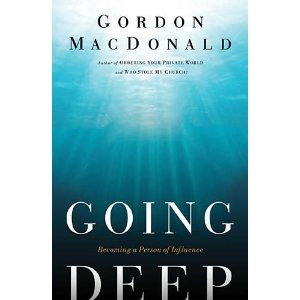
Gordon MacDonald. Going Deep: Becoming a Person of Influence. Softcover, 384p., $15.99. Thomas Nelson.

Plus, you’d read that title and buy it, never suspecting it was actually a work of fiction. Boo.

But again, let’s be fair: The intentions here are good. Gordon MacDonald wants to give us a picture of a church that’s embraced the importance of discipleship—of becoming “deep people,” to borrow his quote from Richard Foster’s Celebration of Discipline—and is willing to face the changes and challenges that come with that. So it’s coming from a good place.

The problem, for me, comes with the fact that it’s a fictional work, and a fairly predictable one at that. People throughout the church get the idea, challenges and speed bumps arrive and are of course ultimately overcome. Plus, there are two real-life characters here—MacDonald and his wife Gail. I didn’t read his last book, Who Stole My Church?, but I understand he uses the same device there. But again, the church itself is fictional. My gut cries out, why?

Not that it’s impossible that this book might inspire anyone to “go deeper,” but there are enough books out there based on real-life experience, with far less tidy plots—and, I hasten to add, more of that desired depth—that would ultimately prove more useful for anyone who really wants to see their church embrace a life of discipleship. At least a couple of them have been reviewed here, in fact. Thus, as I like to say: Go—fetch.

Posted in Uncategorized | Tagged , , | Leave a comment

That Was You, God… Right?


When have you done something believing it’s what God wanted, then later realized it wasn’t? What happened? (Ignore the embarrassment you’re feeling right now—just process it.) Looking back now, what really motivated you?

It’s pretty easy to get caught up in our own dreams. For that reason, it can be  tough to know when, and how, God wants us to step out in faith. Sometimes we want something so badly that we can talk ourselves into believing it’s what God wants, too. And maybe it is what God wants. But maybe it isn’t. And maybe our desire isn’t in synch with God’s timing, even if it is what God wants.

“We naively think that the more we grow as Christians, the easier… to discern the will of God. But the opposite is often the case,” J. Oswald Sanders rightly observes in his book Spiritual Leadership. “God treats the mature leader as a mature adult, leaving more and more to… spiritual discernment…. The resulting perplexity adds to a leader’s pressure.”

This is all about that kind of discernment—of knowing whether this vision we have is really God’s as well. It’s tricky stuff. So let’s do our best to check our own desires at the door and discover what God wants.

Last Wednesday, we looked at a “case study” from the Bible, to understand how others before us have walked out the vision God’s given them. Let’s go ahead and look at two examples this week. Get that new tab open, look at Judges 6:34-40 and 1 Samuel 3:1-19, then think about this:

• How did Gideon and Samuel (and Eli, for that matter) figure out whether it was really God who was speaking?
• Would you say any of them showed a lack of faith—or, were making wrong demands of God? Why or why not?
• Think again about your missteps from earlier. What’s different between the approaches taken in these passages, and what you did?
• Look once more at Gideon’s example. When is it OK to “put out a fleece,” and when are we just trying to “fleece” ourselves into doing something that’s not really God’s idea (or get out of doing something that is)?

It’s important to figure out early whether this thing we’re praying about and talking about really is from God—or, for that matter and entirely likely, whether it’s both you and God, flesh and spirit, mixed together right now. It’s critical that we stop to figure out what’s God and what’s us, because once things get real, we’re almost certainly going to find ourselves disagreeing with God on some things.

And guess what? God’s right.

So when that happens, you’ll need to remember which parts of this vision are truly God’s, so you’re able to keep on trusting Him when you don’t understand what’s going on. “This one clear command would redefine you…. On those days when things were dark or difficult, you would at least know you were doing what you were called to do. That clarity… while a great burden, would be a great gift to us,” Brian Sanders (no relation to Oswald) puts it in Life After Church: God’s Call to Disillusioned Christians.

So right now, think through these questions. Take as long as you need. Ask yourself:

• As I’m pursuing this vision, am I sensing God revealing more about the things he truly cares about?
• Will this vision, once it’s realized, reveal more about God to others, or just more about me?
• Which parts of this vision were clearly not my idea (even if I’m excited about the idea now)?
• Have I tried letting go of this idea, only to find God bringing it up again?
• Would I still want this to happen even if someone else did it—or even if I did it and someone else got the credit?

One more question: What do you need right now, if anything, to be really certain that this vision you’re pursuing is really God’s idea? If you’re certain, why are you certain?

You might believe it with all your strength. You might still have doubts, too, and that’s OK—sometimes being obedient to God means staying put until you’re sure it’s what God wants. Thank God right now for wherever it is you’re at. Ask Him to help you discover what His will truly is for you in the weeks to come, and that your certainty and confidence is in Him, no matter where He leads them. May you move forward, in the path and at the pace God’s chosen for you.

Posted in Uncategorized | Tagged , , | 1 Comment

Who Are You… Really?


I’d like you answer our title question right now. Who are you and what are you about?

There’s one catch, though: You can’t mention what you do. No mention of jobs, hobbies, volunteer work—any kind of accomplishment or activity. Go!

So, how’d you do?

How does telling people what you do help them understand who you really are? How doesn’t it?Let’s have a re-do: If you wanted people to know just one thing about you right now—with no restrictions on what you could say—what would it be?

We’re going to spend much of the next several Mondays discovering how God’s made each of us, and what He’s made each of us for. That’s right; we’re gonna get into the spiritual-gifts thang. Before we go there, however, we’re going to spend some time  realizing who we already are in Jesus. As we come to understand who we are in Jesus more and more, His life can flow more easily from us into everything else we do—even when we’re not consciously trying to serve Him.

So let’s discover more about who we really are in Jesus. And let’s start with what the Bible says about us. Note what the following passages say about who you are in Jesus. Then reflect on the questions that follow:

• John 15:15-16
• Romans 8:14-17
• Romans 8:31-39
• 2 Corinthians 5:16–6:2
• Ephesians 1:5-14
• Ephesians 2:4-10
• 1 Peter 2:9-10
• 2 Peter 1:3-4

• What encourages you about these verses?
• Truthfully: What things that God is telling you here do you still have a hard time believing? Why?
• How does—or could—knowing who you are in Jesus affect every other part of your life? Try to come up with some practical examples.

If you haven’t seen the movie Chariots of Fire, you’ve at least heard the Vangelis theme song (and/or the scene to the right) parodied endless number of times. Eric Liddell was a celebrated Scottish runner and missionary. In this clip, he’s trying to decide whether he should participate in the 1928 Olympics or go back into the missions field in China (where he would ultimately die in an internment camp near the end of World War II). Watch it up to the 1:37 mark, then think about this:

• Do you normally look at “God’s work” Jennie’s way or Eric’s? How so?
• Be honest: How much do you “feel [God’s] pleasure” in your everyday life? Why do think that is (or isn’t)?

You have searched me, LORD,
   and you know me.
You know when I sit and when I rise;
   you perceive my thoughts from afar.
You discern my going out and my lying down;
   you are familiar with all my ways.
Before a word is on my tongue
   you, LORD, know it completely.
You hem me in behind and before,
   and you lay your hand upon me.
Such knowledge is too wonderful for me,
   too lofty for me to attain.

Where can I go from your Spirit?
   Where can I flee from your presence?
If I go up to the heavens, you are there;
   if I make my bed in the depths, you are there.
If I rise on the wings of the dawn,
   if I settle on the far side of the sea,
even there your hand will guide me,
   your right hand will hold me fast.
If I say, “Surely the darkness will hide me
   and the light become night around me,”
even the darkness will not be dark to you;
   the night will shine like the day,
   for darkness is as light to you.

 For you created my inmost being;
   you knit me together in my mother’s womb.
I praise you because I am fearfully and wonderfully made;
   your works are wonderful,
   I know that full well.
My frame was not hidden from you
   when I was made in the secret place,
   when I was woven together in the depths of the earth.
Your eyes saw my unformed body;
   all the days ordained for me were written in your book
   before one of them came to be.
How precious to me are your thoughts,God!
   How vast is the sum of them!
Were I to count them,
   they would outnumber the grains of sand—
   when I awake, I am still with you (Psalm 139, NIV).

• How would believing that God really is everywhere you are help you live out your faith?
• What—or who—could help you to remember who you are in Jesus, and help you stretch your circle of influence wider?

“If there’s anything in life that we should be passionate about, it’s the gospel… passionate in thinking about it, dwelling about it, rejoicing in it, allowing it to color the way we look at the world,” C.J. Mahaney says in the The Cross Centered Life. May that become our passion as well. 

Posted in Uncategorized | Tagged , , | Leave a comment

Lay Down Your Hurt


I’ve been thinking a lot lately about the following passage: “He (Christ) was numbered with the transgressors” (Isa. 53:12, Mark 15:28). I believe that in our own way we too are called to this, and that it’s a key to moving past our old life and into the life Christ intends for us.

Because… well, let’s start by facing a simple truth here: We are among the transgressors.

This isn’t to dismiss or excuse some of the truly horrific sins that others perpetrate upon us or others. But for the majority of us, most of our lives aren’t about those kind of transgressions. They’re about responding to everyday hurts—insults, gossip, other inconsiderate acts—or even “bigger” but not necessarily deeper sins committed against us—deliberate acts where we’re deemed inferior or just not good enough, slanderous words against our reputation, things being “taken” from us….

Even in more extreme cases, I think this idea of being numbered with the transgressors applies. Every so often, we’re surprised by a news story about an act of extreme forgiveness. Many of us think it can’t possibly be legitimate—that they’re just saying it but that they really still harbor anger or resentment. Or maybe we just resign ourselves to the idea that we’re incapable of that degree of forgiveness in the face of that kind of abuse or injustice.

But when we allow ourselves to “be numbered with the transgressors”—and I don’t just mean sheepishly shrugging “yeah, I’m a sinner just like everyone else,” but looking straight at the people around you who carry sins that do offend and maybe even repulse you, and admitting “These are my people, too; I really am like them except for Christ, and He chose to be numbered with them”—that’s a place where God can work. That requires us to check our pride and self-righteousness at the door. And it opens us to the opportunity to overlook the sins of others—not excusing or denying them, but understanding they’re part of the same mess we’re in and truly forgiving them and finding compassion in its place.

Jesus lived a perfect life and died for every one of those sins—yes, even the ones people commit against us. And He calls us to follow Him and “be perfect,” by learning how to die to those sins, and the hurt we’ve suffered from them, as well.

Now there is in Jerusalem near the Sheep Gate a pool, which in Aramaic is called Bethesda and which is surrounded by five covered colonnades. Here a great number of disabled people used to lie—the blind, the lame, the paralyzed. One who was there had been an invalid for thirty-eight years. When Jesus saw him lying there and learned that he had been in this condition for a long time, he asked him, “Do you want to get well?”

“Sir,” the invalid replied, “I have no one to help me into the pool when the water is stirred. While I am trying to get in, someone else goes down ahead of me.”

Then Jesus said to him, “Get up! Pick up your mat and walk.” At once the man was cured; he picked up his mat and walked.

The day on which this took place was a Sabbath, and so the Jewish leaders said to the man who had been healed, “It is the Sabbath; the law forbids you to carry your mat.”

But he replied, “The man who made me well said to me, ‘Pick up your mat and walk.’ ”

So they asked him, “Who is this fellow who told you to pick it up and walk?”

The man who was healed had no idea who it was, for Jesus had slipped away into the crowd that was there.

Later Jesus found him at the temple and said to him, “See, you are well again. Stop sinning or something worse may happen to you.” The man went away and told the Jewish leaders that it was Jesus who had made him well (John 5:2-15, NIV).

You might be wondering “What’s the connection between this passage and what you were saying before?” But do you notice something in this story? No-one’s terribly motivated for this guy to get well—including the man himself. But Jesus is.

This scenario seems to run counter to the conventional wisdom propagated around us, but the fact is, this is how we really are—both in terms of ourselves and those around us. We’d rather read a self-help book and feel healed, than actually be healed. We’d rather stick with the status quo, no matter how much it actually hurts, than encounter the fear of the unknown that comes with truly being healed—or in seeing other “invalids” in our lives healed. We’re a lot more like the nitpicky Pharisees here than we’d like to admit.

Jesus asks the invalid at the pool, “What do you want me to do? Do you want me to heal you?” Think about this in terms of your own “internal injuries.” Would you rather identify yourself by your hurt, your blindness—say it: your willfulness in withholding forgiveness—or would you rather get on with your undiscovered future, by growing into your new life and identity in Christ?

The beginning of healing is admitting that you’re broken. That’s true of your internal state, and it’s just as true about all the broken relationships around you. So lay down your hurt. Take Jesus’ yoke. Be numbered with the transgressors. You’ll start to see them differently. And more importantly, you’ll let Jesus bring healing and grace to you—and them.

Lay It Down Today

I’ll keep this simple: Where do you need to be “numbered with the transgressors” today? Is it an act of forgiveness? Is it treating some “weird” person you avoid with the same dignity you’d want? Is it reaching out somehow to the more marginalized of society—not just by being charitable but by being present and available?

You know what you felt as you read today’s entry, so I won’t get in the way of what God wants to do with it. But start making it happen today. Respond to what God’s trying to tell you.

Posted in Uncategorized | Tagged , , | 2 Comments

The Learned Desperation of Prayer


“There is nothing secret about communion with God. If we live a holy life before God, broken of our pride and self-will, crying out for grace, then we will be in communion with God. It really is that simple.”

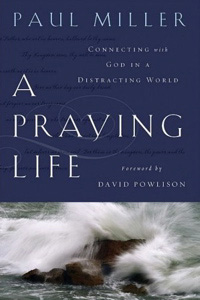
Paul E. Miller. A Praying Life: Connecting With God in a Distracting World. Softcover, 288p., $14.99.

Courtney Miller Sneed and Cyndi Anderson. Paul E. Miller’s A Praying Life Discussion Guide. Softcover (spiral-bound), 136p. , $9.99. Both NavPress.

This isn’t a tough read—except, of course, it’ll change you. And change is tough. I slowed my pace down quite a bit, to make sure I’d taken it all in before moving on.

Paul Miller’s message in A Praying Life is simply: Learn to depend on Jesus… for everything. Or as he puts it,
“[P]rayer is not the center of this book. Getting to know a person, God, is the center.” Doing that requires us to do quite a bit of unlearning as well. It wouldn’t be entirely out of line to call this book the story of one man’s unlearning and relearning.

Thus, this book is refreshingly free of “expert commentary.” In fact, after reading this, it could be argued that the best human teacher Paul has had on the subject of prayer has been his autistic adult daughter Kim. I’ll let you discover the story woven throughout the book for yourself, but suffice to say nothing fosters a dependence on God like…. well, having to depend on God. “Learned desperation is at the heart of a praying life,” he says at one point.

The bulk of the book is an exercise in, if you will, spiritual disarmament—in other words, laying aside what we think God can and can’t or should and shouldn’t do and just coming to Him as a child, letting Him lead the way out of our cynicism and trusting Him for everything. “Bending your heart to the Father” is one way he puts it. It should be such an obvious piece of what prayer is, but we have a tendency to let this basic truth get away from us.

Part 4, “Living in Your Father’s Story,” expands our level of trust, from giving it all to God to training our eyes to see how God is answering those prayers—especially when they’re not our answers. There’s a section about “living in the desert” that I especially appreciated: “The desert becomes a window to the heart of God. He finally gets your attention because he’s the only game in town.” But because of that, “The fresh, clear water of God’s presence that you discover in the desert becomes a well inside your own heart.”

There are some solid and creative practical tips about prayer here, mostly in the final section of the book “Praying in Real Life,” but they come long after the reader’s trust has been established—by which point you’ve already opened yourself up what God’s telling you to do about your prayer life. Thus, you can use or discard the ideas here, but they’ve clearly helped him, so they’re worth taking note of on that basis alone.

The Discussion Guide will also prove useful, both for personal reflection and for small groups. The bulk of the guide is comprised of thought-provoking  reflection questions on each of the book’s 32 chapters. There are also recommended small-group sessions for both 13- and 18-week studies, primarily built around the reflection questions.

I’m not yet sure how much my prayer life (heck, my life in Christ) has been altered by this book. But I can tell you that it already has been. And if that’s not a recommendation, I don’t know what is.

Posted in Uncategorized | Tagged , , , , | 2 Comments