Believe Who You Are, Do What You Must


As I read David Alves’ book, a thought came to me… and roll with me on this. I wonder if…

a) our current unwillingness to claim and live out of our status as sons and daughters of God is, in part, an overreaction to the advent of Eastern and/or New Age religions and their emphases on self-actualization—as if to claim that our own sonship to God would somehow seem like guilt by association. (After reading this, I noticed a related comment on the back cover, so maybe I’m on the right track. :)) And thus, I also wonder if…

b) the recent (and welcome) resurgence of books on the matter of our sonship and/or identity in Christ is, just maybe, the Spirit’s move to restore things (and us) to their (and our) proper perspective.

Regardless, I think both a) and b) are addressed by this simple truth: Our sonship to God is not contingent upon our accomplishments, but rather upon God’s willingness to adopt us. And as we live out of that truth, things change. And that, I believe, is the crux of the book I’m holding here.

Dr. David C. Alves. We’re the “Sons of God”… So What?: Believe God About Who You Really Are. 192p., $16.95, iUniverse.

Thus, the book is both an encouragement and a challenge. “We are the Father’s legitimate heirs of this world. But it comes at a cost to us,” Alves says. “We must desire our inheritance. We must love what God loves and want what God wants. We must have an arena where we demonstrate the Father’s intense love for his creation. That intense love can only be verified as we stand in our authority and take back this world, wherever we set the soles of our feet.”

In fact, the chapter on spiritual authority here is one of the most helpful in the book, as is the chapter on believing God, which takes up close to a quarter of the book. As Alves points out, “[H]umility is not thinking and speaking less of yourself than is true…. Dr. Livingston said, ‘True humility is not to think low of oneself but to think rightly, truthfully of oneself.’ ” The call, then, is to believe about both who we are, and more importantly, who we are in Christ. As we see ourselves properly in relation to Christ, humility will attend to itself. And when we do this, and walk in it, not only do we change but our world changes as well.

Another thought that occurred later on near the end of my reading: There is no question about whether God wants revival. The question is: Are we committed to seeing the Spirit bring it? Are we willing to be obedient to what God has called us to, and to who God has called us to be? Are we willing to set aside our own self-image, good or bad, and believe that God has something better for us, no matter what package it might initially come in?

I believe you’ll be similarly challenged as you take on this book. David Alves reminds us who we were called to be, even while reminding us, “God’s sons want to move down to know him better.” After all, that was the way The Son of God himself chose.

Posted in Uncategorized | Tagged , , | 1 Comment

Bullet-List the Blue Sky


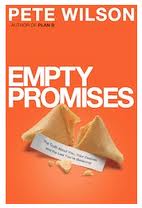
This book, regarding the idols we have in our lives, has gotten some serious props from other sectors (not the least of them being Rick Warren, who contributes the foreword). But it won’t be getting much of that here. Perhaps the best way to approach this review is to pick out one of the few good chapters, and explain what went right….

Pete Wilson. Empty Promises: The Truth About You, Your Desires, and the Lies You’re Believing. 224p., $15.99, Thomas Nelson.

… and that chapter would be “Money Always Wants to Be More Than Money.” (The chapters on beauty and chasing a dream have their moments as well, to be fair.) Here’s what worked (and what you won’t see nearly as often elsewhere):

• There’s hardly any bullet lists in this chapter, and they don’t come until near the end. (And yes, I know; enjoy the irony here.) Elsewhere—and I mean like a good 10 percent of the book—we’re littered with either lists of the obvious or series (plural) of closed-ended questions.

• There’s also a minimum of quotes from outside sources in this chapter. Not that quoting other sources is intrinsically a bad thing, but when it’s at least a quarter of your book (on top of the aforementioned bullet lists), it is.

• Ideas in this chapter are broken down and dealt with in some degree of depth, rather than one page over here, followed by a new page of thoughts here (and of course, repeatedly broken up by the aforementioned quotes and bullet lists).

Feeling the avalanche effect here? Me too. Basically, the book is kind of a fluffy monster, even as it purports to deal with the deep heart idols nearly all of us carry.

I do wonder whether this book preaches better than it reads. It’s not that it’s a bad message, by any means; it’s just that it doesn’t go into enough depth to really illumine anything. There’s a few places where Pete Wilson gets more personal, and those sections tend to work. But far too much of this is restating the obvious, and often in the most obvious manners possible.

For a better recent book dealing with our idols, I would once more direct you to Ed Welch’s What Do You Think of Me? Why Do I Care? For the most part, unfortunately, Wilson’s book lives up to its title.

Posted in Uncategorized | Tagged , | 1 Comment

The Joy of Scandal


To be honest, I liked this far more than I expected going in. Then again, knowing nothing about the author, I was expecting a book coming out of a “bunker mentality.” Thankfully, this (and he) is nothing of the sort.

Yes, we sometimes take a lot of grief for being Christians (although far less than people in other parts of the globe), and this book certainly addresses that. But rather than using that fact as an exhortation to be more combative or to brush up on apologetics that in truth preach largely to the converted, R.T. Kendall encourages to take a more biblical view: Follow Jesus wholeheartedly, and rejoice for being counted worthy to take grief from others for something that basic—even sometimes from other Christians who resist and resent seeing a new work from God.

R.T. Kendall. Unashamed to Bear His Name: Embracing the Stigma of Being a Christian. 208p., $13.99, Chosen Books.

And by the way, shame on me for not knowing recognizing the name R.T. Kendall, senior minister for Westminster Chapel in London for a quarter-century.

“[I]t is a privilege to be scandalized or stigmatized for following Jesus Christ,” Kendall warns us at the outset, but also encourages us, “What at first you may resent—and certainly underestimate—will be what you eventually treasure and esteem more than you can imagine.” Kendall draws from a wealth of experiences, and shares how God drew him further out of his own shell and ultimately led him to his current “retirement ministry” to the charismatic community (The arrival of worldwide cross-carrier Arthur Blessit to London, and Kendall’s encounter with the leaders of the Toronto Blessing, are two such life-altering instances among others.)

Kendall also takes us through some historical perspective, both biblically and in terms of church history, to further prove his point. (Remember kids, the terms Methodist, Quaker, and Nazarene—let alone Christian—weren’t always met with a modicum of social decorum.) Time is also spent late in the book on dealing with certain unpopular but nonetheless thoroughly orthodox doctrines (namely, creation, predestination, and hell). I particularly appreciated the call, especially present throughout the second half of the book, to minister in both word and spirit, as most churches tend to emphasize one to the near-exclusion of the other.

The final chapter is an invitation to come “outside the camp”—to follow Jesus no matter what the cost or the stigma, nor whether that stigma comes from inside or outside the church. New works of the Spirit are almost always going to cause friction with the established order, Kendall suggests; get used to it, and rejoice in what God is doing. Let God’s works replace ours.

This is a book I’ll be coming back to. But you can take your first crack at it right now.

Posted in Uncategorized | Tagged , , | 2 Comments

Lay Down Your Future: a small-group session


This  session is based upon the following past devotionals—refer back, or forge ahead at yr discretion (the one place you’ll need to re-read is hyperlinked):

Lay Down Your Anxiety
Lay Down Your Doubt
Lay Down Your Goals
Lay Down Your Expectations
Lay Down Your Fears

For this session, you’ll need….

• beanbags, stress balls, or other soft items that can be tossed around—two for every group of four or five

Laying Down Your Day (10 minutes)

Have everyone get into subgroups of four to five. (If your group is less than eight people, stay together.) Give each subgroup two beanbags (or whatever items you’re using).

I’m sure everyone’s experienced a certain amount of tension today, so let’s de-stress a bit before going any further. A couple of you are holding beanbags. Take a few moments to squeeze them. Let out some of that stress…. that’s it!

Now, toss your beanbag to someone else so he or she can squeeze it. But don’t give any clue who you’re going to toss it to next. Keep squeezing and tossing your beanbags around for the next minute, then we’ll move on.

After a minute, have subgroups discuss the following questions:

1. When have you felt like you’ve had more things thrown at you than you could handle? How do you normally respond when that happens?

2. Is all stress bad? Why or why not?

Allow five minutes for discussion, and then bring subgroups back together. Ask for volunteers to share a few of their answers.

There are plenty of poor ways to respond when we’re feeling stressed or anxious— anger, negative talk, withdrawing from others, turning to bad habits or addictions…. The list goes on, and we’re all too familiar with it—and for that matter, so are the people who we subject to our responses. So today, we’re going to focus more on the kind of perspective God desires us to have as we face the things that come at us—or for that matter, the things that haven’t yet happened that we’re already worried about.

Laying Down the Word (30 minutes)

Read the following passage, and then read Matthew 6:25-34. Discuss the questions that follow.

“God intervenes in our lives when He’s supposed to, at our time of deepest need—not when we think He ought to show up, or when it would be easiest for us. Those who constantly take faith-filled risks live in 11:59. The rest of us would do well to remember that 11:59 might, in fact, be the best place to live our lives.”

3. What usually makes you more anxious, things that are currently happening or things you think are about to happen? Why do you think that is?

4. Think again about your responses to those situations. What are those responses saying to God (maybe even verbally) about your ability to trust that He’ll “clothe” you with whatever you need in that moment?

5. When have you had an “11:59 moment”—when you’ve said, “OK God, I give up,” and then God addressed those things you were so concerned about (or at least your anxiety over them)? Talk about it a little.

Take turns reading Luke 19:12b-26. Then read the following passage, and discuss the questions that follow:

“God wants to create new things through us, not just give us control over things (and kingdoms) we already know. But we can only prepare to receive them by remaining obedient to the King we already have, and by remaining faithful to His kingdom and the things He’s already entrusted to us….

“So stop expecting too much from yourself spiritually, or otherwise. Stop expecting instant regeneration, or instant success. Trust in God as you once did. Don’t try to anticipate His moves before He’s made them. Allow Him to grow you at His pace, instead of thinking you can run out ahead.”

6. Which servant in our Luke passage do you feel more like right now? How come?

7. What’s your reaction to the idea that God wants to create new things in your life, and will in fact reward you for your current faithfulness?

8. Where are you trying to push God for an answer to a “crisis” you’re facing right now, or an area you’re tired of being “stuck” in? How’s that working? Based on your reading and discussion this week, what do you think God’s been trying to tell you?

It’s worth remembering that our ability to trust God with our futures doesn’t just affecting us—it also affects our responses to the world around us. The more we try to protect ourselves, the less room we have in our lives for both God and others. Let’s close by spending some time with the “others” piece.

Laying Down Your Life (20 minutes)

Ask for a volunteer to read 1 John 4:18. Then, read the following passage and discuss the question afterward:

“Whether it’s a pre-emptive strike or a full-scale retreat, we’ll do just about anything to avoid the hard work of loving others. But the way to God is through loving others…. Even the difficult matters in our lives are signs of God’s love for us. When we can place ourselves before those circumstances, neither shrinking back not attacking, the perfect love of God can become fully manifest in us.”

9. In what tangible ways does God’s love removes fear, anxiety, and stress from our lives? When have you experienced this truth?

10. How being freed from fear, anxiety, and stress, in turn, free you to love others the way God intends? Try to come up with some concrete examples—either present, past, or future.

During our last session together, we paired up with others in the group who we would stay accountable to for the remainder of this study. Get back in your pairs now. Give yourselves enough room that you can talk confidentially and/or not interrupt another pair’s discussion.  

Give everyone time to pair up. If people are absent, help stragglers to get with another pair for the rest of this session. Again, it’s OK to have a triad, but have no more than three people together.

In your pairs, review Paul’s “remedy to fear” from 2 Timothy, here. Spend up to five minutes discussing which of the items in this bullet list are speaking to you the loudest right now, and why. Keep it to your one or two top items each.

After you’re done sharing, spend another few minutes praying for one another about what you’ve shared. And again, set aside a time each week when you can touch base with one another. Once you’re done those things, remain quiet and give the other pairs a chance to wrap up. May God bless each of you this week, as you trust Him with whatever your future brings—this week and beyond.

Posted in Uncategorized | Tagged , , , , , | 1 Comment

…Because He First Loved Us


The premise of William Smith’s latest book is a simple but profound one: We can only love others as well as we can receive and recognize Jesus’ love for us. The rest of the book is a matter of learning how to learn from Jesus, so that we can literally flesh out that premise.

William P. Smith. Loving Well (Even If You Haven’t Been). $15.99, 288p., New Growth Press.

In Smith’s own words, “[Y]ou’re more easily touched by someone else’s tears when you know your God is touched by yours.” This book helps us understand more deeply that what God feels for us is far beyond what we feel for others. As we receive that truth, we’re freed and emboldened to turn around and share that love with others.

The book’s 15 chapters are broken into three parts, Love That Responds to a Broken World (in the forms of comfort, sympathy, confession, forgiveness, and longsuffering love), Love That Reaches Out to Build Others Up (partnering, shepherding, communicating, serving, and meeting physical needs), and Love That Enjoys Heaven on Earth (welcoming, submitting, celebrating, living in harmony, and hospitality).

In each chapter Smith takes the same approach: He shows us how Jesus did it, then helps us see what that aspect of love looks like for us. Reflection questions are at the end of each chapter to help the reader go deeper.

Take the chapter on forgiving love. After walking us through our own sin in the garden, and the degree of God’s forgiveness toward us, Smith gives us this practical illustration on living it out:

“I have had countless conversations with my wife geared entirely toward this thought: how can I say this in the best way possible so that we don’t ever have this conversation again? I’ve tried the time-honored traditions of threatening my children so they don’t dare cross me or, when that hasn’t worked, the equally time-tested option of bribing them to leave me alone. With other people I’ve tried bullying or intimidating when I can get away with it, or ignoring and running away when I can’t. All of these approaches have one thing in common: they are strategies for making sure people won’t sin against me.”

And there’s more where that came from. So come and find it.

Posted in Uncategorized | Tagged , , | Leave a comment

Lay Down Your Fears


A great deal of the sin in our lives is little more than a lame attempt to “protect” ourselves from the possibility of being sinned against. Whether it’s a pre-emptive strike or a full-scale retreat, we’ll do just about anything to avoid the hard work of loving others. But the way to God is through loving others. “There is no fear in love, but perfect love casts out fear. For fear has to do with punishment, and whoever fears has not been perfected in love” (1 John 4:18). We long to be perfect, but God’s perfect work in us cannot be completed without a willingness to expose ourselves fully to the people and situations that God has placed before us.

Even the difficult matters in our lives are signs of God’s love for us. When we can place ourselves before those circumstances, neither shrinking back not attacking, the perfect love of God can become fully manifest in us.

But almost all of us struggle with fear, whether we show it or not. No less a man than Timothy—who helped Paul write the books of 2 Corinthians, Philippians, Colossians, 1 and 2 Thessalonians, and Philemon—clearly struggled with fear throughout much of his ministry. Consider the following passage written by Paul, near the end of his life and while in prison, to the man who by this time had become bishop of Ephesus:

I am reminded of your sincere faith, a faith that dwelt first in your grandmother Lois and your mother Eunice and now, I am sure, dwells in you as well. For this reason I remind you to fan into flame the gift of God, which is in you through the laying on of my hands, for God gave us a spirit not of fear but of power and love and self-control.

Therefore do not be ashamed of the testimony about our Lord, nor of me his prisoner, but share in suffering for the gospel by the power of God, who saved us and called us to a holy calling, not because of our works but because of his own purpose and grace, which he gave us in Christ Jesus before the ages began, and which now has been manifested through the appearing of our Savior Christ Jesus, who abolished death and brought life and immortality to light through the gospel, for which I was appointed a preacher and apostle and teacher, which is why I suffer as I do. But I am not ashamed, for I know whom I have believed, and I am convinced that he is able to guard until that Day what has been entrusted to me.  Follow the pattern of the sound words that you have heard from me, in the faith and love that are in Christ Jesus. By the Holy Spirit who dwells within us, guard the good deposit entrusted to you (2 Timothy 1: 5-14, emphasis mine).

What’s Paul remedy to fear, then? Several exhortations come up here:

  • Remember your faith, and who you are in Jesus. (v. 5)
  • Take the spark God’s given you, and fan it into a flame. (v. 6)
  • Exert the “power of love and self-control” you’ve already received. (v. 7)
  • Be willing to take some heat for the gospel you believe. (v. 8)
  • Remember that Christ has conquered death—what more is there to fear? (v. 10)
  • Accept suffering as part of the package of both sanctification, and of life itself, and realize that even in those times God’s protection remains upon you. (v. 12)
  • Do what you know to be true and right. Obey God, faithfully and in love. (v. 13)
  • Through the Holy Spirit, guard what God’s already given you. (v. 14)

Which of these is at the top of your list right now? In what ways can you step out of fear and into “life and immortality to light through the gospel”? Eternal life begins now. So lay down your fear, and step into the light boldly.

Lay It Down Today

If you can’t do this final activity for the week immediately, plan to do it within 24 hours of reading this: Read Paul’s two letters to Timothy, in one sitting. They’re 10 fairly modest chapters (less than 200 verses total), but chock full of fatherly advice and en-courage-ment to a son in the faith. As you read, put yourself in Timothy’s place, reading these personal letters from a spiritual father he might never see again in the flesh. Think of these letters as a mentor writing to you, sharing his life experience while he still has the opportunity. Feel the immediacy here.

After reading, ask God to show you how to act upon what you’ve just read? Which of Paul’s words struck you hardest, and why? What does God want to do with that? Spend time praying through that, “pushing” God for an answer. Don’t stop until you’re satisfied you’ve put it all before God.

Posted in Uncategorized | Tagged , , | 4 Comments

It’s a Church PLANT, Not a Church PLAN


If you know anything about me, you know that church plants are near and dear to my heart. And if you know anything about church plants, you know that no two are alike, no matter what books on church planting might tell you. Therefore, I was excited to receive this book, as it addresses a much more important part of church planting than 99% of the books out there—the hearts of the church planters themselves, and the people they serve.

Gentry McColm. The Inner Life of the Church Planter: Getting to the Heart of God-centered Leadership. $12.00, 96p., ChurchSmart Resources.

“When Jesus extended the invitation, ‘Come to me, all who labor and are heavy laden, and I will give you rest,” he gave us advance notice as to who would be coming to our churches. It would be the needy, the broken, those on the margins of society,” McColm says in his chapter on success. To make his point even clearer, he then launches into an exposition on 2 Corinthians 6:3-10, and the premise that Paul’s beatings, imprisonments, and general hardship were a much greater indication of success in God’s eyes than “numbers.” Planting requires integrity, endurance, and a heart to serve those God has placed you among, and McColm drives that home over and over.

It’s also often lonely and frustrating, especially when trying to plant a church “cold” without any core group, as was McColm’s case as he planted Hope Church-Presbyterian in West Pearland, Texas. And as he points out, planting in a “more Christian” part of the country is no indicator of success, and brings its own problems. But as McColm discovered his own calling to “love and teach,” it freed him and those around him to pursue this vision the way God intended.

“When you are living by faith (and not by sight) you find yourself actually working hard to accomplish God’s will. In the context of church planting, it means that faith gets you asking what kinds of efforts would please God. You are without a care to the outcome; your only care is pleasing God through your work. This is a great liberty I hope you will get to experience.”

The two appendices – a look at core values through the lens of Titus, and a reprinting of Robert Murray M’Cheyne’s sermon “The Love of Christ” – also drive home the importance of loving, enduring, and letting go of control.

If anything, I wish McColm had included more personal experiences in the book. But he includes enough of them, and what he’s learned from them, to help the future church planter better understand the unique challenges he or she will be facing. Instead of a plan, we get someone walking alongside. And personally, I think that’s a lot more useful.

Posted in Uncategorized | Tagged , | Leave a comment

Lay Down Your Expectations


Rather than attacking this idea from the front—and our previous rumination on goals and plans hit on many of the ideas inherent in this idea already—I’d like to approach today’s meditation from a different angle.

Over the last several years, and from multiple sources, God has reinforced the importance of expectancy in my life. Meaning: When we lay down our time, our possessions, our attitudes, whatever, and actually give God something to work with in our lives, do we really expect that God will show up?

At the same time, as I’ve been working on developing that sense of expectancy, I’ve realized how little expectancy bears resemblance to expectation. If I bring my own agenda, even with the best of intentions, about the only thing I can expect is disappointment—or at least to do more damage than good, and not least of all to myself. And that’s not only true about my relationship with God, but about every part of the life He’s given me. Conversely, when I turn to God and say, “This is Your gig; do what you will” (or the old-fashioned but still effective “not my will, but thine”), things tend to fall into line much more easily—because they’ve been left in the hands of Someone who can draw a line correctly.

Hopefully, it’s obvious that being expectant doesn’t translate to “do nothing.” It means: Go about the business God’s called you to, and let the results take care of themselves. The Parable of the Talents gives us a nice illustration of this:

 “A nobleman went into a far country to receive for himself a kingdom and then return. Calling ten of his servants, he gave them ten minas, and said to them, ‘Engage in business until I come.’ But his citizens hated him and sent a delegation after him, saying, ‘We do not want this man to reign over us.’ When he returned, having received the kingdom, he ordered these servants to whom he had given the money to be called to him, that he might know what they had gained by doing business. The first came before him, saying, ‘Lord, your mina has made ten minas more.’ And he said to him, ‘Well done, good servant! Because you have been faithful in a very little, you shall have authority over ten cities.’ And the second came, saying, ‘Lord, your mina has made five minas.’ And he said to him, ‘And you are to be over five cities.’ Then another came, saying, ‘Lord, here is your mina, which I kept laid away in a handkerchief; for I was afraid of you, because you are a severe man. You take what you did not deposit, and reap what you did not sow.’ He said to him, ‘I will condemn you with your own words, you wicked servant! You knew that I was a severe man, taking what I did not deposit and reaping what I did not sow? Why then did you not put my money in the bank, and at my coming I might have collected it with interest?’ And he said to those who stood by, ‘Take the mina from him, and give it to the one who has the ten minas.’ And they said to him, ‘Lord, he has ten minas!’ ‘I tell you that to everyone who has, more will be given, but from the one who has not, even what he has will be taken away.” (Luke 19:12b-26)

In re-reading this recently, something hit me that I hadn’t previously noticed. There is a bit of conjecture to it, but it makes sense: The king comes back after “receiving his kingdom,” and upon seeing the faithfulness of the first two stewards gives each of them authority over several cities. Where do you think those cities came from? My bet’s on the kingdom that the nobleman just received. Someone’s got to watch over those cities, after all.

Likewise, God wants to create new things through us, not just give us control over things (and kingdoms) we already know. But we can only prepare to receive them by remaining obedient to the King we already have, and by remaining faithful to His kingdom and the things He’s already entrusted to us. Expecting that God’s goodness (or in the third steward’s case, His “badness”) will look a certain way like is usually a futile exercise. God will show us what we need when we need it. Sometimes we get a glimpse into what God’s fulfilled vision in our lives looks like, but more often He’ll let us know when it’s time to move forward, and into what new kingdom.

So stop expecting too much from yourself spiritually, or otherwise. Stop expecting instant regeneration, or instant success. Trust in God as you once did. Don’t try to anticipate His moves before He’s made them. Allow Him to grow you at His pace, instead of thinking you can run out ahead. At the same time, don’t underestimate what God can do as you’re faithful with what He’s has already entrusted to you. Live in the expectancy that the good things He’s already given you will produce even better things beyond your expectations.

Lay It Down Today

We’re going to try a little parallel Bible study today. Read the Parable of the Talents again, in both versions—Matthew 25:14-30 and Luke 19:11-27. Note the similarities and the differences between each account of the parable. More importantly, note what God’s saying to you through these both versions.

Then, reflect on this: What can you identify as things God has already entrusted to you—things you know God wants you to do? It could be a specific calling or impression of the Spirit; it could be something as “mundane” as being a better parent or spouse. Whatever those things are, list them out now. Then, pray over your list. Ask God to help you “[be] faithful in [the] very little” He’s given you so far, so that you may ready to receive the authority you need for the new works He has in store for you—both here and beyond.

Posted in Uncategorized | Tagged , , , | Leave a comment

Lay Down Your Goals


Let’s return to the idea of us “taking things out of God’s hands” through our own control issues—and specifically, through the plans and goals we lay out for ourselves. There’s nothing wrong with having plans and goals for our lives. They give us focus; they inspire us; they inspire others. And quite often, those goals are things worth aspiring to.

But there’s a down side: Namely, they’re our goals and plans. And thus, they can become a wall that gets between us and God’s plans for us—even when what we have in mind and what God has in mind look very similar on the surface. God is always more concerned with what’s going on under the surface. Let’s look at one of Jesus’ more blatant parables, and dig down from there:

And he said to them, “Take care, and be on your guard against all covetousness, for one’s life does not consist in the abundance of his possessions.” And he told them a parable, saying, “The land of a rich man produced plentifully, and he thought to himself, ‘What shall I do, for I have nowhere to store my crops?’ And he said, ‘I will do this: I will tear down my barns and build larger ones, and there I will store all my grain and my goods. And I will say to my soul, “Soul, you have ample goods laid up for many years; relax, eat, drink, be merry.”’ But God said to him, ‘Fool! This night your soul is required of you, and the things you have prepared, whose will they be?’ So is the one who lays up treasure for himself and is not rich toward God” (Luke 12:15-21)

While this parable specifically addresses our possessions, we would be wise to expand our definition of the word “possessions.” Let me ask a simple question: When you’ve reached a goal, whose accomplishment is it? If you answered “mine,” congratulations—you have a possession. It’s no coincidence that in the Luke version of the gospel, Jesus follows up this parable with his command to not be anxious. When our goals are more our goals than God’s, we feel we’re the ones who need to protect them. “For where your treasure is, there will your heart be also” (Luke 12:34).

The next time you’re feeling stressed, ask yourself, “What am I protecting here that God can’t protect a million times better?” Again, it may not be the goal or the plans that are wrong, but who’s being glorified by them. If God truly wants us to pursue such things, then we can lay down our goals at His feet, confident that He’ll take care of them.

In my previous book, I’d put forth a series of questions for those considering pursuing a “God-given vision”—specifically, to determine whose vision it really was. I think, with a few minor tweaks, those same questions are a good filter for any goals and plans we have in life. Think about two or three of the goals you have right now, and then apply the following questions to each of them:

  • As I’m pursuing this goal, am I sensing God revealing more about the things he truly cares about?
  • Once this goal has been reached, will it reveal more about God to others, or just more about me?
  • Which pieces of the plan were clearly not my idea (even if I’m excited about them now)?
  • Have I tried letting go of my plans, only to find God bringing them up again?
  • Would I still want this to happen even if someone else did it—or even if I did it and someone else got the credit?

How did you do? It’s OK (for now) if you thought, “Well, it’s both, actually—it’s me and God, it’s flesh and spirit.” But it’s critical that we stop to figure out what’s God and what’s us, because we’re almost certainly going to find ourselves disagreeing with God on some things. And guess what? God’s right. So when that happens, you’ll need to remember which parts are truly God’s, so you’re able to keep trusting Him when you don’t understand what’s going on. Hold your own plans loosely, and hang on for dear life to God’s plans.


Lay It Down Today

Read Luke 12:13-48—or rather review, review, and reflect. Because this passage is a three-parter: It’s today’s passage, a reiteration of Day 1’s passage, and two more parables that are tied in more than you might think. So read slowly. Then, when you get to verses 35-48, read them aloud. Put some inflection into your reading; think about how Jesus said these words to his disciples as you read. Because, after all, you’re one of them.

Reflect on today’s questions again, in light of what you’ve just read. Allow God’s Word to be “living and active, sharper than any two-edged sword, piercing to the division of soul and of spirit, of joints and of marrow, and discerning the thoughts and intentions of the heart” (Hebrews 4:11). Ask God to help his Word to penetrate more deeply into your goals and plans, so that the parts that are “just you” are cut away—if even if that means all of them. Trust that God’s plans are far better than anything you could come up with, and act on His leading as it comes.

Posted in Uncategorized | Tagged , , , | Leave a comment

Spiritual Rhythms in Solitude


This one’s more a brief journal piece, but worth sharing. As promised a few weeks back, I’m working my way through Keith Meyer’s Spiritual Rhythms in Community. The Week 3 assignment was to watch, reflect, on, and preferably discuss the movie Into the Wild (and not that you shouldn’t—it’s a good movie). But instead, I chose today to take a 7-mile hike through the high-desert “wilderness” of Colorado’s steppes & foothills, about 10 minutes up the road from here. If you know me, you know I love hiking the mountains, and this was a good warm-up. Also, this particular hike was perfectly in line with the week’s meditation, Psalm 63. The hike was basically this:

  • 1 mile of prairie;
  • another mile climbing 500 feet to the top of one (Coyote) ridge;
  • another mile descending and walking through the valley between ridges (not the valley of the shadow of death — in fact, there was no shadow at all for 99% of the hike — but the terrain did feel very psalmlike nonetheless, especially on the way back);
  • a mile loop around the next ridge (RimRock);
  • then back again, through the valley and up and down the first ridge.

Did feel like I was beginning to hear God more clearly on the way back, especially as I finished coming back through the valley and prepared to go back up the first ridge. (Note to self: Let’s see who I’m working for/with come September.)

Got back to the ridge and stopped under the only bit of shade available the whole way. Looked up, and on the other side of the trail, in the only other shaded spot, was a herd of mule deer — maybe four or five at first, then joined by another handful as I sat there. (I didn’t have a camera; this is about as close a representation as I could find. They were maybe 10-15 feet away from me the entire time.) We spent a good five minutes just looking at each other. I then gave them a mini-sermon, a la St. Francis (I’d just finished the Little Flowers a week ago, after all).

Finally, someone else came up the trail, from the starting end. I stood up, put a finger to my lips, then pointed over to the herd; he was about to miss them as well. We both just enjoyed that “sacred space” for another couple minutes, then both moved on, him thanking me as we headed in opposite directions—him further into the wilderness and me back home.

I think I made the right choice to skip the movie. 🙂

Posted in Uncategorized | Tagged , | Leave a comment