Who We Are, Where We’re Going, and How We Get There


(or: How I Spent My Extended Summer Vacation, 2011 version)

Buckle up, friends—this’un’s gonna be almost as autobiographical as informative. But the back story does inform the official one. So bear with me….

For the final 4 1/2 years I was with my last major employer, a group of us guys from work got together every Friday morning, and got our “Bible fix” via a study called Gospel Transformation, put out by World Harvest Mission. Great content, all about our identity in Christ and how to live out of that. Rock-solid theology, but also very useful in terms of “the rubber hitting the road.” (For that matter, WHM founder Jack Miller’s Outgrowing the Ingrown Church has been a regular “re-read” of mine for 10 years now.)

One issue, though: The content was so substantial (both depthwise and pagewise) that it took us three years to work through it. By the time we finished, it was an entirely different group (aside from Brent [our leader] and me). Thus, after trying a more “small-group friendly” WHM study in vain, Brent suggested, “Hey, WHM has a new edition of Gospel Transformation; let’s go through that again.” So we ordered our new editions and got re-started. And then, in January 2011, the axe fell. We tried keeping the group going at my house (since half of us were now unemployed), but it fizzled out after a couple months.

During this same time, however, I received an e-mail from WHM (as re-purchasing GT got me on their mailing list), announcing that all their products would now be handled by a certain New Growth Press. Never heard of them, so I checked them out. What struck me off the bat was a) they had a healthy small-group section, and b) one of their resources was a study that went with the very book I was re-reading at that moment (Instruments in the Redeemer’s Hands, by Paul David Tripp).

So, being the enterprising soul I am, I shot out an e-mail, asking if they could use some editorial/small-group help. I was pleasantly surprised to receive an e-mail back from NGP editorial director Barbara Miller Juliani (who, I discovered months later, is Jack Miller’s daughter), saying that, yeah, she might have something for me in the future.

About four months later, Barbara e-mails me, indicating that World Harvest Mission wants to turn Gospel Transformation into a small-group series, and would I like to take on the project? And need you guess my answer?

So that’s the back story. Now, on to the real story—the series itself, and why you oughta run to your nearest Internet and buy it:

World Harvest Mission. The Gospel Series (follow hyperlinks below for more info/sample sessions):
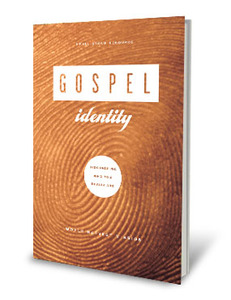
 

• Gospel Identity: Discovering Who You Really Are.
• Gospel Growth: Becoming a Faith-Filled Person.
• Gospel Love: Grace, Relationships, and Everything That Gets in the Way. Each 128p., $12.99. New Growth Press.

Each study can be worked through separately, but there is a sequence going on here, and we tend to skip over the focus of the first study (and ultimately, the entire series): Everything we do emanates out of our identity in Christ—or our obliviousness to that. And the fact that we so often ignore that we’re new creations in Christ trips us up further down the road.

Gospel Identity directly addresses this issue, starting with how we tend to justify ourselves apart from Jesus—which only serves to illustrate how thoroughly we do need Jesus. From there, this first study examines the blessings we’ve been given through our new identity and new life in Jesus—justification, adoption, unity with Christ—how that helps us overcome our self-centeredness and idolatry, and how it pushes us outward so others can also see and experience new life in Jesus.

The second study, Gospel Growth, helps us better see how the gospel transforms us more into Jesus’ likeness. And as you grow deeper in your relationship with Jesus, you’ll discover how the Spirit desires to extend that growth far beyond you. Over the course of this study you’ll look at such topics as living by faith; spiritual disciplines; the hand-in-hand roles of faith and repentance in transformation; the meaning and importance of living in power of the Spirit; the goal of sanctification in our lives; and our increasing identification with the suffering, death, and resurrection life of Christ.

Which brings us to the most overtly “missional” of the three, Gospel Love—although again, without first knowing and growing in Christ, it’s mostly just “doing” instead of truly living out of our life in Christ. Thus, you’ll learn how the gospel frees you to actively love and accept everyone God puts in your path—because those people are your path. You’ll learn that you’re part of a new family—the Body of Christ. You’ll discover what living incarnationally looks like, exploring the importance of love in community; loving and forgiving those who are difficult to love; extending grace in our relationships; loving honestly, even in conflict; the role of the Spirit in growing the Body of Christ, and finally, exploring opportunities to extend your new family by bringing the gospel to others.

So, what’s changed from the original Gospel Transformation, aside from the more deliberate grouping of themes into more manageable-size studies? Quite a bit, actually. Again, the beating heart has been successfully transplanted here, but into a quicker, more agile body. As opposed to the 15-20 questions and several long reading passages of each of the original GT sessions, the small-group sessions are built to run 75 minutes a pop. Thus, each session sticks to 8-12 questions; and shorter leader transitions have replaced the longer narratives. There’s also a lot more group interaction built in, so subgroups can better interact with the material—and with each other.

Each session concludes with a series of optional weekly challenges that group members are encouraged to take on (and discuss with one another during the week), so that the lesson is something actually put into practice, not just discussed then dismissed.

In addition, a) there’s been a lot of resequencing of the original material, and b) several of the sessions are either brand new or complete overhauls of the originals. It’s far more than just a condensation of the original GT. Honestly, I’d say close to half of the material here is brand new. (You’re welcome. :))

But again, this didn’t come about ex nihilo. The message and intent of the original Gospel Transformation (from Jack and Paul Miller, through Neil Williams) is very much intact here. Likewise, there’s still plenty of scriptural and theological meat to chew on here—it’s just significantly easier to digest in one sitting. Think of it as a series of filet mignons, rather than a 32-ounce porterhouse. (But if you’ve got that kind of appetite, looks like the original GT is still available here; I believe WHM/NGP are planning on making it available electronically as well, in due time.)

I’ve said it a number of times before, but now I’ll say it “officially”: This is the proudest I’ve been of my work on a product not called Growing Out. Again, I had great material to work with—as well as great people, particularly Barbara at NGP and Patric Knaak at WHM. And at the end of the day, we all felt that I was able to take all that great material and make it a lot more manageable for a small-group audience, without compromising the integrity of the message itself—and make it a lot more applicational in the process.

But you be the judge. Follow those links above, and prepare to have your life changed.

Posted in Uncategorized | Tagged , , , , | 2 Comments

Gospel Identity: The Reviews Start Coming in….


Someone else’s words today, but that’s OK…

“You have to make a choice between material that is Christ centered and material that is easy enough for lay-leaders to use. You have to choose between material that is well packaged and material that is banal. Rarely can you find something firing on all cylinders.”

Needless to say, I SO agree. 🙂 My own longer review will be forthcoming (when my own review copies are in hand), but in the meantime this captures everything good about the Gospel series, that I was shooting for when I worked on it last year…. enjoy….

futonreformer's avatarConfessions of a Futon Reformer

At this year’s General Assembly of the PCA, I received a preview copy of New Growth Press’s small group materials. I was excited because I am a big fan of New Growth Press and their partnering organization, World Harvest Missions. As a pastor, finding small group material is often the rough equivalent of getting a root canal. Trust me, I hate the dentist; this is the most horrifying analogy I can come up with. You are constantly being torn between material. You have to make a choice between material that is Christ centered and material that is easy enough for lay-leaders to use. You have to choose between material that is well packaged and material that is banal. Rarely can you find something firing on all cylinders.

When I received the copy of Gospel Identity, I immediately tore into it. It is an excellent booklet for small groups. I…

View original post 575 more words

Posted in Uncategorized | Tagged , , | 1 Comment

A Remedy for Burnout


“Life doesn’t start when you’re twenty, or when you’re forty. Life starts at Calvary. And that’s where fruitful service begins as well.”

I’m still bothered trying to figure out exactly how much of this really happened and how much is fiction (or at least heavily embellished), especially as it’s presented/marketed in the form of a factual account. But you don’t need to obsess nearly as much about it. Just enjoy the story, accept the more fantastic/literary effects for what they are, and soak in the wisdom offered throughout.

Jose Luis Navajo. Mondays with My Old Pastor. 240p., $15.99, Thomas Nelson.

I don’t want to give away the story line here, so suffice to say for now: A quickly burning-out middle-aged pastor realizes he needs help, and quickly. He seeks out the advice of his former pastor, and they ultimately decide to meet each Monday over the course of a few months. Each meeting between the two pastors, then, becomes a self-contained lesson/chapter, addressing such matters as family, forgiveness, and the importance of placing ourselves fully before God. Ultimately, it all (literally) spells out the message: Everything is by grace.

Each Monday is peppered with at least one story illustrating the older pastor’s teachings for that week, and they’re well chosen. Most appear to be (at least recent) Spanish folk tales, but we’re also treated to Shel Silverstein’s The Giving Tree at one point as well.

If all this sounds a bit contrived, well, it kind of is. But again, it only trips up overly analytical people like myself. Those who just like a good story will roll with all this just fine, because it is told well. The interaction between the two pastors is pretty believable—and the struggles of the “younger” pastor certainly are. The advice offered by the older pastor is stuff we can all use, especially if we’re not in a good place in our ministry right now:

“Are you really thinking of abandoning the seed you planted with excitement and hope? Will you leave the plow to which you fastened your life to be stuck in the middle of an abandoned field? Plant your feet solidly on the ground… your ground. Grab onto the plow firmly… your plow. Look straight ahead and continue planting because spring is drawing near.”

All in all, Mondays with My Old Pastor is an encouragement to all of us to keep walking out our calling. So before summer’s completely over, give the left side of your brain a break and receive the gentle wisdom being offered here.

Posted in Uncategorized | Tagged , | Leave a comment

Lay It Down: A Re-Introduction


(As many of you already know, I’m in a[nother] period of transition here. So, as I restructure—and as I rework the first draft of the next book—thought I’d reintroduce said book here. And if you’re new to all this and like where it’s going, feel free to wander back through the archives. So enjoy, as I regain my bearings in a variety of ways….)

**********

“Greater love has no one than this, that someone lay down his life for his friends. You are my friends if you do what I command you” (John 15:13-14).

We read the words in John 15, and take great comfort in the fact that Jesus laid down His life for us, His friends. But if we truly belong to Jesus, guess what? Then He’s our friend, too. If we belong to Jesus, we too are to take up our crosses and follow Him (Matthew 16:24). Re-read the passage above with that in mind, and follow the implications.

“…And you know the way to where I am going” (John 14:4).

The idea of laying down our lives for Christ’s sake may seem impossible, but it’s not just an idea—it’s our calling. In fact, it’s our life-long calling—and beyond. It’s not only foundational; it’s eternal. It’s how we first came to Jesus, and it’s how Jesus continues to shape our will in union with His. It is salvation; it is sanctification; and it is the totality of eternal life in Jesus. Our lives have to move from being of Christ or for Christ to being “in Christ” (Romans 8:1, et al.) to the point where finally our life “is Christ” (Philippians 1:21, et al.).

Therefore, within these pages you’ll find some pretty heavy ideas being… well, laid down here. And why not? This is your life we’re talking about, and about laying down every piece of it for the glory of God. There’s nothing more important than that. It’s not easy. Quite the contrary: It’s the hardest thing you’ll even have to do. And if you do it right, you’ll get to do it every day for the rest of your life.

In some ways, this is meant to be a very practical book. But it’s not all about doing. Before that, and along with that, each of us is called to “be transformed by the renewing of your mind” (Romans 12:2). We are called to become the new person Christ intends each of us to be, and to understand that each of us is a new person.

The challenge for me, as writer—and for you, as reader—is to avoid compartmentalizing these things into stages, steps, 10 easy ways, etc. And because this is a book with a beginning, middle, and end, I’m presenting a certain structure and sequence to make it easier to understand. But the fact is, God doesn’t compartmentalize—because He doesn’t change. Repentance and grace go hand-in-hand. Obedience and freedom go hand-in-hand. Inner discipline and outward service go hand-in-hand. Walking in the Spirit and loving our fellow human beings go hand-in-hand. And we stumble away from God’s will for us when we try to separate these things.

Furthermore: Laying it down is not just about releasing our bad stuff, but offering up everything “good” we have to God. Jesus, the ultimate good, offered Himself up for us. Who are we to do less—and why do we think the ultimate results would not be as glorious?  “Truly, truly, I say to you, whoever believes in me will also do the works that I do; and greater works than these will he do, because I am going to the Father” (John 14:12).

Many equate laying down with giving up—specifically, with being a quitter. In some ways that’s true—for example, as when God calls us to quit the sins and/or idols in our lives. But as we venture further with Jesus, laying down becomes less about ceasing some activity we’re doing, sinful or otherwise, and more about a different kind of giving up—the surrendering of everything we do to Christ. It doesn’t mean we’ll stop doing the good things we surrender to Him, but it does mean that we give up control of those things to Jesus, so He can direct them, so that His will can be done.

Therefore, we don’t stop working, but we “work… for the Lord” (Colossians 3:23). We’re still parents and children and spouses, but our priority becomes glorifying God in those relationships rather than pleasing ourselves, or even that spouse or parent or child. We still use our gifts and talents, but we do it to serve God fully and not just for ego fulfillment—even, or maybe especially, in the context of “doing God’s work.” We still receive amazing blessings from God, but we learn to immediately place them back in God’s hands, knowing that even the people and things we love most were given to us for His purposes, and that our joy must rest in that rather than in His gifts.

So let’s get ready to Lay It Down.

Posted in Uncategorized | Tagged , , , , | Leave a comment

Being the Church by Being There for Others


“What does it take to influence someone to commit his or her life for Christ? How much effort must be put forth to impact a life for eternity?” asks church consultant Michael Wiles early on in these pages. His answer (my version): A lot. But the good news is: Anyone can do it.

Michael  Wiles. The Influence of Community. $12.00, 120p., ChurchSmart Resources.

(Full disclosure alert: I was editor for this book. Then again, who better to tell you what’s in here? :))

Although the focus of this book is squarely evangelistic, the emphasis is on letting our lives and our actions do the talking. Every person who’s met Christ has a story, he exhorts, and when it’s actually shared, other lives change as well.

Throughout these pages, Michael emphasizes the importance of simply investing into others — and faithfully keeping the commitments we make to them. The backdrop, and tangible illustration, for much of this is his brother Bishop Terry Wiles’ church in East Hartford, Connecticut, Crossroads Community Cathedral (Assemblies of God). Over and over, Michael emphasizes the church living up to its “middle name.” As he points out (after surveying more than 1,000 believers at Crossroads), 95 percent of those who gave their lives to Christ were first impacted by a lay person — an invitation to church, one-on-one relationship, or simply the love and acceptance by a person or group there.

All the while, however, strong biblical teaching was a huge factor. This is about seeker-friendliness, not seeker sensitivity. People visiting Crossroads, and other hurches Michael has counseled, were confronted with the real Jesus, not a watered-down version. It’s about community and commitment.

My favorite chapter, then, is the penultimate one, “The Impact of Presence.” I’ll let it speak for itself here (after which it’ll be no surprise why it’s my favorite). After walking us through the Model of Change — potentially either a cycle or a progression from pre-conversion to salvation, and then to discipleship or to relapse (in which case, back around again), Michael observes:

To get to the Relapse portion of the wheel you have to go through—or rather, skip over—Discipleship. If you ignore Discipleship, then Salvation will lead straight to Relapse.

It is my belief that many churches place at least some level of intentional effort on getting people saved, but almost no intentional effort on Discipleship. Without discipleship, many new converts will fall by the wayside. Many who get saved at our altars have no clue how to live a Christian life. They don’t know the power of spiritual disciplines such as prayer and Bible study. They don’t automatically realize that they need to be fed the Word of God by attending church. If someone doesn’t take the responsibility to nurture these new Christians along, they’ll go back to their former ways of living.

Discipleship is a necessity. And the person who helped someone see the need to become a Christian is, in many cases, the person best suited to help disciple that person, since he or she already have a relationship with with person.

I’ve often said that the unwillingness of mature Christians to go back and help newer Christians walk through the same things they have is the missing link in the church today; and it was nice to see someone else say it, too (especially in a book I had the privilege to work on).

The book closes with a more expanded “secret” of church growth, which Michael refers to as TINDER — Teach the Word of God; Instill a burden for the lost; Never settle for status quo; Develop Leaders; Empower the Congregation; Remain faithful. I think this speaks for itself — and if not, you can always go read the fuller version.

Each of the book’s 13 chapters contains a series of reflection and discussion questions, which are great for helping either groups or individuals turn their thoughts into action. A small group or Sunday school class could do far worse than to work their way through this book over a semester.

The Influence of Community has a simple message, but if it’s heeded — and acted upon — that influence has the potential to go way beyond church leadership.

Posted in Uncategorized | Tagged , , , | 1 Comment

So, Now What? (or, help a Christian brother OUT!)


This post’s for me. But you can help. A lot.

First, thank you for following along. With the last few entries earlier this week, I’ve completed the first draft of Lay It Down: The Life Jesus Has Always Wanted. It’s already begun doing its rounds with publishers and we’ll see where God takes it from here. (BTW, I’m considering dropping the more provocative/ornery subtitle and going with the perhaps more accurate A Journey Into Trust. But I’ll go with whatever the marketing department deems best.)

Which bring us to our question above: Now what?

Certainly I’ll still be writing more reviews, as well as more random entries. But “Now what?” is really a much bigger question than what happens on this blog. Let me elaborate….

This weekend, I went on a men’s retreat at Ravenscrest Chalet (Torchbearers International) in Estes Park, and I needed it in the worst way. I didn’t know anyone else there going in, and I was OK with that. I got to hear stories of what God’s doing in people’s lives, and the struggles they’re facing; and either just listen and be humbled and/or help them talk/pray it through, respectively.

In short, I got to be with a group of men who were earnestly seeking God. And I realized how much I missed that.

A little more than 18 months ago, I was creating adult resources/small-group materials at a Christian publishing company — theoretically, my dream job (or at least to close it — I’m still keeping an eye on my dream company). And let’s be entirely fair here: Through any number of serendipitous events, I got the opportunity to create something I never would have gotten the opportunity to create otherwise. And that’s not nothing.

However, a number of bad decisions — both businesswise and (I’d argue) theologically — led to the dismissal of myself and many of the people I cared most about there, close to 30 in all. (Interestingly, Lay It Down was first conceived about 24 hours before that all went down. I guess God knew I’d need something to hang onto.)

Mind you, even 5 1/2 years earlier, it was clear fairly early on that in this professed “open door”/”egalitarian” company, there were sectors where I would never really be welcome. Still, others equally “outside the camp” were many of the finest people I’ve ever known (and again, most of them were victims of the same layoffs).

I am at least working steadily again, and am thankful that I at least have a job (and especially with God’s timing, as unemployment was abruptly and inexplicably cut off just days after I accepted the position). Still, more often than not I feel like an exile. I’ve lost something — a lot — by being cut off from people pursuing God earnestly, and interacting with them on a daily basis. Even if, as speaker/Torchbearers director Chris Thomas put it this weekend, “the back of the [ministry] loom isn’t pretty,” it’s still taking part in weaving a tapestry.

And thus, once I had some alone time Saturday night, I found myself saying — pretty much choking out — the following prayer: “Lord, is it too much to ask to have that kind of community and a job with a purpose?”

So thus, I put that question out to you. I know you guys have connections, and a few of you may even have openings. And I figure putting out an APB here is as good a place as any to start. Not that I haven’t been looking for 18+ months now — and trust me, I’ve interviewed with and been turned down (sometimes repeatedly) by the best 🙂 — but this weekend just reinforced where my heart really is at, and that’s it’s not just “the thrill of the chase” or even the need for validation. Not that those aren’t present — I am what I am — but now I know in my hearts of hearts that I truly want this, and that it’s right to want it. So I’m asking, with the hope that I shall receive.

So thank you in advance for your help. And again, thank you for tuning in.

Posted in Uncategorized | Tagged , , , , | 1 Comment

Pick It Up—Put It On—Walk It Out — a small-group session


This  session is based upon the following past devotionals—scroll down as needed:

Pick Up Yr Cross
Pick Up Yr New Life
Put on Your New Self
Put on Eternity
Walk It Out

For this session, you’ll need….

• 1 old, beaten-up jacket AND one new jacket, for every 4 to 6 people.The older and smellier your old jacket is, the better—but not so bad that people would get dirty just putting it on! (Know any mechanics or landscapers who’d loan you their jackets for the day?) Pair up your jackets, and leave them in an open area where everyone will be able to easily access them.
• a plan to worship
• a plan to celebrate. However you want to handle this is up to you; perhaps you even want to have a separate session for this. But do make plans to celebrate together what God’s been doing in your midst over the last several weeks.

Laying Down Your Day (15 minutes)

It’s our final session of this study—thanks for coming! I know you’ve just arrived and gotten comfortable, but I’m going to ask you to put on coats anyway—the coats you see over there.

Have your group gather into groups of four to six by each pair of coats.

Everyone should try on the old jacket first. But don’t just put it on and take it off again—try to get comfortable with it. Take a whiff of it; get a feel for where this jacket has been.

Leader: Put on one of the dirty jackets, and show everyone how it’s done.

Once you’ve done that, pass it on to the next person to try on, while you go ahead and try on the new jacket. Again, leave it on for a few moments—get a feel for where this jacket hasn’t been yet, and what kind of person might wear it.

Pass on your dirty jacket to the next person, and repeat your actions with the new jacket. Once everyone’s had a chance to try on both jackets, bring the group back together. Discuss:

1.Which jacket felt better while trying it on? Why?

Ask for one or more volunteers to read Colossians 3:1-16, then discuss:

2. How was trying on and taking off each jacket like the taking off of the “old self” and the putting on of the “new self” that Paul describes here? How is it different?

Ask for another volunteer to read the following passage. Then, discuss the question that follows.

Our natural “old” experience is life and death, and that experience extends to everything else in this life. The new resurrection life is life and life only. … Gaining this perspective on our lives on earth changes everything, and frees us to become more like the Savior we profess to follow.

3. When have you experienced this truth? Or, put another way: How does “put[ting] on the new self” (Colossians 3:9) free us to “seek the things that are above” (v. 1)? Share from your own experience.

Laying Down the Word (20 minutes)

Read Hebrews 12:1-15 as a group, letting each member read at least one verse each (or three each, if you have a group of five). Since the math probably won’t work out perfectly—and you might hate math anyway—it’s OK to let the same person read the opening and closing verses. But make sure everyone gets a turn.

Let’s connect this passage with how we’ve experienced this study, and discuss these questions together:

4. Describe the flow of this passage. How does it start, where does it go to, and where does it end?

5. Let’s apply that flow to ourselves now. On a personal level, how has your laying of your life and your pursuit of Jesus—and the disciplines you’ve undertaken in order to do that—already begun to produce “the peaceful fruit of righteousness” in you? Share a little about that.

6. How has that, in turn, enabled you to “ [s]ee to it that no one fails to obtain the grace of God”? In order words, how has this study helped you to help others to “lay it down”? Again, share about how God’s been able to use you in this capacity.

Have a volunteer read the following passage, and then discuss the question that follows:

Your life is no longer yours. Stop behaving as if it is. You cannot force God to lead you into the next phase of your life. You can renounce all you have and entrust your life to Him, move when He tells you to move, and then rejoice in that He considered you worthy to be trusted with anything. Pick up your cross—consider yourself dead to sin and alive in Jesus—and truly begin to follow the One who carried your cross before you were even born.

7. How are you still wrestling with this idea? Is there fear, a lack of understanding, maybe even an unwillingness to deal with it? Take a step of faith here and be open about what you’re still working through.

Laying Down Your Life (20+ minutes)

Get into your pairs one more time. Give everyone time to reassemble.

We’ve spent a lot of time this week looking beyond this week. For the next 15 minutes, I’d like you to do the same thing with your partner. Talk about how God’s been speaking to your heart this week, and over the last few months. How has God helped you to better understand what He’s created you for, and what are the next steps you think He’s leading you into?

When you’re done sharing, pray for one another. Don’t be afraid to pray not only about what the other person’s shared, but also about what you’ve been seeing in that other person over the last several weeks. Put together what God’s been showing you with what God’s been showing them. Let’s get started.

Bring your group back together after 15 minutes. Ask for a few volunteers to share what God’s been showing them—but if more than a few people share, don’t cut if off. Let God have His way.

Afterward, lead your group in prayer, again giving everyone the opportunity to pray. Thank God for your time together—and for the eternal life you look forward to together. Ask God to help each of you to go even deeper into laying down your lives before Him, and before others.

Posted in Uncategorized | Tagged , , , , , , | Leave a comment

Walk It Out


All of our lives, when lived rightly, are a journey into trust. In fact, I’ve been praying/adapting a certain prayer for quite a while, and I think (and hope) that the development of this prayer has been reflected in these pages.

At first, and for a long time, it went like this: “Lord, help me to learn to trust You more deeply.” However, over the last several weeks, I’ve felt the need to add this: “…and to become more worthy of Your trust.”

This is not about theology, so don’t go there (and I apologize for any shortcomings in that department). This is about relationship. I want to know God more deeply, but I have to allow Him to know me more deeply. Again, suspend the theology here—I know that God knows me. And yet, I try to hide. And this journey into trust requires me to stop hiding. It requires me to put my sin and my agenda and my fear away, so that I can truly experience God’s knowing of me—that my relationship with God might be truly intimate and not just “all in order.”

The fact is, both parts of this prayer are flip sides of the same problem—because there’s only one person in this equation who can’t be trusted. But my own untrustworthiness feeds my inability to trust God. Only as I begin to obediently walk out what God’s commanded do I begin to in turn feel as if I can trust God with every part of my life. God doesn’t condemn me; He forgives me and wants me to be better.

And this isn’t just for me. At the same time that I need to receive His grace, I need to extend it to others. I need to show genuine pity—not in the sense of “I feel sorry for you,” but in the sense of “I ache for you and want to help you.” Because that’s the kind of pity Jesus has shown to me.

As we’ve observed repeatedly this week, we know the way to where Jesus is going. It’s time to walk it out.

We are called to be a blessing to every person we meet, whether they realize it or not. The only way to become that blessing is to be emptied of our own stuff, so that God can fill and transform us into the individuals He has created us to be. Each of our lives need to move from being of Christ to being in Christ—and finally to the point where our life “is Christ” (Philippians 1:21, et al.).

Love is union—with Jesus and with those He’s called us to love. We, as Christians—or, as C.S. Lewis put it, “little Christs”—are called to reconcile the world to God. We’re not just here waiting to be taken from the world, but to begin bringing a foretaste of the kingdom of heaven to the world now, even as we are “in the world but not of it” (see John 17:15-16).

We cannot change the things, or the opportunities, that we’ve lost, but we can be prepared to receive and walk in the new things God has created us to do. We are new creations. And God is still creating something new within us.  God wants to bring us into something new. But we must want what God wants—not just something new.

Therefore, since we are surrounded by so great a cloud of witnesses, let us also lay aside every weight, and sin which clings so closely, and let us run with endurance the race that is set before us, looking to Jesus, the founder and perfecter of our faith, who for the joy that was set before him endured the cross, despising the shame, and is seated at the right hand of the throne of God. Consider him who endured from sinners such hostility against himself, so that you may not grow weary or fainthearted…. Therefore lift your drooping hands and strengthen your weak knees, and make straight paths for your feet, so that what is lame may not be put out of joint but rather be healed. Strive for peace with everyone, and for the holiness without which no one will see the Lord (Hebrews 12:1-3, 12-14).

One more thing to remember about walking: It’s not always exciting. Sometimes there are breathtaking vistas, and that great feeling of “a second wind.” Sometimes it’s monotonous. Sometimes it’s difficult. Often, it’s just plain tiring. But walking gets you somewhere. And if we’re following Jesus, it’s somewhere better.

We can walk in the knowledge that tomorrow will be a good day—and that even if it’s not a good day, experientially speaking, God is working out the events of the day for our good (Romans 8:28). Because His good is our good.

The time to walk out our new lives in Christ is today. So let’s do it. And may God continue to bless you as you lay it all down again each day, for the sake of the One who laid down His life for us.

Lay It Down Today

We’ve approached your next steps from a variety of angles this week. Hopefully, at least one of these approaches has resonated with you. So now, it’s your turn.

If you sense what God is leading you into next, or know you’re already in the midst of it, spend time thanking God for the desire He’s given you, how He’s fulfilling it, and for the desire to keep moving forward. If not, spend time pursuing things with God. “[H]ow much more will your Father who is in heaven give good things to those who ask him! (Matthew 7:11).

Finally, spend some time thanking God for this journey into trust He’s taken you on over the last few months; and ask Him to take you far beyond even where you are now—and into eternity with Him.

Posted in Uncategorized | Tagged , , , | Leave a comment

Put on Eternity


If then you have been raised with Christ, seek the things that are above, where Christ is, seated at the right hand of God. Set your minds on things that are above, not on things that are on earth… seeing that you have put off the old self with its practices and have put on the new self, which is being renewed in knowledge after the image of its creator(Colossians 3:1-2, 9-10).

Those of you in the Northeast might be familiar with the radio ministry of Wayne Monbleau (Loving Grace Ministries); perhaps not. In any case, he ministered heavily to my wife and me about 20-25 years ago, and he’s still going. He’s also written his share of worship songs, and one in particular sticks with me, the epic acoustic hootenanny “Let Heaven Fill Your Thoughts.” Seriously, it’s an eight-minute song that gets more rollicking as it goes along, as it depicts the reunion that awaits us in heaven. But it’s the lines that close out the minor-keyed introduction that still resonate with me on a regular basis:

Let heaven fill up all of your thoughts; keep your mind upon the Lord
Your life right now will seem so small when you think what you will behold
When you’re a thousand—years—old
When you’re a million—years—old
When you’re ten million—years—old.

Obviously it’s a great way of gaining perspective on our lives right now. But I’m beginning to view it even more in terms of what awaits us. An eternity with Jesus awaits us. And as we begin to gain a broader and deeper perspective on that, we don’t have to consciously adjust our vision to make our lives “seem so small”—they are that small.

And yet our small lives are seeds that contain this far greater eternal life. And by reaching for what lies beyond this life—and bringing that life to those around us—we begin to sprout and grow into the life God has intended for us all along.

To be human is to die. Everything around us… ends. That’s why Christ had to become a man, and had to die a human death, in order to reach us and impart eternal life to us. He calls us to do the same. To follow Jesus is to follow Him through death and into eternal life. And if God allows, we will have the privilege of helping others walk that same ever-beginning path.

Indeed, serving others now prepares us to serve God throughout eternity, and softens our hearts so that Jesus himself may continue to serve and guide us. Because that’s what’s in store for us: “Therefore they are before the throne of God, and serve him day and night in his temple; and he who sits on the throne will shelter them with his presence…. For the Lamb in the midst of the throne will be their shepherd, and he will guide them to springs of living water, and God will wipe away every tear from their eyes” (Revelation 5:15-17).

When all is said and done, what will I have to show at the day of judgment? I watered some seeds, helped plant a few trees, and did a whole lot more not even worth discussing.  Millions, maybe even billions, will have more to show, and go on to greater rewards. And I should rejoice in that, because God’s work was accomplished. More importantly, I will rejoice that one day I will no longer be unknowingly in God’s presence, buried under my own sins and those of the world around me—or often at best, mentally acknowledging a presence I cannot quite feel. “For now we see in a mirror dimly, but then face to face. Now I know in part; then I shall know fully, even as I have been fully known” (1 Corinthians 13:12).

Our natural “old” experience is life and death, and that experience extends to everything else in this life. The new resurrection life is life and life only. We are just passing through…

…not having received the things promised, but having seen them and greeted them from afar, and having acknowledged that they were strangers and exiles on the earth. For people who speak thus make it clear that they are seeking a homeland. If they had been thinking of that land from which they had gone out, they would have had opportunity to return. But as it is, they desire a better country, that is, a heavenly one. Therefore God is not ashamed to be called their God, for he has prepared for them a city (Hebrews 11:13-16).

Gaining this perspective on our lives on earth changes everything, and frees us to become more like the Savior we profess to follow. Remember, we “know the way to where [Jesus] is going” (John 14:4). Eternal life starts now. So let’s get ready to walk it out….

Lay It Down Today

Let’s begin practicing our ministry to God right now. For the next 24 hours, commit to praying every half-hour. If you need a reminder, set an alarm or create an Outlook event, and keep putting it to sleep. It doesn’t need to be a long or complex prayer—in fact, it could be a one-sentence prayer such as, “Lord, open my eyes to see the needs You’ve given me to meet, and help me to meet them in Your strength.” Just pray faithfully and repeatedly throughout your day. See what God bring to your attention as a result—and ask Him what He wants you to do about it.

Posted in Uncategorized | Tagged , , , | 1 Comment

Put on Your New Self


Whatever we truly do for God, it is Christ in us. Whatever holiness we have is not ours to take credit for, but Christ’s to be glorified with. And even then it is not what Christ does, but Who Christ is—and how He is being formed in us.

Slowly, we are becoming the people God created us to be. Slowly, the new life Christ has in us is growing outward. However, it’s not all about waiting for things to happen. We can begin, even now, to put on our new identities in Christ, even as we wait to mature enough to “fill out the suit.”

“In my Father’s house are many rooms. If it were not so, would I have told you that I go to prepare a place for you? And if I go and prepare a place for you, I will come again and will take you to myself, that where I am you may be also. And you know the way to where I am going” (John 14:2-4).

When we look to Jesus, we “know the way to where [He] is going,” and consciously turn ourselves in that direction. And as we look to Jesus, we see One who “emptied himself, by taking the form of a servant, being born in the likeness of men” (Philippians 2:7) but who nonetheless was in constant communion with God. It is simultaneously putting the flesh to death and living entirely for the Father. This can become the increasing reality of our lives—not perfectly, but intentionally, and progressively better. We position, we put on the new self that’s already given to us, the Spirit empowers us.

Because He is The New Man, Jesus looks at even the most common things in godly terms, and by doing so transforms them into lessons, parables, teaching instruments… temporary things capable of conveying eternal life. And in doing so—and because we remain connected with Him—He continually shows us how to follow Him as human beings. We become people who are capable of conveying eternal life.

We are no longer—check that: never were—self-appointed experts, no matter what the world tells us. We are God’s children, whom God increasingly entrusts with the fullness of His life so that the other kids can see it.

In the words of Thomas Merton, “We do not want to be beginners. But let us be convinced of the fact that we will never be anything else but beginners, all our life!” There is so much God has for us next, and our perspective and our actions need to change to reflect that. We need to take those steps of faith that will allow the Spirit to change our perceptions and our actions—to faithfully and intentionally put ourselves in places where only God can work.

And we have not been left alone to figure out how to follow Him. “But when the Helper comes, whom I will send to you from the Father, the Spirit of truth, who proceeds from the Father, he will bear witness about me. And you also will bear witness, because you have been with me from the beginning” (John 15:26-27). It’s a common misconception that walking in the Spirit invites abuse. The fact is: It’s the counterfeits of walking in the Spirit that invite the abuse, not the real thing. If we are truly in Christ, it will be impossible to go out into left field. Christ takes care of us, and the Spirit “will guide you into all the truth” (John 16:13).

But again, remember: Our new lives in Christ bear fruit by abiding, not merely by doing. (John 15:4-10). Our lives are about passing along the life God has given us, in the ways He’s given it to us, not manufacturing something “to please God”—which ultimately doesn’t. It’s possible that God will honor our intent, and yet the works themselves will be “wood, hay, straw… and the fire will test what sort of work each one has done” (1 Corinthians 3:12-13 ESV). Isn’t it better to pass on those things you know have been given to you by God?

Receive the new identity you’ve been given in Christ, and cover yourself in it like it’s armor (because it is). Then, get ready to walk forward.

Lay It Down Today

Take as long as you need for this one—it could be a minute; it could be an hour. But get somewhere quiet and begin repeating the following to yourself: “I am in Christ, and Christ is in me.” Allow some silence between each repetition, but keep repeating this truth until it sinks in.

Then, once you’re “there,” ask yourself this question: “If Christ is in me, what does Christ want to do through me?” This is not the same as asking “What would Jesus do?” This is discovering how we are “created in Christ Jesus for good works, which God prepared beforehand, that we should walk in them” (Ephesians 2:10). Earnestly seek an answer from God, and take your first steps in making that answer a reality.

Posted in Uncategorized | Tagged , , | Leave a comment