Lay Down Your Doubt


Our anxiety expresses itself through doubt. And our doubt expresses itself by taking things into our own hands. Whether we say it or even consciously think it, trying to make things happen on our own says, at best, “God’s not giving me what I want when I want it, so I’d better make it happen myself.” And despite what seventy-five percent of Christians believe (Barna, 2005), the phrase “God helps those who help themselves” does not come from the Bible.

In this season of my life, God has been confronting my tendency to live out of my doubt. Ask anyone: I’m good at coming up with a plan, pulling things together, and making them happen. I am, to use a human compliment, resourceful. Heck, I like referring to myself as “tenacious.” And yet, in this season all my efforts have come to nothing. Instead, God says, “Depend on me. Let me handle it.”

I try every idea at my disposal, thinking one of them will work. They don’t. And then something that wasn’t my idea shows up and accomplishes what all my bright ideas and efforts couldn’t. Again, God repeats, “Depend on me. Let me handle it.”

Sometimes we already know things are out of our hands. And yet, we wrestle with the same problem as the anxious and the self-reliant—the failure to acknowledge that things still in God’s hands. We see a great example of this as Jesus encounters a boy with an unclean spirit—and even moreso in the people surrounding Jesus and the boy:

And when they came to the disciples, they saw a great crowd around them, and scribes arguing with them. And immediately all the crowd, when they saw him, were greatly amazed and ran up to him and greeted him. And he asked them, “What are you arguing about with them?” And someone from the crowd answered him, “Teacher, I brought my son to you, for he has a spirit that makes him mute. And whenever it seizes him, it throws him down, and he foams and grinds his teeth and becomes rigid. So I asked your disciples to cast it out, and they were not able.” And he answered them, “O faithless generation, how long am I to be with you? How long am I to bear with you? Bring him to me.” And they brought the boy to him. And when the spirit saw him, immediately it convulsed the boy, and he fell on the ground and rolled about, foaming at the mouth. And Jesus asked his father, “How long has this been happening to him?” And he said, “From childhood. And it has often cast him into fire and into water, to destroy him. But if you can do anything, have compassion on us and help us.” And Jesus said to him, “‘If you can’! All things are possible for one who believes.” Immediately the father of the child cried out and said, “I believe; help my unbelief!” And when Jesus saw that a crowd came running together, he rebuked the unclean spirit, saying to it, “You mute and deaf spirit, I command you, come out of him and never enter him again.” And after crying out and convulsing him terribly, it came out, and the boy was like a corpse, so that most of them said, “He is dead.” But Jesus took him by the hand and lifted him up, and he arose. And when he had entered the house, his disciples asked him privately, “Why could we not cast it out?” And he said to them, “This kind cannot be driven out by anything but prayer.” (Mark 9:14–29)

I love the incredulousness of Jesus’ “If you can!” It not only carries the sense of “Who do you think I am?” but also “Don’t you understand who you are, in God’s sight?” Which is borne out by Jesus’ next sentence, “All things are possible for one who believes.”

While it’s not simply a matter of “God helps those who help themselves,” our inability to “make” God’s will manifest might indeed be a matter of us not being in position for God to use us. Our doubt restrains God’s ability to operate. Not that he couldn’t blow past it any time he liked, as Jesus in fact does here. Nonetheless, God wants us to believe, and is willing to withhold his temporal blessings and deliverance until we do so.

I’m not advocating a “name-it-and-claim-it” theology here, but I am suggesting a principle of “believe it and you’ll receive it”—provided it’s what God wanted to give you all along. Psalm 84:11b affirms this: “No good thing does he withhold from those who walk uprightly.” There is a truth buried within the more positivistic twistings of the gospel, and it’s this: So much of God’s will for our lives remains unclaimed, because we can’t bring ourselves to believe that God would really want to do something good for us.

Thus, I suspect that the prayer and fasting the disciples lacked for this situation wasn’t purely a matter of failing to press the right spiritual buttons—let alone “if you do this spiritual discipline more regularly, you’ll be so much more effective for the kingdom.” There’s truth to that, but there’s a deeper truth here: Like every spiritual discipline, prayer and fasting was a way for the disciples to humble themselves before God so that they too could see the situation properly, become acutely aware of their own fallenness, human inability, and just plain lack of trust—and acknowledge, as the boy’s father did, “I believe; help my unbelief!”

Lay down your doubt, and let Jesus help your unbelief, so that you can receive the good things he has already prepared for you.

Lay It Down Today

Let’s get more creative with today’s passage from Mark. Read it again right now, putting yourself in the disciples’ place. Experience the inability to heal, Jesus’ rebuke, and the curiosity/humility afterward. Then read it once more, from the perspective of the father—the overwhelmedness and desperation for his son to be delivered, and the equally deep desperation to want to believe fully that Jesus could, and would, deliver his son.

Who do you identify with more right now? Spend some time giving up your doubt, and the roadblocks you’ve placed to reinforce that doubt, to Jesus right now. Hand over to him those things that make you anxious or overwhelmed. Let him handle them, and ask him to keep those things out of your hands from this day forward.

Posted in Uncategorized | Tagged , , , | Leave a comment

Between Us Guys


For dads, and for all those conversations they’ve been meaning to have with their sons. . . .

Image result for new growth press Between Us GuysJoel Fitzpatrick. Between Us Guys: Life-Changing Conversations for Dads and Sons. 128p., $17.99, New Growth Press.

This easy-to-use, life-changing book for fathers and sons gives readers the tools to have important conversations with boys about life, faith, and being a man. With a conversational and captivating tone, fathers and other caregivers are guided into having gospel-focused conversations with boys ages six to ten about a wide range of topics from social justice and friendships to money, anger, and more.

Dads are given an incredible opportunity to be one of the primary influences in their children’s lives for the gospel. By inviting conversations in every arena of life, fathers pass down the message of Christ to the next generation. As a youth and family pastor and father to a young boy who’s entered into many of these conversations, Joel Fitzpatrick knows it’s important not to shy away from difficult subjects.

But he also knows dads and other caregivers need help in how to have intentional conversations with boys about God, themselves, and what difference knowing the gospel makes to their everyday life. Fitzpatrick invites fathers to share with their sons how the gospel shapes all aspects of life, including how they treat women, people from other ethnic groups, and much more. Specific, practical help is given to dads through suggested activities, God’s Word, and insightful questions.

In a world where television, the internet, social media, and gaming culture have taken away from quality time spent between fathers and sons, Between Us Guys urges readers to lean in to important conversations with the grace and knowledge of Christ.

Posted in Uncategorized | Tagged , , , | Leave a comment

Lay Down Your Anxiety   


Let’s begin our exploration of our future at its most immediate location: Today.

11-59My dad has a phrase I’ve used a lot in the past couple decades: “He’s the God of 11:59.” In other words, God intervenes in our lives when he’s supposed to, at our time of deepest need—not when we think he ought to show up, or when it would be easiest for us. Those who constantly take faith-filled risks live in 11:59. The rest of us would do well to remember that 11:59 might, in fact, be the best place to live our lives.

Peter wrote the following about the Day of the Lord, but I believe it applies pretty well on this day, too: “But do not overlook this one fact, beloved, that with the Lord one day is as a thousand years, and a thousand years as one day. The Lord is not slow to fulfill his promise as some count slowness, but is patient toward you, not wishing that any should perish, but that all should reach repentance” (2 Peter 3:8–9).

What I interpret as God’s slowness in making my life less stressful is, rather, his patience in waiting for me to repent. God is waiting for me to be willing to live in 11:59—to fully accept the easy yoke of Jesus, so that I move at his correct pace, knowing that his provision will always be there when I need it, and that his provision to me in fact brings him glory. Thus, I’m also often been fond of adding a corollary phrase to my dad’s:

“I need to reset my watch.”

The truth is, we often have no clue about God’s timing. But a good rule of thumb is this: Remove yourself, and anything else other than the God you trust in,  from the equation—which is also to say, remove the pain that “waiting” brings to you—then view the situation again. At that point in time when it’s clear there’s nothing you can do to meet that need, there God will be.

I’m writing today’s entry in such a season. Over the past year, things I thought I could depend on—schedules, promises, routines, people—have failed or fallen by the wayside. My wife and I are in a place where each week could be the one when we no longer can successfully pay the bills, when work may or may not come. And yet, weeks, months, and years like this have now gone by, and a check or an assignment arrives in time, or the money went further than expected. Thus, if we look at the situation objectively rather than with an anxiety about our future, the fact is . . . we lack nothing.

We are already residing in eternity, even here. The more I realize that, the less I need to worry that God will take care of our needs. We all have to rely on God, whether we care to admit that or not. The blessing, when it comes right down to it, is when we realize that and live as if it were true. Because it is.

Matthew 6—the center of the Sermon on the Mount—is loaded with Jesus’ assertions about our future: the Lord’s Prayer; the promise that our private giving and fasting will be rewarded openly; the encouragement to store up treasures in heaven rather than on earth; but most apparently in the following passage used by every one of us who worry about the future—thus, I’ll step aside and let Jesus close today’s thoughts, because after all they’re about today:

Therefore I tell you, do not be anxious about your life, what you will eat or what you will drink, nor about your body, what you will put on. Is not life more than food, and the body more than clothing? Look at the birds of the air: they neither sow nor reap nor gather into barns, and yet your heavenly Father feeds them. Are you not of more value than they? And which of you by being anxious can add a single hour to his span of life? And why are you anxious about clothing? Consider the lilies of the field, how they grow: they neither toil nor spin, yet I tell you, even Solomon in all his glory was not arrayed like one of these. But if God so clothes the grass of the field, which today is alive and tomorrow is thrown into the oven, will he not much more clothe you, O you of little faith? Therefore do not be anxious, saying, “What shall we eat?” or “What shall we drink?” or “What shall we wear?” For the Gentiles seek after all these things, and your heavenly Father knows that you need them all. But seek first the kingdom of God and his righteousness, and all these things will be added to you.

Therefore do not be anxious about tomorrow, for tomorrow will be anxious for itself. Sufficient for the day is its own trouble. (Matthew 6:25–34)

Lay It Down Today

We’re going to be spend some extra time in the Word over the next several entries, to discipline ourselves in this habit. But first, let’s try a little experiment. Find a watch or a clock with a second hand. Then, do not be anxious: Close your eyes and wait before Jesus right now. In fact, do it for exactly 1 minute and 59 seconds—or at least what you think is 1 minute and 59 seconds. Keep your eyes closed until you think that amount of time has passed, then look up. Note how close you were (or weren’t). Read Matthew 6:25–34 again, then reflect:

  • How hard was it to still yourself and wait, for not even two minutes? What kinds of things went through your head during that time? Why?
  • Why do we seem to be able to do everything but wait? Why does that make us so uncomfortable?

Close your eyes once more—this time to pray. Ask God to “reset your watch,” that you can live more within his perfect will and timing, free from anxiety about your future—including your future today.

Posted in Uncategorized | Tagged , , , | 3 Comments

God’s Gift of Tremendous Power


We all need more of God’s strength in our life. This book will help you learn more about how to get there. . . .

God's Gift of Tremendous Power coverAnn Shakespeare. God’s Gift of Tremendous Power. 128p., $13.99, Deep River Books.

God’s Gift of Tremendous Power presents a dynamic vision of what it means to live “in Christ Jesus” and to be empowered by Him. It is a practical and inspirational book, explaining how we can align with biblical truth to become channels of God’s love and resurrection power.

Readers will gain a richer understanding of the Christ and our position of authority in Him. Its pages inspire us to live purposefully in the flow of our true identity, and to discover how to pray more powerfully in union with the One who makes all things new.

Posted in Uncategorized | Tagged , , , | Leave a comment

Lay Down Your Love (Retreat Session 4)


Throughout the course of this retreat, you’ve been exposed to—and sometimes thrown into in—just a few of the spiritual disciplines. But the fact is, every spiritual discipline is a form of worship. It’s a way of being intentional about recognizing God’s “worth-ship.” As you’ve hopefully experienced, they get us out of our own way so we can see and appreciate God for who he is.
In this final session, we’re going to focus more on worship in the more “conventional,” outward sense, as well as use the above disciplines, with Revelation as our guide. We need to always remember that our lives are prep time for eternity. Right now, we’re being prepared to live forever in God’s presence. Just thinking about that should help us view our lives differently. Thus, we’ll also consider what God still has in store for us here—how we can serve the world he’s placed us in, for his sake. So let’s begin to pick up our new life in Jesus, put it on, and walk it out.

Take fifteen minutes to think and journal on these questions:

  • Out of the activities you’ve done during this retreat—study, prayer, silence, confession, “alone time with God” (and fellowship and service, if you’ve been with a group)—which have helped you connect with God the most? Why do you think that is? 
  • Which disciplines would like to do more often? How can you become more deliberate about doing them?
  • Think about a meaningful time or season of worship (of any kind), or of closeness to God, that you’ve experienced. What made that time so meaningful? What did it feel like? How did it affect your thoughts and actions?
  • How has your idea of what worship is (and isn’t) changed over the course of your Christian life? How has your own approach to worship before God changed, as a result?

Leaders: Take twenty minutes for this as a group. If you have ten people or fewer, do this initial discussion time together; if more than ten, use your subgroups. Give a few minutes’ warning when your twenty minutes is almost up, and regain everyone’s attention when you’re ready to move on.

Read Revelation 7:9–8:3. Then read it again. Once more, if you need to, to get the whole picture of what’s taking place here. Then move on.

We’re not going to observe an entire half-hour of silence, but we are going to take a few more minutes to just sit and be silent before God. Close your eyes, and put yourself in the middle of this passage. Go from being an observer to a participant, because that’s what you’ll be one day. Meditate on this passage until you can truly see yourself there.

Once you’re ready to leave the scene, take at least ten more minutes to reflect on these questions:

  • How did you feel as you reflected on this scene? Were you excited? Uncomfortable? Scared? Or did you have a hard time resonating with it at all? In any case, why?
  • Regardless of your answer, how does (or should) knowing our eternal future with Jesus help us make worship—however we do it—a higher priority in our lives?
  • How easy is it for you to accept the idea that you’re created for God’s pleasure—and that God delights in growing you even further? Explain.

Leaders: Encourage group members to read through Revelation 7:9–8:3 as many times as they need to, in order to get the picture here. Then, move on to the instructions in the next paragraph. Ask everyone to be totally silent for the next five minutes, imagining themselves in the midst of this passage. When five minutes are up, have everyone get back into their subgroups. Give everyone fifteen minutes to debrief their experience and to discuss the questions that follow. Again, give a heads-up when a few minutes remain. Ask for volunteers from each subgroup to share their answers and insights afterward.

Before you move on to the next section, spend some time worshiping God, in whatever form you’re comfortable doing. But do something audible and visible before God—maybe even shout, cry, and fall on your face. Get ready to become a part of what you’ve just experienced in Revelation 7.

Leaders: After your discussion time, take a worship break. Take at least fifteen minutes to sing, pray, praise—whatever comes most naturally to your group. Encourage group members to be audibly and visibly expressive in their worship during this time.

Then, read Revelation 21:1–7, 21:10–22:5. Read it as many times as you need to for the images here to sink in. Then think once more about the people you’ve reflected on during the course of this retreat. Consider this: They, too, with be with you for eternity. In fact, you’re going to spend eternity with every believer who’s ever walked the earth. Then, take fifteen minutes to reflect on these questions:

  • How can remembering your destination enable you to begin living eternal life more fully right now?
  • Where is it most apparent to you that you’re not yet “one who conquers”? How can the One who has conquered help you in that battle?


  • Even more important than you: Who are the “conquered” in your life right now? Who needs joy? Healing? Comfort? A sense of God’s presence? Refreshing? A sense of their value to God? How could God use you to help bring that to them? Be specific.

Leaders: Get back into your subgroups, and take twenty minutes for this next section. Take turns reading this passage, twice around, and then discuss the questions that follow. Give subgroups a heads-up when a few minutes remain. Afterward, ask people to share their answers and insights. Encourage as many responses to that last question as possible, but don’t force anyone to answer.

Take at least fifteen minutes to pray in response to that last question. Ask God to build upon and expand the vision he’s begun to place upon your heart. Ask him to guide you to those people that either you can come alongside or who can come alongside you, or both, depending on your situation.

Try to have an extended time of worship between you and God to close your retreat time. Pray, sing, talk . . . give whatever you can give to God. When you feel you’ve done that, thank God once more for your time together, and then get back out there—because eternal life starts now.

Leaders: You can either do this section as an entire group or in your subgroups, depending on your size. If you do get into subgroups, bring everyone back together after fifteen minutes and close your prayer time together. Then, spend at least fifteen more minutes in worship. Again, encourage group members to be audibly and visibly expressive. If you need to sing or pray or anything else longer, do it. Let the Spirit do his full work in your midst, and don’t end your time together until you’re satisfied you’ve allowed that to happen fully.

Posted in Uncategorized | Tagged , , , | Leave a comment

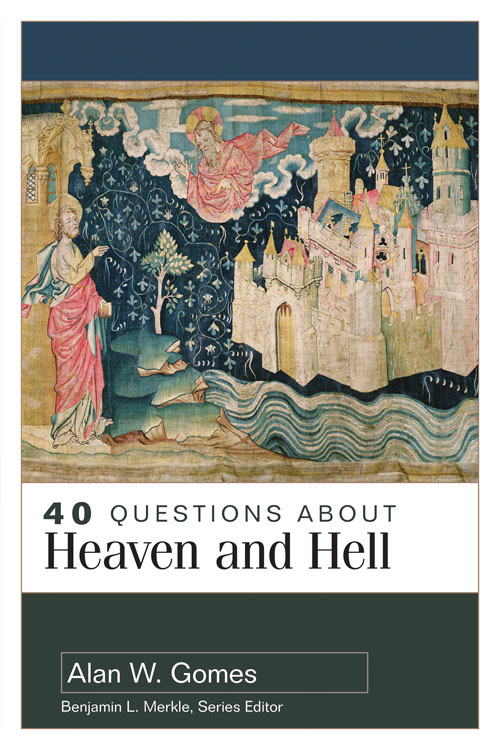
40 Questions about Heaven and Hell


For all you fans of last Thursday’s post. . . . 🙂

Alan W. Gomes. 40 Questions about Heaven and Hell. 384p., $25.99, Kregel Academic.

In 40 Questions About Heaven and Hell, Alan Gomes surveys the Old and New Testaments to present a comprehensive picture of the afterlife. The question-and-answer format makes it easy to find answers to specific questions on heaven, hell, the intermediate state, the final judgment, and life in eternity. Readers will find solid answers to many vital questions:

  • What should we conclude about those who claim to have seen heaven or hell?
  • Is it possible for us to communicate with the dead?
  • Is there such a place as purgatory?
  • What will our resurrected bodies be like?
  • What will we do in the eternal state?
  • Will there be animals in the eternal state?
  • What is hell like?
  • How can a God of love send people to an eternal hell?
  • Did Jesus “descend into hell” like the Apostles’ Creed says?

Study notes point to additional resources for learning, and reflection questions at the end of each chapter make the book ideal for small group studies.

Posted in Uncategorized | Tagged , , , | Leave a comment

Lay It Down and Lay It Out (Retreat Session 3)


God has called each of us as individuals, and to respond to him in the unique way he’s called each of us . . . but we’re not in this alone. God wants us to share what he’s done and give him the glory for it—and he wants to accomplish much of that in the context of Christian relationship.

The trick here isn’t to pursue relationships with other Christians, but to pursue Jesus together as Christians. The two things sound similar, but there’s all the difference in the world between them. When Jesus is our focus, suddenly all the little things that often get in the way in our relationships don’t seem so important. When we pursue Jesus together, our relationships naturally become closer and deeper—because Jesus sets the tone. Jesus is never going to steer us the wrong way.

We’re going to use Romans 12 as our roadmap from the individual to the corporate. In some ways this “roadmap” seems all over the map, but as we work through it you’ll hopefully begin to observe the connections between who we individually should be before God, and how Jesus wants us to serve the world together as his body.

Read Romans 12:1–2, repeatedly. Reflect on your time spent on this retreat so far, and then take at least ten minutes to respond to these questions:

  • Based on what’s gone on between you and God so far, how do you believe he’s called you specifically to “present your bod[y] as a living sacrifice”? What do you think your next move actually looks like?
  • When do you find it easier to try harder—to “be conformed to this world”—to get things done, rather than be “a living sacrifice”? What would God’s “good and acceptable and perfect” will look like in those situations? (And if your answer is “I don’t know,” what do you need to change in your thinking to find out?)

Leaders: Have everyone get into their subgroups. Let them know they’ll be working together for the entire session. You’ll be prompting them along the way to transition from section to section, but otherwise the extent of your leadership is getting them started and wrapping things up. Introduce the session, saying something along the lines of our introduction. And then let your groups get to work. Allow fifteen minutes for them to talk through this first section; prompting them when there’s a few minutes left. In this group context, it’s only necessary to read the passage once. Also, encourage your subgroups to stop and pray for one another throughout their time together. Don’t just save it all up for the end of the session; begin inviting God in as you sense your need for him.

Read verses 3–5, again repeatedly. Then take at least fifteen minutes to reflect and write concerning the following questions:

  • Why is it important to remember that we’re part of a body—and only one part? Come up with at least one example to illustrate your answer.
  • Likewise, why is it important to remember that God has given each member a measure of faith?
  • When have you seen a healthy church body (or group) work together? What made it work so well?
  • On the other hand, when have you seen God’s purposes thwarted by his body? Complete this sentence in response to that situation: “If only. . . .”
  • What was your part in that “If only . . .”—or what should it have been?

Leaders: Give subgroups twenty minutes to talk through this section. Again, prompt them when they have a few minutes left.

Before beginning your next reading, take two or three minutes to think of all the commitments you’re responsible for in a given week, and write them down as they come to you.

Now, read and reread verses 6–10. Take at least fifteen minutes to journal on these questions:

  • Where do you fit into this “short list” of spiritual gifts—or wish you did? How else has God gifted you that’s not listed here?
  • Who exhibits some of the gifts that make you say “that’s so not me”? How could working with that person or people benefit both of you, as well as benefit those you’re serving (or would like to serve)?
  • Stay on those people you just thought of. How does showing mutual love and honoring those people help smooth over those places where it’s painfully obvious how different you are? Can you think of an example when that’s happened? Write that down as well
  • What would mutual love and honoring look like, specifically, in your life right now?
  • Look at the “commitments” list you made earlier. How does this passage, and your responses to it, help you keep “your” work for the Lord in perspective?

Leaders: Give subgroups twenty-five minutes to talk through this section. Again, prompt them when they have a few minutes left.

Go on to verses 11–20. Read it, then reread it. Take ten more minutes to reflect and respond:

  • Which of these commands—if any—do you look at and say, “Hey, no problem”? On the other hand, which of these commands just make you cringe? In both cases, why?
  • Reflect once more on your coworkers from the section above. What, specifically, could that person or persons teach you that you lack?

Leaders: Give subgroups thirty minutes to talk through the following section—but even moreso, to pray for one another. Help everyone to key in on the follow-up question below, “Which of these sections resonated most with you as you studied and journaled?” and pray together over each other’s answers. The Spirit is probably doing some serious work in people’s lives right now; take advantage of that. Encourage groups to open their hearts even further to God, and to one another. Encourage them to recognize and honor one another’s gifts as they pray. Again, let everyone know when there’s a few minutes left.

This session has probably brought up a lot of current struggles. The good news is: God wants to help you in those struggles, and so do the people you thought about during this session—more than you know, or likely suspect. Now’s the time to invite God in (and if you’re in a group, others as well).

Which of these sections resonated most with you as you studied and journaled? Spend time talking to God about it. Ask him for wisdom, and for people to walk alongside you, as you pursue God’s “good and acceptable and perfect” will for your life. Also ask that your heart be changed toward others, so that you may “[l]ove one another with brotherly affection” and “[o]utdo one another in showing honor.”

Leaders: Bring everyone back together. Invite people to share prayer requests, and how the Spirit has been moving among your entire group. Then spend at least a little more time praying together, and for what God wants to do in your midst next.

Posted in Uncategorized | Tagged , , , | Leave a comment

40 Questions about Angels, Demons, and Spiritual Warfare


Everything you wanted to know, but was afraid to ask. . . .

John Gilhooly. 40 Questions about Angels, Demons, and Spiritual Warfare. 256p., $21.99, Kregel Academic.

In 40 Questions About Angels, Demons, and Spiritual Warfare, John Gilhooly provides a biblical and balanced perspective on the many issues surrounding the spiritual realm. Using a question-and-answer format, he explains spiritual warfare, angels and demons, the role of Satan, models and practices for spiritual warfare, and topics related to the occult. Beneficial as a comprehensive overview or as a reference guide to particular subjects, this volume provides concise but thorough answers to many important questions, including:

  • Do believers have guardian angels?Can Christians be demon-possessed?

  • Are there territorial spirits?

  • Why and when did the devil fall from heaven?

  • What is the role of prayer in spiritual warfare?

  • Are there such things as spiritual curses?

Posted in Uncategorized | Tagged , , , | Leave a comment

Lay Down and Listen (Retreat Session 2)


Even if you’re with a group, this session is about you and God spending trail ridgetime together. Just you and God. This might seem scary, or lead to unrealistic expectations, if you’re not used to “wasting time with God.” Don’t let it be. I’ve had profound, life-changing experiences with God during these some of these retreat times. Other times, I didn’t sense God’s presence at all, even when I really desired to hear his answers. Yet other times, it was something in between—I felt God’s presence, if only briefly, but didn’t come back with “the answer from the mountaintop.” But my time with God has always been a time to be refreshed and to regain some perspective. If you go in with any expectations at all, let it be that.

Leaders: Instruct everyone to come back in ninety minutes. Chances are several will come back early; others may not return on time. Again, if God’s talking, don’t circumvent that. Move on together as a group at the ninety-minute mark, and let those who straggle in later share as they’re led. If your meeting location has a lot of property, or is located near a park or natural area, add up to thirty minutes to this “alone time with God” piece. This will give people time to find (and return from) a nice, secluded spot, and will be even more conducive to their hanging out with God just a little bit longer.

Take at least ninety minutes for your “alone time with God.” Find a secluded (or at least private) area; bring your book, your journal, and something to write with. Once you’ve found your spot, spend some time in prayer, asking God to prepare your heart. If some things from Session 1 have bubbled to the surface, spend time talking to God about them as well before moving on. Don’t be surprised if distracting thoughts pop up during your prayer time or “alone time.” If it’s something that has some legitimacy—for example, something you need to remember to do when you get back home—just jot it down in your journal, then forget about it and move on.

Read 1 Kings 18:17–19:18, slowly. Then read through it again, before proceeding.

Note that God not only provides sustenance, but also provides fellowship and support. In the midst of Elijah’s turmoil and depression, God points him toward Elisha, his disciple and successor. In our next session, we’ll focus more on the power of prayer and on those God provides to support us. (If you’re with a group, some of those people might even be waiting for you when you get back.) But for now, think about this:

  • When have you had an Elijah-type experience—where you’ve had a huge success, followed by an emotional/spiritual collapse? When have you wanted to (or did) say, “God, just kill me now?”
  • How did God meet you during that time—or do you still wonder where he was or why he allowed it to happen?


Be brutally honest with this question. It’s not as if God doesn’t know the answers already, but maybe you need to acknowledge the pain you still feel—or properly express the joy of having experienced God’s provision and deliverance. Or both. Talk to God about that time right now before moving on. Spend more time in repentance, if you need to. Cry, scream, shout in praise, or be quiet and calm—respond to God as you need right now. Again, take as much time as you need to “clear the decks.” But also, even now, begin giving God the opportunity to respond.

When you’re done, take at least fifteen minutes to be totally silent before God. You may or may not hear God’s “still small voice” during that time, but give him the chance to speak to your heart, and your mind. If God does bring something to mind, and/or you realize there’s more you want to speak to him about, write it down. But don’t interrupt your time of silence; save your words for later.

Afterward, reflect on these questions. Again, write out your answers, and include details—try to think through the “why behind the why”:

  • When have you found yourself expecting to hear God in the big circumstances—in the windstorms and earthquakes and fires—rather than in the calm that followed? When have you tried to “force” God to speak by creating a windstorm of your own?
  • When have you felt alone and abandoned, as Elijah did? Or that everything you’d truly felt you’d done for God was worth nothing? How did that affect the other parts of your life?
  • What might you have been expecting of God during those times that were more about what you wanted than what God wanted?


Again, when you’re done, take a couple more minutes to be silent. Deal with your feelings, and contrast them with God’s truth. Then, spend some more time talking things through with God before moving on.

When you’re ready, read through John 15—the entire chapter—at least once. Then, reflect on these questions, and respond to the corresponding prompts for prayer:

  • At what point do you usually realize you’ve stopped “remaining”? Why then?
  • Why is staying connected, rather than being connected in stops and starts, so critical to bearing fruit?


Ask forgiveness for the times you’ve turned away from Jesus—again, be specific if there are instances you haven’t already prayed about during your retreat time—and for the strength to “stay remained” in him.

  • How have you felt God pruning you over the last few months? What’s been the fruit of that process so far?


Thank God for the growth he’s produced in your life—and even for the pain that might have occurred in order for that growth to happen.

  • Conversely, how have you felt more connected to Jesus, or to other Christians, over the past few months? How can you strengthen those connections further?


Ask God for wisdom and insight on how to proceed.

  • What’s one way you need to remain in Jesus, in a way that you really haven’t? More specifically: What has God impressed upon you during this alone time, and what do you think he wants you to do about it? Who might he want you to do it with?

Close your alone time in prayer, thanking God for your time together, and asking for his strength and wisdom to live out those things he’s impressed upon you during your time together.

Leaders: Have a debriefing time together as a group to wrap up. Allow thirty to forty-five minutes for this time. It’s likely you’ll be amazed and blessed by what God has already shared with your group members. Start at the time you asked everyone to return, whether they’ve all returned yet or not. Open the floor up; invite people to share how they spent their time with God and what they heard. Chances are 1) they’ll have something to share, and 2) they won’t want to be the first ones to speak. Therefore, be ready to share your own story, to get the wheels rolling; then step back and watch what God does (and already has done).

Close your sharing time in prayer, thanking God for the opportunity to “waste time with him.” Thank him for what he’s revealed to each person in your group already, and ask him to help keep your eyes and ears open to his presence for the remainder of this retreat—and beyond. Then, enjoy your lunch together! Chances are, even more will get shared as you relax and enjoy your meal together.

Posted in Uncategorized | Tagged , | Leave a comment

He Called Himself a Barnstormer


Another one from the fiction-based-on-fact department, this one in the more historical vein. . . .

Charlotte Reynolds. He Called Himself a Barnstormer. 334p., $15.99, Deep River Books.

He Called Himself a Barnstormer is a fictionalized story about a real man, James Scott, who seemed to have the hand of God on his young life. As a direct descendant, author Charlotte J. Reynolds shares the miraculous story of how James was the lone survivor of a deadly shipwreck in 1822. After being marooned on an island for two years, he was finally rescued and eventually made his way to Indiana in the mid-1800s.

Young James Scott couldn’t shake these nagging questions:

Why was I saved?

What is my purpose?

This is the story of the surprising way the Lord answered those questions.

Posted in Uncategorized | Tagged , , | Leave a comment