Living into Leadership


Spiritual eldership is something lived and recognized, not something attained. That said, growing into eldership requires guidance. Bob Thune’s book helps potential elders—and potential leaders at any level, for that matter—to get some of that guidance and training, and in a way that’s substantial without being overwhelming.

gospel_eldershipRobert H. Thune. Gospel Eldership: Equipping a New Generation of Servant Leaders. 144p., $14.99, New Growth Press.
(Disclosure alert: I was editor for this book. Of course, that’s just another reason why you should buy it.)

This book is set up so that elder training can be done in smaller groups, and includes practical exercises and discussion questions for each of the ten lessons here. As such, it makes a nice complement for books such as Oswald Sanders’ Spiritual Leadership or Alexander Strauch’s Biblical Eldership (the latter being a heavy influence on this volume). There’s a good amount of content here, but again in this form it’s manageable for people to process.

And again, there’s that “living” thing. The emphasis here, refreshingly, is not on “leadership skills” but on living in a way that reflects Christ—because, as an elder, you need to to be doing that, far more importantly than knowing business principles, etc. Thus, lessons and exercises focus on such matters as having a servant heart, dealing with false righteousness, inculcating spiritual disciplines, having a missional focus, and dealing with temptation (including those temptations that are peculiar to spiritual leadership).

It’s worth noting that Bob is coming from a complementarian position here when it comes to eldership, rather than an egalitarian one. (In layman’s terms: Only men can serve as elders.) If that’s a stumbling block, so be it. If not and/or if you’re on the fence about it, there’s plenty here worth processing, regardless of your own/your church’s position on eldership.

And again: All of us had better be on a path toward spiritual maturity. And if you are, there’s plenty to be gleaned from Gospel Eldership, whether you’re ready to become “that elder guy” or not.

Posted in Uncategorized | Tagged , , , , , | Leave a comment

All This Gettin’ Born….


As I continue to ruminate on Bill Mallonee’s latest, it’s hard not to see it as a concept album of sorts, that concept being: Life is long. And hard.

Now, before you say, “Well duh, it’s a Bill Mallonee album,” hear me out.

It’s true that “existential [and sometimes literal] Dust Bowl tunes” have been Bill’s stock-in-trade for quite some time now. At the same time—and this was touched on in my review of his previous album, Lands and Peoples—with each passing album, the songs have become even less observational and even more lived-in. It’s music for the end of a long day—heck, a long life—when you’re finally slowed down enough to hear it properly.

That said: Despite the struggles that ooze out of Bill’s work, there’s hope. There’s always hope. And sometimes, even joy. That’s why I trust him—and why you should, too.

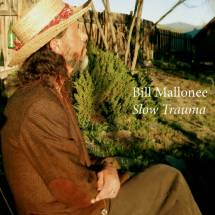
slow traumaBill Mallonee. Slow Trauma. CD $18; download $12.

So let’s touch on that hope and joy—and faith—a bit more. Because while there’s a deepening sense of mortality throughout this, there’s also an almost-constant reminder that life doesn’t end here, and that we can catch glimpses beyond this life even now. In the end, that’s what keeps us going even in this life. We get it all in the same package, good and bad, and a lot of this album is about accepting that truth.

And that truth is nowhere clearer than in the opening invocation, “One and the Same.” It’s probably the shortest song Bill’s ever recorded in 70+ albums, and yet it’s all you need to kick this thing off. Stately, slidy, “hi-strung” (Bill’s term) guitars ease in, as Bill croons in one of the highest vocal registers he’s ever hit:

What you hold onto
and what you let go of
and what you should give away
What’s gonna save you
and what makes you smile?
Sometimes, they are one and the same.

And with that, the Rickenbackers are off and ringing in “Only Time Will Tell,” a song of promise, both future and unfulfilled, about all of us who have ever come west in the hope of a new life: “You got your bonanza towns and turning up the soil / a kind of madness seems to take hold …. / Flash of a coin and we go under the spell / Where’s it all going? Only time will tell.”

From there, the next couple songs steer more strongly into that aforementioned mortality (and just plain human frailty) territory. Waiting for the Stone (to Be Rolled Away)” largely takes place in “the parking lot of the Holy Spirit Assembly / …a beacon in the desert night until the break of day,” and reminds us that “it’s so hard to get clean, and it’s hard to stay that way / Waiting for the stone to be rolled away.” Bill and wife Muriah Rose harmonize together nicely on the next one, the moody, cinematic, and probably self-explanatory “Hour Glass (Only So Many Grains of Sand).”

We get one of those literal Dust Bowl songs next with “WPA (When I Get to Where They’re Taking Us),” the story of a husband/father seeking work who-knows-where for who-knows-how-much: “Tossing you a scrap; throwing you a crust / it’s all ashes to ashes and dust to dust…. / Say good-bye to the family / I promise I’ll write regualrly / When I get to where they’re taking us.”

Just when things start to feel a bit too down, though, things perk back up with “Ironclad,” another song about leaving, but with a wry look at the past and with a better end in mind:

Wind the tape back to the very start
And offer up another broken heart

Georgia never was a place I could call home
Too many paths to navigate with those on the throne
And it’s good to know when to stay & when to flee
Every truth worth learning is right there on the streets.

The soulful, slightly trippy “High-Beam,” arguably my favorite here (but it changes near-daily), continues the threads of self-confession and departure:

My pen? It never went dry
This guitar could always woo
Till my soul my the color of box-car rust
& my heart was big-sky blue

Whatever is heavy as hell
is what you shouldn’t carry….

All this gettin’ born
and these roses & thorns, and the confusing parts
Well, I cobbled a life together with them
just to watch it fall apart.

“Doldrums in Denver” (an Allen Ginsburg reference) brings us back to the moodiness (“and it’s time you leave this town / there ain’t nothin’ for you now”), before looking up—and as way up as the man can muster—for the last couple songs. “The King’s Highway (A New Set of Wheels)” is really the first of two endings. After warning us, “You can go with God, or with a clenched fist,” we’re both cautioned and promised, “The Great Beyond is gonna have to wait another day / But you’ll get a new set of wheels on the King’s Highway…. Could be soon, could be far, but that’s not for me to say.”

And then there’s the official closer, “One Last Hill.” In it, Bill’s looking, praying for a longer glimpse of that Great Beyond, and hoping, praying that he’ll get it—even as he glimpses in the rear-view mirror at a past he’d wished had gone better in so many ways:

You know, it’s funny how things can get so damn misplaced
Where you bet your farm & where you place your faith…

Will the Gatekeeper know my name?
Will there be Someone to claim me for his own?…

Lord, gather me unto Thyself
when my wayward heart grows still
I just wanna see over that last hill.

And that’s something we should all be able to appreciate. So hit that link by the album cover above, and get appreciating.

Posted in Uncategorized | Tagged , , , , | Leave a comment

Pick It Up—Put It On—Walk It Out: a small-group session


For this session, you’ll need….

  • 1 old, beaten-up jacket and one new jacket, for every four to six people. The older and smellier your old jacket is, the better—but not so bad that people would get dirty just putting it on! (Know any mechanics or landscapers who’d loan you their jackets for the day/evening?) Pair up your jackets, and leave them in an open area where everyone will be able to easily access them.
  • a plan to worship
  • a plan to celebrate. However you want to handle this is up to you; perhaps you even want to have a separate session for this. But make plans to celebrate together what God’s been doing in your midst over the last several weeks.

Laying Down Your Day (15 minutes)

It’s our final session of this study—thanks for coming! I know you’ve just arrived and gotten comfortable, but I’m going to ask you to put on coats anyway—the coats you see over there.

Have your group gather into groups of four to six by each pair of coats.

Everyone should try on the old jacket first. But don’t just put it on and take it off again—get comfortable with it. Take a whiff of it; get a feel for where it’s been.

Put on one of the dirty jackets; show everyone how it’s done.

Once you’ve done that, pass it on to the next person to try on, while you go ahead and try on the new jacket. Again, leave it on for a few moments—get a feel for where this jacket hasn’t been yet, and what kind of person might wear it.

Pass on your dirty jacket to the next person, and repeat your actions with the new jacket. Once everyone’s had a chance to try on both jackets, bring the group back together. Discuss:

  1. Which jacket felt better while trying it on? Why?

Ask for one or more volunteers to read Colossians 3:1–16, then discuss:

  1. How was trying on and taking off each jacket like the taking off of the “old self” and the putting on of the “new self” that Paul describes here? How is it different?


Ask for another volunteer to read the following passage from Day 4. Then, discuss the question that follows.

Our natural “old” experience is life and death, and that experience extends to everything else in this life. The new resurrection life is life and life only.… Gaining this perspective on our lives on earth changes everything, and frees us to become more like the Savior we profess to follow.

  1. When have you experienced this truth? Or, put another way: How does “put[ting] on the new self” (Colossians 3:9) free us to “seek the things that are above” (v. 1)? Share from your own experience. 

Laying Down the Word (20 minutes)

Read Hebrews 12:1–15 as a group, letting each member read at least one verse each. It’s OK to let the same person read the opening and closing verses, but make sure everyone gets a turn.

Let’s connect this passage with how we’ve experienced this study, and discuss these questions together:

  1. Describe the flow of this passage. How does it start, where does it go to, and where does it end?


  1. Let’s apply that flow to ourselves now. On a personal level, how has the laying down of your life and your pursuit of Jesus—and the disciplines you’ve undertaken in order to do that—already begun to produce “the peaceful fruit of righteousness” in you? Share a little about that.


  1. How has that, in turn, enabled you to “ [s]ee to it that no one fails to obtain the grace of God”? In order words, how has this study helped you to help others to “lay it down”? Again, share how God’s been able to use you in this capacity.


Have a volunteer read the following passage from “Pick Up Your Cross,” and then discuss the question that follows:

“Your life is no longer yours. Stop behaving as if it is. You cannot force God to lead you into the next phase of your life. You can renounce all you have and entrust your life to him, move when he tells you to move, and rejoice that he considered you worthy to be trusted with anything. Pick up your cross. Consider yourself dead to sin and alive in Jesus. And truly begin to follow the One who carried your cross before you were even born.”

  1. How are you still wrestling with this idea? Is there fear, a lack of understanding, maybe even an unwillingness to deal with it? Take a step of faith here and be open about what you’re still working through.


Laying Down Your Life (20+ minutes)

Get into your pairs one more time. Give everyone time to reassemble.

We’ve spent a lot of time this week looking beyond this week. For the next fifteen minutes, I’d like you to do the same thing with your partner(s). Talk about how God’s been speaking to your heart this week, and over the last few months. How has God helped you to better understand what he’s created you for, and what are the next steps you think he’s leading you into?

When you’re done sharing, pray for one another. Don’t be afraid to pray not only about what the other person’s shared, but also about what you’ve been seeing in that other person over the last several weeks. Put together what God’s been showing you with what God’s been showing them. Let’s get started.

Bring your group back together after fifteen minutes. Ask for a few volunteers to share what God’s been showing them—but if more than a few people share, don’t cut if off. Let God have his way.

Afterward, lead your group in prayer, again giving everyone the opportunity to pray. Thank God for your time together—and for the eternal life you look forward to together. Ask God to help each of you to go even deeper into laying down your lives before him, and before others.

Posted in Uncategorized | Tagged , , , , , , | Leave a comment

Repent and Believe… Simple, Right?


There’s a number of things I really like about this book; there’s other things about it that are rather distracting/annoying (and which may or may not be the author’s fault). As such, it’s kind of the epitome of “three-and-a-half stars.” Whether you fall on the four-star side or the three… well, read on….

AndersonNeil Anderson. Becoming a Disciple-Making Church: A Proven Method for Growing Spiritually Mature Christians. 240p., $15.99, Bethany House.

A lot of people will recognize Neil Anderson, and should; his books The Bondage Breaker and Victory over the Darkness, among many others, have helped a lot of people discover how to live out of their identity in Jesus, and in so doing experience deliverance from sin and/or destructive habits and thought processes. A few quotes to give you a bit more of the flavor of this book:

  • “It took me years to realize that people are not in bondage to past traumas; they are in bondage to lies they believe because of the trauma, such as I’m no good. God doesn’t love me. I’ll never measure up. I can’t trust anybody. Essentially, we become prisoners to the lies we believe.”
  • “[A]n African bishop… asked, “Why do you have so much counseling in your country?… In Africa we repent!”
  • “Your old self was (past tense) crucified with Christ. The only proper response to this powerful truth is to believe it. You may be tempted to ask, “What experience must I have in order for this to be true?” We don’t make anything true by our experience [emphasis mine]. We choose to believe what God already accomplished for us and to live accordingly by faith—then it works out in our experience.”

If that sounds like the kind of book you’re looking for, you won’t be disappointed here—especially if you’re unfamiliar with Anderson’s previous work. If you are… well, that leads into my kvetches about this book….

  • From the verso page, it’s apparent that almost everything here is a reworking of material from past books.
  • As the above examples illustrate, this book is really more about deliverance than discipleship. Granted, there’s a relationship between the two, but it was especially disappointing to get to the chapter “A Strategy for Making Reproducible Disciples,” and discover that its centerpiece is a bare-boned outline of Anderson’s Victory Series, basically listing the various studies in the series.
  • Indeed, when it’s not re-presenting old (albeit rich) material, the book often reads like an infomercial for Freedom in Christ Ministries. And again, while I wouldn’t want to discourage anyone from pursuing more of Anderson’s materials—some of which I know is genuinely good stuff—that’s not what I look for from the book I’m actually reading.

That all said, there’s a very basic message here that all of us need to get back to: repent, and believe that Jesus is who He says He is—and that He can do what He says He can do in each of our lives. When that happens, people—and churches—become healthy, fully functional, and growing. And that message, as they say, is not nothing.

Posted in Uncategorized | Tagged , , , , , | Leave a comment

Walk It Out


All of our lives, when lived rightly, are a journey into trust. A few days ago, I mentioned one prayer I’ve been repeatedly lifting up to God. In fact, there’s another particular prayer I’ve been praying for quite a while, and I think (and hope) that the development of this prayer has been reflected in these pages.

At first, and for a long time, it went like this: “Lord, help me to learn to trust you more deeply.” However, over the last several weeks, I’ve felt the need to add this: “…and to become more worthy of your trust.”

This is not about theology, so don’t go there. This is about relationship. I want to know God more deeply, but I have to allow him to know me more deeply. Again, suspend the theology; I know God knows me. And yet, I try to hide.

This journey into trust, however, requires me to stop hiding. It requires me to put my sin and my agenda and my fear away, so I can truly experience God’s knowing of me—that my relationship with God might be truly intimate and not just “all in order.”

The fact is, both parts of this prayer are flip sides of the same problem—there’s only one person in this equation who can’t be trusted. However, my own untrustworthiness feeds my inability to trust God. Only as I begin to obediently walk out what God’s commanded do I begin to, in turn, feel as if I can trust God with every part of my life. God doesn’t condemn me; he forgives me and wants me to be better.

This isn’t just for me. At the same time that I need to receive his grace, I need to extend it to others. I need to show genuine pity—not in the sense of “I feel sorry for you,” but in the sense of “I ache for you and want to help you.” Because that’s the kind of pity Jesus has shown to me.

As we’ve observed repeatedly this week, we know the way to where Jesus is going. It’s time to walk it out.

We are called to be a blessing to every person we meet, whether they realize it or not. The only way to become that blessing is to be emptied of our own stuff, so that God can fill and transform us into the individuals he has created us to be. Each of our lives need to move from being of Christ to being in Christ—and finally to the point where our life “is Christ” (Philippians 1:21, et al.).

Love is union—with Jesus and with those he’s called us to love. We as Christians—or, as C.S. Lewis put it, “little Christs”—are called to reconcile the world to God. We’re not just here waiting to be taken from the world, but to begin bringing a foretaste of the kingdom of heaven to the world now, even as we are “in the world but not of it” (see John 17:15–16).

We cannot change the things, or the opportunities, that we’ve lost, but we can be prepared to receive and walk in the new things God has created us to do. We are new creations. God is still creating something new within us. God wants to bring us into something new. But we must want what God wants—not just something new.

Therefore, since we are surrounded by so great a cloud of witnesses, let us also lay aside every weight, and sin which clings so closely, and let us run with endurance the race that is set before us, looking to Jesus, the founder and perfecter of our faith, who for the joy that was set before him endured the cross, despising the shame, and is seated at the right hand of the throne of God. Consider him who endured from sinners such hostility against himself, so that you may not grow weary or fainthearted…. Therefore lift your drooping hands and strengthen your weak knees, and make straight paths for your feet, so that what is lame may not be put out of joint but rather be healed. Strive for peace with everyone, and for the holiness without which no one will see the Lord (Hebrews 12:1–3, 12–14).

One last thing to remember about walking: It’s not always exciting. Sometimes there are breathtaking vistas, and that great feeling of “a second wind.” Sometimes it’s monotonous. Sometimes it’s difficult. Often, it’s just plain tiring. But walking gets you somewhere. If we’re following Jesus, it’s somewhere better.

We can walk in the knowledge that tomorrow will be a good day—and that even if it’s not a good day, experientially speaking, God is working out the events of the day for our good (Romans 8:28). Because his good is our good.

The time to walk out our new lives in Christ is today. So let’s do it. And may God continue to bless you as you lay it all down again each day, for the sake of the One who laid down his life for us.

Lay It Down Today

We’ve approached your next steps from a variety of angles this week. Hopefully, at least one of these approaches has resonated with you. So now, it’s your turn.

If you sense what God is leading you into next, or know you’re already in the midst of it, spend time thanking God for the desire he’s given you, how he’s fulfilling it, and for the desire to keep moving forward. If not, spend time pursuing things with God. “[H]ow much more will your Father who is in heaven give good things to those who ask him!” (Matthew 7:11).

Finally, spend some time thanking God for this journey into trust he’s taken you on over the last few months; and ask him to take you far beyond even where you are now—and into eternity with him.

Posted in Uncategorized | Tagged , , , , , | Leave a comment

Put on Eternity


If then you have been raised with Christ, seek the things that are above, where Christ is, seated at the right hand of God. Set your minds on things that are above, not on things that are on earth… seeing that you have put off the old self with its practices and have put on the new self, which is being renewed in knowledge after the image of its creator (Colossians 3:1–2, 9–10).

Those of you in the Northeast might be familiar with the radio ministry of Wayne Monbleau (Loving Grace Ministries); perhaps not. In any case, he ministered heavily to my wife and me twenty-plus years ago, and he’s still going. He’s also written his share of worship songs, and one in particular sticks with me—the epic acoustic hootenanny “Let Heaven Fill Your Thoughts.” Seriously, it’s an eight-minute song that gets more rollicking as it goes along, as it depicts the “family reunion” that awaits us in heaven. But it’s the lines that close out the minor-keyed introduction that still resonate with me on a regular basis:

Let heaven fill up all of your thoughts; keep your mind upon the Lord
Your life right now will seem so small when you think what you will behold
When you’re a thousand—years—old
When you’re a million—years—old
When you’re ten million—years—old.

Obviously it’s a great way of gaining perspective on our lives right now. But I’m beginning to view it even more in terms of what awaits us. An eternity with Jesus awaits us. As we begin to gain a broader and deeper perspective on that, we don’t have to consciously adjust our vision to make our lives “seem so small”—they are that small.

And yet our small lives are seeds that contain this far greater eternal life. By reaching for what lies beyond this life—and bringing it to those around us—we begin to sprout and grow into the life God has intended for us all along.

To be human is to die. Everything around us… ends. That’s why Christ had to become a man, and had to die a human death, in order to reach us and impart eternal life to us. He calls us to do the same. To follow Jesus is to follow him through death and into eternal life. If God allows, we will have the privilege of helping others walk that same ever-beginning path. Indeed, serving others now prepares us to serve God throughout eternity, and softens our hearts so that Jesus himself may continue to serve and guide us. Because that’s what’s in store for us:

Therefore they are before the throne of God, and serve him day and night in his temple; and he who sits on the throne will shelter them with his presence…. For the Lamb in the midst of the throne will be their shepherd, and he will guide them to springs of living water, and God will wipe away every tear from their eyes (Revelation 7:15–17).

When all is said and done, what will I have to show at the day of judgment? I watered some seeds, helped plant a few trees, and did a whole lot more not worth discussing. Millions, maybe even billions, will have more to show, and go on to greater rewards. And I should rejoice in that, because God’s work was accomplished. More importantly, I will rejoice that one day I will no longer be unknowingly in God’s presence, buried under my own sins and those of the world around me—or often at best, mentally acknowledging a presence I cannot quite feel. “For now we see in a mirror dimly, but then face to face. Now I know in part; then I shall know fully, even as I have been fully known” (1 Corinthians 13:12).
Our natural “old” experience is life and death, and that experience extends to everything else in this life. The new resurrection life is life and life only. We are just passing through…

…not having received the things promised, but having seen them and greeted them from afar, and having acknowledged that they were strangers and exiles on the earth. For people who speak thus make it clear that they are seeking a homeland. If they had been thinking of that land from which they had gone out, they would have had opportunity to return. But as it is, they desire a better country, that is, a heavenly one. Therefore God is not ashamed to be called their God, for he has prepared for them a city (Hebrews 11:13–16).

Gaining this perspective on our lives on earth changes everything, and frees us to become more like the Savior we profess to follow. Remember, we “know the way to where [Jesus] is going” (John 14:4). Eternal life starts now. So let’s get ready to walk it out….

Lay It Down Today

Let’s begin practicing our ministry to God right now. For the next twenty-four hours, commit to praying every half-hour. If you need a reminder, set an alarm or create an Outlook event, and keep putting it to sleep. It doesn’t need to be a long or complex prayer—in fact, it could be a one-sentence prayer such as, “Lord, help me to desire what you desire, and to meet those needs in your strength.” Just pray faithfully and repeatedly throughout your day. See what God brings to your attention as a result—and ask him what he wants you to do about it.

Posted in Uncategorized | Tagged , , , , , | Leave a comment

Put on Your New Self


Whatever we truly do for God, it is Christ in us. Whatever holiness we have is not ours to take credit for, but Christ’s to be glorified with. Even then, it is not what Christ does, but who Christ is—and how he is being formed in us.

Slowly, we are becoming the people God created us to be. Slowly, the new life Christ has in us is growing outward. However, it’s not all about waiting for things to happen. We can begin, even now, to put on our new identities in Christ, even as we wait to mature enough to “fill out the suit.”

In my Father’s house are many rooms. If it were not so, would I have told you that I go to prepare a place for you? And if I go and prepare a place for you, I will come again and will take you to myself, that where I am you may be also. And you know the way to where I am going (John 14:2–4).

When we look to Jesus, we “know the way to where [he] is going,” and consciously turn ourselves in that direction. As we look to Jesus, we see One who “emptied himself, by taking the form of a servant, being born in the likeness of men” (Philippians 2:7), but who nonetheless was in constant communion with God. It is simultaneously putting the flesh to death and living entirely for the Father. This can become our increasing reality—not perfectly, but intentionally, and progressively better. We position ourselves, we put on the new self that’s already ours—and as we do, the Spirit empowers us.

Because he is the New Man, Jesus looks at even the most common things in godly terms, and by doing so transforms them into lessons, parables, teaching instruments… temporal things capable of conveying eternal life. In doing so—and because we remain connected with him—he continually shows us how to follow him as human beings. We become people capable of conveying eternal life.

We are no longer—check that: never were—self-appointed experts, no matter what the world tells us. We are God’s children, whom God increasingly entrusts with the fullness of his life so that the other kids can see it. In the words of Thomas Merton, “We do not want to be beginners. But let us be convinced of the fact that we will never be anything else but beginners, all our life!”

There is so much God has for us next, and our perspective and our actions need to change to reflect that. We need to take those steps of faith that will allow the Spirit to change our perceptions and our actions—so that we faithfully and intentionally put ourselves in places where only God can work.

We have not been left alone to figure out how to follow him. “But when the Helper comes, whom I will send to you from the Father, the Spirit of truth, who proceeds from the Father, he will bear witness about me. And you also will bear witness, because you have been with me from the beginning” (John 15:26–27).

It’s a common misconception that walking in the Spirit invites abuse. The fact is: It’s the counterfeits of walking in the Spirit that invite the abuse, not the real thing. If we are truly in Christ, it will be impossible to go out into left field. Christ takes care of us, and the Spirit “will guide you into all the truth” (John 16:13).

When in doubt, give yourself this test: Is what I’m experiencing helping me love God more, and love others more—or just helping me to love myself and my experiences more?

Our new lives in Christ bear fruit by abiding, not merely by doing (John 15:4–10). We are to pass along the life God’s given us, in the ways he’s given it to us, not manufacture something “to please God”—which doesn’t. It’s possible that God will honor our intent, and yet the works themselves will be “wood, hay, straw… and the fire will test what sort of work each one has done” (1 Corinthians 3:12–13). Isn’t it better to pass on the things you know God’s given you?

Receive the new identity you’ve been given in Christ, and cover yourself in it like it’s armor—because it is. Then, get ready to walk forward.

Lay It Down Today

Take as long as you need for this one—it could be a minute; it could be an hour. But get somewhere quiet and repeat the following to yourself: “I am in Christ, and Christ is in me.” Allow some silence between each repetition, but keep repeating this truth until it sinks in.

Then, once you’re “there,” ask yourself: “If Christ is in me, what does Christ want to do through me?” This is not asking, “What would Jesus do?” This is discovering how we are “created in Christ Jesus for good works, which God prepared beforehand, that we should walk in them” (Ephesians 2:10). If you settled on an answer during your activity in “Pick Up Your Cross,” dwell and pray more on it now. If not, dwell and pray anyway; earnestly seek an answer from God, and discover your first steps in making that answer a reality.

Posted in Uncategorized | Tagged , , , , | Leave a comment

Pick Up Your New Life


I have been crucified with Christ. It is no longer I who live, but Christ who lives in me. And the life I now live in the flesh I live by faith in the Son of God, who loved me and gave himself for me. I do not nullify the grace of God, for if righteousness were through the law, then Christ died for no purpose (Galatians 2:20–21).

Transformation comes by taking Jesus’ yoke—by saying, and believing, “I am yours.” We can hear it, and say, “Yeah, that sounds right,” but we need to learn to see it—really see it—as the reality of our lives.

Some of this can sound pretty abstract. But we need it to become as real to us as our salvation has become to us… just as God himself has become real to us, and continues to become more real to us. It’s OK to nod your head in agreement right now, but pursue it with God, and don’t stop. Be able to say with Paul, “I count everything as loss because of the surpassing worth of knowing Christ Jesus my Lord. For his sake I have suffered the loss of all things and count them as rubbish, in order that I may gain Christ” (Philippians 3:8), and mean it.

There is no question as to whether God wants to see revival. Every word here backs that up—God wants us to draw closer to him, and more often than not that’s going to require our hard hearts to be re-broken so that they might also be reopened to him.

The question is: Are we committed to seeing the Spirit bring this? Are we willing to be obedient to what God has called us to, and to who God has called us to be? Are we willing set aside our own self-image, good or bad, and believe that God has something better for us, no matter what package it might initially come in? Most of all, are we willing to obey this command of Jesus, given to us as new creations in him, “that you love one another: just as I have loved you, you also are to love one another. By this all people will know that you are my disciples, if you have love for one another” (John 13:34–35)?

I believe Jesus is talking directly to the church here. Literally, he’s talking to the first apostles, but with the knowledge of what the Spirit would create in their midst only weeks later. Of course this commandment also applies outside the walls of the church, but I fear many of us treat the church (at least in its current state) as a bad idea to be given up on. I get that. Boy, do I get that. But Jesus has not given us that option. We not only have been given new life, but are part of a bigger new life—the Body of Christ.

Given how we’ve done with this commandment inside the church, it’s painfully apparent that we’ll never get it right outside the church until we take off the polite faces and begin truly relating to our fellow Christians in love. Besides: Who’d want to come inside the church until we do?

Those within the church have the same problems as those outside the church. We have the same temptations, and the same sins—a fact the world has no trouble pointing out to us. You’ve read all this, probably as a believer. I’ll bet you’ve identified with a lot of what I’ve talked about here. Well, guess what? Nonbelievers struggle with (or for that matter, go on blissfully unaware of) all the same things we do.

The only difference between “us” and “them”… is Jesus. Jesus is the only reason we have a new life to talk about. It’s literally all the difference in the world, and beyond.

One way other people will begin seeing that difference is when we actually love those other annoying, flawed—and yes, sinful—Christians. In other words: those people who are like us. If we can pull that one off, how will we fail to love someone with the same problems who doesn’t know Jesus? We want those people to know Jesus, after all. But without love, they’ll never see Jesus in us or through us, let alone beyond us.

Just as we’re here because we’ve recognized Christ as our eternal Savior, we need to recognize him as our Savior, and our life, from moment to moment. Paul David Tripp, in Instruments in the Redeemer’s Hands, observes, “[I]t is impossible to celebrate God’s work of transformation without confessing your need for more. No one is more ready to communicate God’s grace that someone who has faced his own desperate need for it.”

Let God’s work of transformation begin here. And let it spread to the ends of the earth. We have a job to finish. Let’s begin living our new lives in full and get it done.

Lay It Down Today

Look inside your church today—or at least at the Christians you’re still in relation with. How can you serve them in love today, or in the coming week? I’m not asking for a long-term commitment here (although that’d be great); just come up with one thing that breaks your routine, gets you outside your own life, and gets your sharing your new life in Jesus with someone else who has that new life—especially if it’s someone you don’t normally do it with. And watch what the Spirit does with it.

Posted in Uncategorized | Tagged , , , , , , , | Leave a comment

Pick Up Your Cross


Then Jesus told his disciples, “If anyone would come after me, let him deny himself and take up his cross and follow me. For whoever would save his life will lose it, but whoever loses his life for my sake will find it…. For the Son of Man is going to come with his angels in the glory of his Father, and then he will repay each person according to what he has done” (Matthew 16:24–25, 27).

We’ve spent a lot of time in this study laying our lives down, and rightfully so. Our hearts need to be prepared to receive what God has for us, and that means loosening up the soil of our hearts so that we can bear good fruit. After all, as you read repeatedly last week, “A healthy tree cannot bear bad fruit, nor can a diseased tree bear good fruit” (Matthew 7:18).Pick_up_your_Cross

So finally, we move on to the “what he has done” (Matthew 16:27) part—the good fruit our lives have always been meant to bear in Christ. This isn’t about being “missional” (as if that idea were some breakthrough unique to the twenty-first-century church). This is about walking in the realization that “we are his workmanship, created in Christ Jesus for good works, which God prepared beforehand, that we should walk in them” (Ephesians 2:10).

There’s a prayer I’ve started putting before the Lord recently, and it while it sounds a bit odd to our modern ears, I’m betting something like it was a lot more popular even 150 years ago: “Lord, help me to take joy in your commandments.” Because let’s face it: We don’t. We don’t really believe Jesus when he says, “Take my yoke upon you, and learn from me, for I am gentle and lowly in heart, and you will find rest for your souls.” (Matthew 11:29). Instead, we scramble to find ways to serve visibly; without any sense of rest whatsoever. I’m no exception.

If we could just believe that God truly wants our best, then all the fear, all the striving, all the shame—everything we’ve dealt with here—would be a moot point.

Let’s circle back to where we left off in Romans 6—only this time let’s focus on the section we skipped over:

Now if we have died with Christ, we believe that we will also live with him. We know that Christ, being raised from the dead, will never die again; death no longer has dominion over him. For the death he died he died to sin, once for all, but the life he lives he lives to God. So you also must consider yourselves dead to sin and alive to God in Christ Jesus (Romans 6:8–11).

We—are—dead in Christ. Dead to sin. Dead to ambition. Dead to our past. Dead to anxiety.

And yet, we are alive to God in Christ Jesus. Alive to obey. Alive to rejoice in his good work through us. Alive to walk wherever he calls us to, because his calling is sure.

By submitting every piece of our lives to Christ—and at the same time realizing who we truly are in Christ—we’re being prepared to live in the way Jesus has always wanted. Thus, we don’t do works for ourselves—or even to show the world how great Christianity is—but solely to give glory to God. If no-one sees our good works but “[our] Father who sees in secret” (Matthew 6:4, 6, 18), that is enough. And should “[our] light shine before others, so that [others see our] good works and give glory to [our] Father who is in heaven” (Matthew 5:16) it is God’s glory, and it is our joy to see it.

Your life is no longer yours. Stop behaving as if it is. You cannot force God to lead you into the next phase of your life. You can renounce all you have and entrust it to him, move when he tells you to move, and rejoice that he considered you worthy to be trusted with anything. Pick up your cross. Consider yourself dead to sin and alive in Jesus. And truly begin to follow the One who carried your cross before you were even born.

Lay It Down Today

Another way we’ve been preparing to bear good fruit throughout this study has been these daily assignments. Other assignments this week will be smaller, but because this one’s long-term—again, there is life beyond this study—I want you to start thinking about it today.

I’ve asked some form of this question repeatedly. Now I’m going to ask it again: What has God been impressing on your heart—and you’ve been doing nothing about—for way too long? This week, it’s time to start doing something about it.

Get out a piece of paper, and begin writing down ideas. Who do you need to talk to, or what other actions do you need to take, to begin making this happen? You don’t have to know everything—or maybe even anything—except that God’s given you this burden and that it’s time to start dealing with it. Do expect that as you move forward, God will honor your steps of faith and guide you in the ways you need to go.

If this isn’t where you’re at—or you know you’re already where God wants you—spend your time today thanking God for that. Give him the glory for what he’s already doing, and ask him to keep your heart open so that you can continue to respond as he wants, when he wants.

Posted in Uncategorized | Tagged , , , , , , | 1 Comment

Lay Down Your New Life — a small-group session


For this session, you’ll need….

  • A small (or at least cheap), wrapped “re-gift” from/for everyone in your group.regift
  • Note: If you have time, turn your opening experience into a full-blown “white elephant party.” Or do it as prescribed below. The follow-up questions will work either way.

Laying Down Your Day (20 minutes)

As your group members enter, have them place their gifts on a nearby table or on the floor—somewhere they’re easily accessible.

Have everyone grab a gift to start off your session. Once everyone’s taken a gift, open them simultaneously. Have a good laugh, and then discuss:

  1. When have you given a “re-gift”—or been the obvious recipient of one? Either way, how did you feel about giving/receiving it?

Ask for a volunteer to read Matthew 7:7–11. Then, discuss this question:

  1. How do we sometimes treat God’s good gifts like our “re-gifts” here? Be specific, if possible.

Ask for another volunteer to read the following excerpt from “Lay Down Your Crown.” Then, discuss the question that follows:

“Everything we have from God, ultimately, is a gift…. “The earth is the Lord‘s and the fullness thereof” (Psalm 24:1). Why then do we live as if this isn’t true—as if we need to have a contingency plan in case this “God thing” doesn’t work out?”

  1. What’s your response to this question? And again, what does it say about how you regard God’s good gifts?

God has given us many good gifts—not the least of which is new life in him. But he doesn’t give his gifts just for our sakes. They’re meant to be “re-gifted”—to others, and sometimes even back to God himself. This is how gifts become fruits—and as you’ve read this week, that’s what we want to be known by. So let’s dig further into this. 

Laying Down the Word (20 minutes)

Ask for a volunteer to read the following excerpt from “Lay Down Your Dreams.” Then, discuss the questions that follow:

God has often blessed us by giving us the desires of our hearts. The thing about following Jesus, though, is that he keeps us moving…. Moving forward almost always means leaving things behind—even good things… so God can give us something even better—or transform it into something better. However, God often doesn’t show us “the better thing” until we’ve given him what he’s asked us to give him.

  1. When have you experienced this truth?
  2. Tell about a time God prepared you for something, but it meant letting go of something else. Why do you think God wanted you to let that thing go? What were the results?
  3. Why do you think God often doesn’t show us “the better thing” until we’ve given our good gifts back to him?

Ask for a volunteer to read 1 John 3:16–18, and then discuss:

  1. We’ll explore this more next week, but let’s start today: How does laying down our lives—even the good things in our lives—enable us to love others better? Provide an example, if you can.

Laying Down Your Life (20 minutes)

Have everyone get into their pairs. If anyone’s missing, help group members find another pair for the rest of this session. Again, have no more than three people together.

Laying down our lives isn’t easy. But as Jesus did, we do it for the sake of others, that they too can have new life in Jesus. And as we do, God raises us up higher—and closer to him.

You’ve had a lot of stuff to process on your own this week. Therefore, the rest of this session will be devoted to processing it in your pairs (or trios). Take the time to share your answers—and the questions you’re still struggling with—with one another. When you’re done sharing, take the time to pray for one another. Invite God deeper into the process he’s already started in each of you.

Also, set aside a time during the week to touch base with one another, whether that’s phone, e-mail, texting, whatever. Once you’re done, stay quiet until everyone’s had a chance to finish sharing and praying for one another; then, you’re free to leave—or to keep hanging out and sharing together.

  1. How have you responded to your readings from the Sermon on the Mount this week? What’s hit you the hardest, and why?
  2. Reflect also on your “Lay It Down Today” assignment in “Lay Down Your Life.” (Reread Romans 6:3–4, 12–14; 14:7–9, if you need to.) Discuss your answers to the following questions from that assignment:

How is God calling you to be “instruments for righteousness”? What still needs to die for you to fulfill that calling? Where do you need to trust God and just walk, regardless of the consequences? Where do you need to accept that “you are not under law but under grace” and get on with it? 

Again, close your time together in prayer for one another. And may God continue to bless you—and those he puts in your path—as you lay down your lives even further!

Posted in Uncategorized | Tagged , , , , | Leave a comment