Pick It Up—Put It On—Walk It Out: a small-group session


For this session, you’ll need….

  • 1 old, beaten-up jacket and one new jacket, for every four to six people. The older Image result for greasy jacketand smellier your old jacket is, the better—but not so bad that people would get dirty just putting it on! (Know any mechanics or landscapers who’d loan you their jackets for the day/evening?) Pair up your jackets, and leave them in an open area where everyone will be able to easily access them.
  • a plan to worship
  • a plan to celebrate. However you want to handle this is up to you; perhaps you even want to have a separate session for this. But make plans to celebrate together what God’s been doing in your midst over the last several weeks.

Laying Down Your Day (15 minutes)

It’s our final session of this study—thanks for coming! I know you’ve just arrived and gotten comfortable, but I’m going to ask you to put on coats anyway—the coats you see over there.

Have your group gather into groups of four to six by each pair of coats.

Everyone should try on the old jacket first. But don’t just put it on and take it off again—get comfortable with it. Take a whiff of it; get a feel for where it’s been.

Put on one of the dirty jackets; show everyone how it’s done.

Once you’ve done that, pass it on to the next person to try on, while you go ahead and try on the new jacket. Again, leave it on for a few moments—get a feel for where this jacket hasn’t been yet, and what kind of person might wear it.

Pass on your dirty jacket to the next person, and repeat your actions with the new jacket. Once everyone’s had a chance to try on both jackets, bring the group back together. Discuss:

  1. Which jacket felt better while trying it on? Why?


Ask for one or more volunteers to read Colossians 3:1–16, then discuss:

  1. How was trying on and taking off each jacket like the taking off of the “old self” and the putting on of the “new self” that Paul describes here? How is it different?


Ask for another volunteer to read the following passage from “Put on Eternity.” Then, discuss the question that follows.

Our natural “old” experience is life and death, and that experience extends to everything else in this life. The new resurrection life is life and life only. . . . Gaining this perspective on our lives on earth changes everything, and frees us to become more like the Savior we profess to follow.

  1. When have you experienced this truth? Or, put another way: How does “put[ting] on the new self” (Colossians 3:9) free us to “seek the things that are above” (v. 1)? Share from your own experience.


Laying Down the Word (20 minutes)

Read Hebrews 12:1–15 as a group, letting each member read at least one verse each. It’s OK to let the same person read the opening and closing verses, but make sure everyone gets a turn.

Let’s connect this passage with how we’ve experienced this study, and discuss these questions together:

  1. Describe the flow of this passage. How does it start, where does it go to, and where does it end?


  1. Let’s apply that flow to ourselves now. On a personal level, how has your laying of your life and your pursuit of Jesus—and the disciplines you’ve undertaken in order to do that—already begun to produce “the peaceful fruit of righteousness” in you? Share a little about that.


  1. How has that, in turn, enabled you to “ [s]ee to it that no one fails to obtain the grace of God”? In order words, how has this study helped you to help others to “lay it down”? Again, share how God’s been able to use you in this capacity.


Have a volunteer read the following passage from Day 1, and then discuss the question that follows:

Your life is no longer yours. Stop behaving as if it is. You cannot force God to lead you into the next phase of your life. You can renounce all you have and entrust your life to him, move when he tells you to move, and rejoice that he considered you worthy to be trusted with anything. Pick up your cross. Consider yourself dead to sin and alive in Jesus. And truly begin to follow the One who carried your cross before you were even born.

  1. How are you still wrestling with this idea? Is there fear, a lack of understanding, maybe even an unwillingness to deal with it? Take a step of faith here and be open about what you’re still working through.


Laying Down Your Life (20+ minutes)

Get into your pairs one more time. Give everyone time to reassemble.

We’ve spent a lot of time this week looking beyond this week. For the next fifteen minutes, I’d like you to do the same thing with your partner(s). Talk about how God’s been speaking to your heart this week, and over the last few months. How has God helped you to better understand what he’s created you for, and what are the next steps you think he’s leading you into?

When you’re done sharing, pray for one another. Don’t be afraid to pray not only about what the other person’s shared, but also about what you’ve been seeing in that other person over the last several weeks. Put together what God’s been showing you with what God’s been showing them. Let’s get started.

Bring your group back together after fifteen minutes. Ask for a few volunteers to share what God’s been showing them—but if more than a few people share, don’t cut if off. Let God have his way.

Afterward, lead your group in prayer, again giving everyone the opportunity to pray. Thank God for your time together—and for the eternal life you look forward to together. Ask God to help each of you to go even deeper into laying down your lives before him, and before others.

Posted in Uncategorized | Tagged , , , | Leave a comment

A Small Book for the Anxious Heart


It is what it says it is. 🙂 And it’s by an author a few of you will recognize. . . .

A Small Book for the Anxious Heart: Meditations on Fear, Worry, and TrustEdward T. Welch. A Small Book for the Anxious Heart: Meditations on Fear, Worry, and Trust. 192p., $17.99, New Growth Press.
Fear and anxiety are chronic struggles for many people that are only intensifying and increasing. Best-selling author Edward T. Welch shares the comfort and peace of Jesus in fifty brief readings for those who wrestle with fear.

A Small Book for the Anxious Heart is a small but powerful devotional to remind men and women of the encouraging, beautiful words in Scripture to anxious people.

While many books on fear and anxiety exist—promising to help men and women manage their struggles with methods and formulas—this devotional reaches deeper into Scripture, making the Word of God more accessible. Don’t put a Band-Aid on your fear and anxiety; rather, learn to bring your fear to Jesus, relying on his Word.

Posted in Uncategorized | Tagged , , , , , | Leave a comment

Walk It Out  


All of our lives, when lived rightly, are a journey into trust. A few days ago, I mentioned one prayer I’ve been repeatedly lifting up to God. In fact, there’s another particular prayer I’ve been praying for quite a while, and I think (and hope) that the development of this prayer has been reflected in these pages.

At first, and for a long time, it went like this: “Lord, help me to learn to trust you more deeply.” However, over the last several weeks, I’ve felt the need to add this: “. . . and to become more worthy of your trust.”

This is not about theology, so don’t go there. This is about relationship. I want to know God more deeply, but I have to allow him to know me more deeply. Again, suspend the theology; I know God knows me. And yet, I try to hide.

This journey into trust, however, requires me to stop hiding. It requires me to put my sin and my agenda and my fear away, so I can truly experience God’s knowing of me—that my relationship with God might be truly intimate and not just “all in order.”

The fact is, both parts of this prayer are flip sides of the same problem—there’s only one person in this equation who can’t be trusted. However, my own untrustworthiness feeds my inability to trust God. Only as I begin to obediently walk out what God’s commanded do I begin, in turn, tofeel as if I can trust God with every part of my life. God doesn’t condemn me; he forgives me and wants me to be better.

This isn’t just for me. At the same time that I need to receive his grace, I need to extend it to others. I need to show genuine pity—not in the sense of “I feel sorry for you,” but in the sense of “I ache for you and want to help you.” Because that’s the kind of pity Jesus has shown to me.

As we’ve observed repeatedly this week, we know the way to where Jesus is going. It’s time to walk it out.

We are called to be a blessing to every person we meet, whether they realize it or not. The only way to become that blessing is to be emptied of our own stuff, so that God can fill and transform us into the individuals he has created us to be. Each of our lives need to move from being of Christ to being in Christ—and finally to the point where our life “is Christ” (Philippians 1:21, et al.).

Love is union—with Jesus and with those he’s called us to love. We as Christians—or, as C. S. Lewis put it, “little Christs”—are called to reconcile the world to God. We’re not just here waiting to be taken from the world, but to begin bringing a foretaste of the kingdom of heaven to the world now, even as we are “in the world but not of it” (see John 17:15–16).

We cannot change the things, or the opportunities, that we’ve lost, but we can be prepared to receive and walk in the new things God has created us to do. We are new creations. God is still creating something new within us. God wants to bring us into something new. But we must want what God wants—not just something new.

Therefore, since we are surrounded by so great a cloud of witnesses, let us also lay aside every weight, and sin which clings so closely, and let us run with endurance the race that is set before us, looking to Jesus, the founder and perfecter of our faith, who for the joy that was set before him endured the cross, despising the shame, and is seated at the right hand of the throne of God. Consider him who endured from sinners such hostility against himself, so that you may not grow weary or fainthearted…. Therefore lift your drooping hands and strengthen your weak knees, and make straight paths for your feet, so that what is lame may not be put out of joint but rather be healed. Strive for peace with everyone, and for the holiness without which no one will see the Lord. (Hebrews 12:1–3, 12–14)

One last thing to remember about walking: It’s not always exciting. Sometimes there are breathtaking vistas, and that great feeling of “a second wind.” Sometimes it’s monotonous. Sometimes it’s difficult. Often, it’s just plain tiring. But walking gets you somewhere. If we’re following Jesus, it’s somewhere better.

We can walk in the knowledge that tomorrow will be a good day—and that even if it’s not a good day, experientially speaking, God is working out the events of the day for our good (Romans 8:28). Because his good is our good.

The time to walk out our new lives in Christ is today. So let’s do it. And may God continue to bless you as you lay it all down again each day, for the sake of the One who laid down his life for us.

Lay It Down Today

We’ve approached your next steps from a variety of angles this week. Hopefully, at least one of these approaches has resonated with you. So now, it’s your turn.

If you sense what God is leading you into next, or know you’re already in the midst of it, spend time thanking God for the desire he’s given you, how he’s fulfilling it, and for the desire to keep moving forward. If not, spend time pursuing things with God. “[H]ow much more will your Father who is in heaven give good things to those who ask him!” (Matthew 7:11).

Finally, spend some time thanking God for this journey into trust he’s taken you on over the last few months; and ask him to take you far beyond even where you are now—and into eternity with him.

Posted in Uncategorized | Tagged , , | Leave a comment

Rooted (IN)


A journey out of shame and into healing . . .

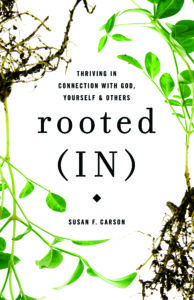
Rooted IN CoverSusan F. Carson. Rooted (IN): Thriving in Connection With God, Yourself, and Others. 240p., $14.99, Deep River Books.
We are all on a journey of becoming who we already are. We are already fully loved, created with intention to live with joy and significance. To thrive in spirit, soul, and body. To live deeply connected with God, with our true selves, and with others.

But something is in the way.

Author Susan Carson says she has experienced it, too—the shame, pain, and disappointments of life leave you isolated and separated from God, your true self, and others. You end up drifting through life outside yourself, longing to experience love and acceptance and grace. . . .

Rooted (IN) is a journey out of shame and into love. The spiritual paths and practices in this book open the way to living rooted and grounded in the love of Christ that heals and restores. Over the last few decades, serving as a Director of Roots&Branches Network, Susan Carson had the honor of praying with hundreds of people. She has learned the only way out of our shame and pain is a journey in.

Rooted (IN) will equip you with the principles and prayerful practices you need to stop being stuck and start living a life full of joy and meaning with your tribe.

Posted in Uncategorized | Tagged , , , | Leave a comment

Put on Eternity    


If then you have been raised with Christ, seek the things that are above, where Christ is, seated at the right hand of God. Set your minds on things that are above, not on things that are on earth… seeing that you have put off the old self with its practices and have put on the new self, which is being renewed in knowledge after the image of its creator. (Colossians 3:1–2, 9–10)

Those of you in the Northeast might be familiar with the radio ministry of Wayne Monbleau (Loving Grace Ministries); perhaps not. In any case, he ministered heavily to my wife and me twenty-plus years ago, and he’s still going. He’s also written his share of worship songs, and one in particular sticks with me—the epic acoustic hootenanny “Let Heaven Fill Your Thoughts.” Seriously, it’s an eight-minute song that gets more rollicking as it goes along, as it depicts the “family reunion” that awaits us in heaven. But it’s the lines that close out the minor-keyed introduction that still resonate with me:

Let heaven fill up all of your thoughts; keep your mind upon the Lord
Your life right now will seem so small when you think what you will behold
When you’re a thousand—years—old
When you’re a million—years—old
When you’re ten million—years—old.

Obviously it’s a great way of gaining perspective on our lives right now. But I’m beginning to view it even more in terms of what awaits us. An eternity with Jesus awaits us. As we begin to gain a broader and deeper perspective on that, we don’t have to consciously adjust our vision to make our lives “seem so small”—they are that small.

And yet our small lives are seeds that contain this far greater eternal life. By reaching for what lies beyond this life—and bringing it to those around us—we begin to sprout and grow into the life God has intended for us all along.

To be human is to die. Everything around us . . . ends. That’s why Christ had to become a man, and had to die a human death, in order to reach us and impart eternal life to us. He calls us to do the same. To follow Jesus is to follow him through death and into eternal life. If God allows, we will have the privilege of helping others walk that same ever-beginning path. Indeed, serving others now prepares us to serve God throughout eternity, and softens our hearts so that Jesus himself may continue to serve and guide us. Because that’s what’s in store for us:

Therefore they are before the throne of God, and serve him day and night in his temple; and he who sits on the throne will shelter them with his presence. . . . For the Lamb in the midst of the throne will be their shepherd, and he will guide them to springs of living water, and God will wipe away every tear from their eyes. (Revelation 7:15–17)

When all is said and done, what will I have to show at the day of judgment? I watered some seeds, helped plant a few trees, and did a whole lot more not worth discussing. Millions, probably billions, will have more to show, and go on to greater rewards. And I should rejoice in that, because God’s work was accomplished. More importantly, I will rejoice that one day I will no longer be unknowingly in God’s presence, buried under my own sins and those of the world around me—or often at best, mentally acknowledging a presence I cannot quite feel. “For now we see in a mirror dimly, but then face to face. Now I know in part; then I shall know fully, even as I have been fully known” (1 Corinthians 13:12).

Our natural “old” experience is life and death, and that experience extends to everything else in this life. The new resurrection life is life and life only. We are just passing through—

. . . not having received the things promised, but having seen them and greeted them from afar, and having acknowledged that they were strangers and exiles on the earth. For people who speak thus make it clear that they are seeking a homeland. If they had been thinking of that land from which they had gone out, they would have had opportunity to return. But as it is, they desire a better country, that is, a heavenly one. Therefore God is not ashamed to be called their God, for he has prepared for them a city. (Hebrews 11:13–16)

Gaining this perspective on our lives on earth changes everything, and frees us to become more like the Savior we profess to follow. Remember, we “know the way to where [Jesus] is going” (John 14:4). Eternal life starts now. So let’s get ready to walk it out. . . .

Lay It Down Today

Let’s begin practicing our ministry to God right now. For the next twenty-four hours, commit to praying every half-hour. If you need a reminder, set an alarm or create an Outlook event, and keep putting it to sleep. It doesn’t need to be a long or complex prayer—in fact, it could be a one-sentence prayer such as, “Lord, help me to desire what you desire, and to meet those needs in your strength.” Just pray faithfully and repeatedly throughout your day. See what God brings to your attention as a result—and ask him what he wants you to do about it.

Posted in Uncategorized | Tagged , , , | 1 Comment

Renovating Your Mind


The renewing of one’s mind, through one person’s process. . . .

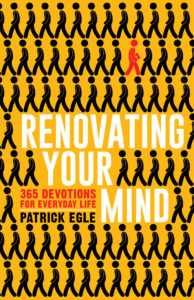
Renovating Your Mind CoverPatrick Egle. Renovating Your Mind: 365 Devotions for Everyday Life. 400p., $15.99, Deep River Books.
Motivated by a desire to strengthen his family’s faith, Patrick Egle decided to share with the members of his family what he had learned from the Bible that day. It was nothing extensive or theologically profound—just a one-paragraph account of how the Lord had spoken to Patrick through His Word. It was from sharing that initial paragraph that Renovating Your Mind came to be.

This book is a collection of those same morning devotions, journaling an average man’s walk with a supernatural God through everyday life situations. These devotions were not written while sitting behind a desk, detached from the realities and struggles of this life. In Renovating Your Mind, experiences are chronicled in detail, challenging readers to alter their thinking that they might be transformed more into the image of Christ by the renewing of their minds (Romans 12:2). These devotions encourage readers to change their perspective from perception to truth. Through the lens of truth, readers will find the freedom and joy that God has abundantly given us through Christ Jesus our Lord.

Renovating Your Mind is written by a simple, yet divinely inspired layman; easy to understand for every level and denomination of believer. Resisting the temptation towards elegant theological verbiage meant to impress scholars and dumbfound readers, this devotional instead is approachable yet profound. Whether a brand-new Christian, or a seasoned follower of Christ, Renovating Your Mind is sure to challenge its readers to deeply consider its contents, and to develop further their fellowship with Christ.

Posted in Uncategorized | Tagged , , | Leave a comment

Put on Your New Self      


Whatever we truly do for God, it is Christ in us. Whatever holiness we have is not ours to take credit for, but Christ’s to be glorified with. Even then, it is not what Christ does, but who Christ is—and how he is being formed in us.

Slowly, we are becoming the people God created us to be. Slowly, the new life Christ has in us is growing outward. However, it’s not all about waiting for things to happen. We can begin, even now, to put on our new identities in Christ, even as we wait to mature enough to “fill out the suit.”

In my Father’s house are many rooms. If it were not so, would I have told you that I go to prepare a place for you? And if I go and prepare a place for you, I will come again and will take you to myself, that where I am you may be also. And you know the way to where I am going. (John 14:2–4)

When we look to Jesus, we “know the way to where [he] is going,” and consciously turn ourselves in that direction. As we look to Jesus, we see One who “emptied himself, by taking the form of a servant, being born in the likeness of men” (Philippians 2:7), but who nonetheless was in constant communion with God. It is simultaneously putting the flesh to death and living entirely for the Father. This can become our increasing reality—not perfectly, but intentionally, and progressively better. We position ourselves, we put on the new self that’s already ours—and as we do, the Spirit empowers us.

Because he is the New Man, Jesus looks at even the most common things in godly terms, and by doing so transforms them into lessons, parables, teaching instruments . . . temporal things capable of conveying eternal life. In doing so—and because we remain connected with him—he continually shows us how to follow him as human beings. We become people capable of conveying eternal life.

We are no longer—check that: never were—self-appointed experts, no matter what the world tells us. We are God’s children, whom God increasingly entrusts with the fullness of his life so that the other kids can see it. In the words of Thomas Merton, “We do not want to be beginners. But let us be convinced of the fact that we will never be anything else but beginners, all our life!”

There is so much God has for us next, and our perspective and our actions need to change to reflect that. We must take those steps of faith that allow the Spirit to change our perceptions and our actions—so that we can faithfully and intentionally put ourselves in places where only God can work.

We have not been left alone to figure out how to follow him. “But when the Helper comes, whom I will send to you from the Father, the Spirit of truth, who proceeds from the Father, he will bear witness about me. And you also will bear witness, because you have been with me from the beginning” (John 15:26–27).

It’s a common misconception that walking in the Spirit invites abuse. The fact is: It’s the counterfeits of walking in the Spirit that invite the abuse, not the real thing. If we are truly in Christ, it will be impossible to go out into left field. Christ takes care of us, and the Spirit “will guide you into all the truth” (John 16:13). When in doubt, give yourself this test: Is what I’m experiencing helping me love God more, and love others more—or just helping me to love myself and my experiences more?

One more thing: our new lives in Christ bear fruit by abiding, not merely by doing (John 15:4–10). We are to pass along the life God’s given us, in the ways he’s given it to us, not manufacture something “to please God”—which doesn’t. It’s possible that God will honor our intent, and yet the works themselves will be “wood, hay, straw . . . and the fire will test what sort of work each one has done” (1 Corinthians 3:12–13). Isn’t it better to pass on the things you know God’s given you?

Receive the new identity you’ve been given in Christ, and cover yourself in it like it’s armor (because it is; Ephesians 6:11). Then, get ready to walk forward.

Lay It Down Today

Take as long as you need for this one—it could be a minute; it could be an hour. But get somewhere quiet and repeat the following to yourself: “I am in Christ, and Christ is in me.” Allow some silence between each repetition, but keep repeating this truth until it sinks in.

Then, once you’re “there,” ask yourself: “If Christ is in me, what does Christ want to do through me?” This is not asking, “What would Jesus do?” This is discovering how we are “created in Christ Jesus for good works, which God prepared beforehand, that we should walk in them” (Ephesians 2:10). If you settled on an answer during your activity in Day 1, dwell and pray more on it now. If not, dwell and pray anyway; earnestly seek an answer from God, and discover your first steps in making that answer a reality.

Posted in Uncategorized | Tagged , , | Leave a comment

Text of the Earliest New Testament Greek Manuscripts


And for those of you who have the Greek (and financial) wherewithal to go to the original sources. . . .

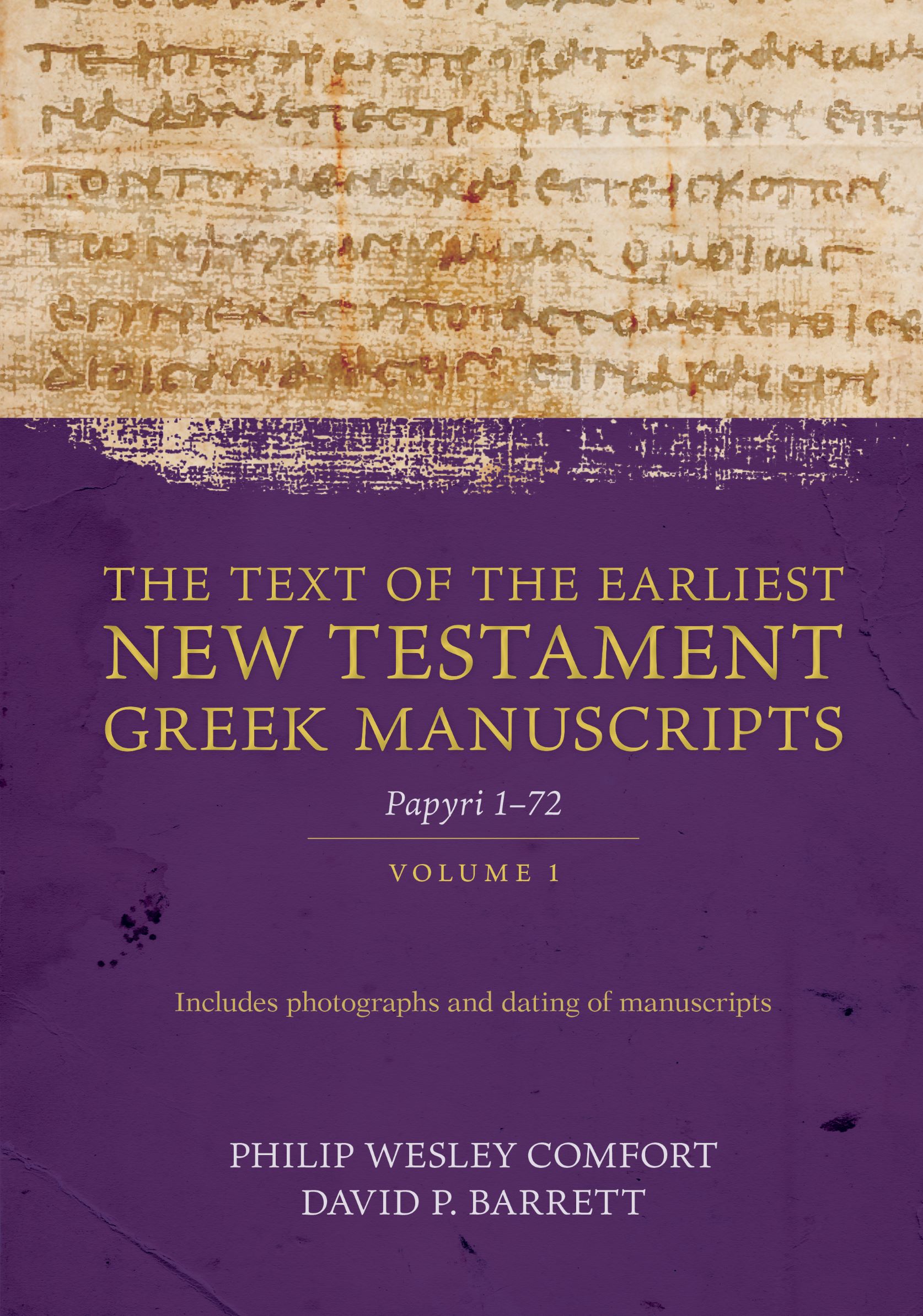
The Text of the Earliest New Testament Greek Manuscripts, Volume 1Philip Wesley Comfort and David P. Barrett, eds. The Text of the Earliest New Testament Greek Manuscripts. Volume 1: Papyri 1–72, Volume 2, Papyri 75–139 & Uncials,; each 528p., $39.99. Kregel Academic.
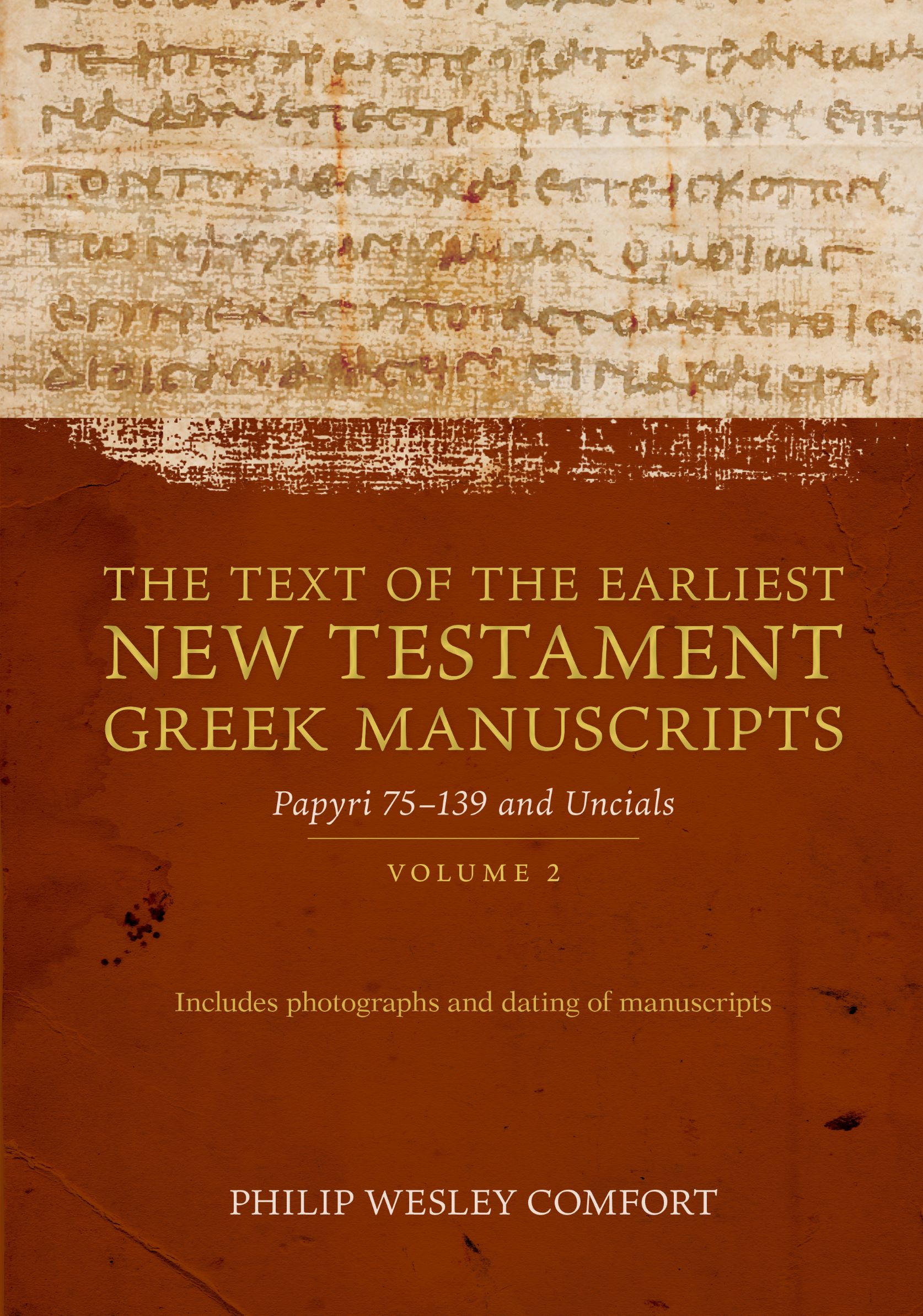
The Text of the Earliest New Testament Greek Manuscripts, Volume 2The manuscripts that form the Greek New Testament are scattered throughout the world and are usually only accessible to scholars and professionals. These were the manuscripts read by the earliest Christians, which comprised their “New Testament.” In his volumes, Philip Wesley Comfort bridges the gap between these extant copies and today’s critical text by providing accurate transcriptions of the earliest New Testament manuscripts, with photographs on the facing pages so readers can see the works for themselves.
Comfort also provides an introduction to each manuscript that summarizes the contents, date, current location, provenance, and other essential information, including the latest findings. This allows students and scholars to make well-informed decisions about the translation and interpretation of the New Testament.  . . . In addition, Volume 2 features a special section on determining the date of a manuscript.

Posted in Uncategorized | Tagged , | Leave a comment

Pick Up Your New Life   


I have been crucified with Christ. It is no longer I who live, but Christ who lives in me. And the life I now live in the flesh I live by faith in the Son of God, who loved me and gave himself for me. I do not nullify the grace of God, for if righteousness were through the law, then Christ died for no purpose. (Galatians 2:20–21)

Transformation comes by taking Jesus’ yoke—by saying, and believing, “I am yours.” We can hear it, and say, “Yeah, that sounds right,” but we need to learn to see it—really see it—as the reality of our lives.

Some of this can sound pretty abstract. But we need it to become as real to us as our salvation has become to us . . . just as God himself has become real to us, and continues to become more real to us. It’s OK to nod your head in agreement right now, but pursue it with God, and don’t stop. Be able to say with Paul, “I count everything as loss because of the surpassing worth of knowing Christ Jesus my Lord. For his sake I have suffered the loss of all things and count them as rubbish, in order that I may gain Christ” (Philippians 3:8), and mean it.

There is no question as to whether God wants to see revival. Every word here backs that up—God wants us to draw closer to him, and more often than not that’s going to require our hard hearts to be re-broken so that they might also be reopened to him.

The question is: Are we committed to seeing the Spirit bring this? Are we willing to be obedient to what God has called us to, and to who God has called us to be? Are we willing set aside our own self-image, good or bad, and believe that God has something better for us, no matter what package it might initially come in? Most of all, are we willing to obey this command of Jesus, given to us as new creations in him, “that you love one another: just as I have loved you, you also are to love one another. By this all people will know that you are my disciples, if you have love for one another” (John 13:34–35)?

I believe Jesus is talking directly to the church here. Literally, he’s talking to the first apostles, but with the knowledge of what the Spirit would create in their midst only weeks later. Of course this commandment also applies outside the walls of the church, but I fear many of us treat the church (at least in its current state) as a bad idea to be given up on. I get that. Boy, do I get that. But Jesus has not given us that option. We not only have been given new life, but are part of a bigger new life—the body of Christ.

Given how we’ve done with this commandment inside the church, it’s painfully apparent that we’ll never get it right outside the church until we take off the polite faces and begin truly relating to our fellow Christians in love. Besides: Who’d want to come inside the church until we do?

Those within the church have the same problems as those outside the church. We have the same temptations, and the same sins—a fact the world has no trouble pointing out to us. You’ve read this, probably as a believer, and I’ll bet you’ve identified with a lot of what I’ve talked about here. Well, guess what? Nonbelievers struggle with (or, go on blissfully unaware of) all the same things we do.

The only difference between “us” and “them” . . . is Jesus. That’s it, but that’s everything. Jesus is the only reason we have a new life to talk about. It’s literally all the difference in the world, and beyond.

One way other people will begin seeing that difference is when we actually love those other annoying, flawed—and yes, sinful—Christians. In other words: those people who are like us. If we can pull that one off, how will we fail to love someone with the same problems who doesn’t know Jesus? We want those people to know Jesus, after all. But without love, they’ll never see Jesus in us or through us, let alone beyond us.

Just as we’re here because we’ve recognized Christ as our eternal Savior, we need to recognize him as our Savior, and our life, from moment to moment. Paul David Tripp, in Instruments in the Redeemer’s Hands, observes, “[I]t is impossible to celebrate God’s work of transformation without confessing your need for more. No one is more ready to communicate God’s grace that someone who has faced his own desperate need for it.”

Let God’s work of transformation begin here. And let it spread to the ends of the earth. We have a job to finish. Let’s begin living our new lives in full and get it done.

Lay It Down Today

Look inside your church today—or at least at the Christians you’re still in relation with. How can you serve them in love today, or in the coming week? I’m not asking for a long-term commitment here (although that’d be great); just come up with one thing that breaks your routine, gets you outside your own life, and gets your sharing your new life in Jesus with someone else who has that new life—especially if it’s someone you don’t normally do it with. And watch what the Spirit does with it.

Posted in Uncategorized | Tagged , , | Leave a comment

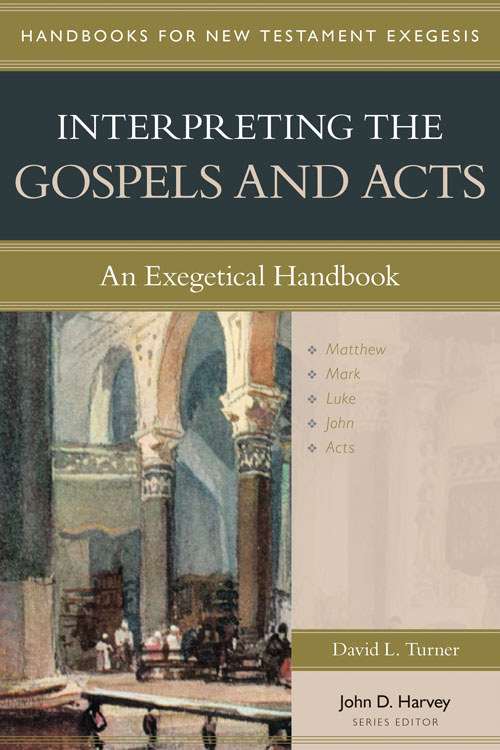
Interpreting the Gospels and Acts


Another one for all you exegetes in the audience. . . .

Interpreting the Gospels and ActsDavid. L. Turner. Interpreting the Gospels and Acts. Handbooks for New Testament Exegesis. 368p., $36.99, Kregel Academic.

In this final volume of the Handbooks for New Testament Exegesis series, David Turner provides a comprehensive guide for interpreting and conveying the lives of Jesus and his early followers. Key background information such as literary genres, historical setting, and theological themes lay the groundwork for properly reading these five books. This is followed by practical guidance on textual issues and original-language exegesis passages from the Gospels and Acts. The final chapter offers an extensive bibliography of books and digital resources useful for instructors, students, and church leaders alike. Interpreting the Gospels and Acts is an essential resource for anyone teaching and preaching these foundational books.


Posted in Uncategorized | Tagged , , , | Leave a comment