
Biblical wisdom literature is the place where the human soul most palpably encounters God. Sorrow encounters joy. Praise encounters despair. Hardness of heart encounters worship. And true to its subtitle, this book is a very worthy introduction to all of it.
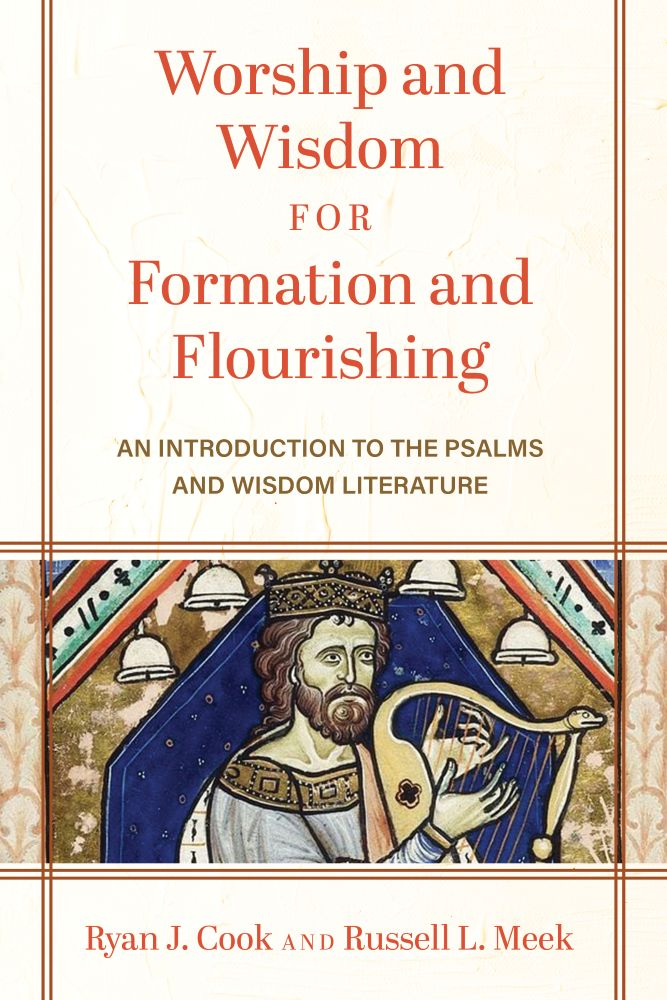
Ryan J. Cook and Russell L. Meek. Worship and Wisdom for Formation and Flourishing: An Introduction to the Psalms and Wisdom Literature. $192p., $24.99, Kregel Academic.
Don’t let rest of the subtitle mislead you, though—the non-Psalms wisdom literature are nowhere near an afterthought. The Psalms do get two chapters—understandable given their breadth and influence—but each of the other (non-apocryphal) wisdom books of the Bible (i.e., Proverbs, Job, Ecclesiastes, and Song of Songs) are given their own chapter. The overall tone is what I’d call “introductory academic”—there’s plenty of finer scholarly points to be had for those looking for them, but the book as a whole is eminently readable and insightful.
Before getting into the books themselves, the authors take a step back in the initial chapter to give readers a better understanding and appreciation of the purpose, structure, and especially the figurative language they’ll encounter throughout the wisdom literature of the Bible. Figurative language has a way of catching us off-guard, for our own good, to “fool us into sense” in a way that simple descriptions can’t. And yet, as the authors point out, “Almost all ancient poetry had pragmatic goals. In addition to expressing emotion, ancient poetry was written . . . to express lament, praise, and thanksgiving; to instruct, warn, and admonish; and to persuafe, celebrate, and reflect. The poetry in these books is used in practical ways that impact our relationship with God and our neighbor.”
My favorite chapter is the one on Job, “God of the Vending Machine” (although I’m pretty sure the authors would have wanted me to like the Ecclesiastes one more, given its more unique central thesis which you can discover for yourself). “God of the Vending Machine” addresses the misconceptions of both Job’s friends (through their accusations) and of Job himself (through his protestations of innocence)—and thus own own misconceptions—about making absolutes out of God’s “retributive justice.” As the chapter makes clear, God works on us primarily through relationship—made even clearer by the fact that Job’s friends are told directly by God that they spoke wrongly of him to Job, whereas Job appeals to God, and gets a response, in spades (even if it wasn’t the one he was seeking).
The final chapter brings it all together. Reviewing each of the wisdom books once more, the authors then pose the question(s): Why are all these books in the Bible? What is the theme that holds it all together? Again, in a word: relationship—with God and others in prayer and worship (Psalms), in practical decision-making and human interactions (Proverbs), in suffering (Job), in everyday injustice (Ecclesiastes), and in love and, yes, sexuality (Song of Songs). “Yahweh is God and seeks relationship with humans.”
Thus, wisdom literature—and this book—helps us to get our heads on straight and gives us ways to seek that relationship.


