Lay Down Your Triggers: a small-group session


The pre-reading for this (should you choose to do so) is easy—just scroll down, then work your way back up. The relevant entries are as follows:

Lay Down Your Circumstances
Lay Down Your Ambition
Lay Down Your Boundaries
Lay Down Your Weakness
Lay Down Your Self-Consciousness 

For this session, you’ll need….

• a DVD of the movie Fried Green Tomatoes. (Note: You can still have the discussion without viewing the clip, but it’s a good way to set the mood/get everyone relaxed.) Cue the movie to 1:21:02 (DVD Chapter 27), where Evelyn is cruising into the parking lot.

• a 6-8’ strip of masking tape. Before your session, place your tape strip across the floor of your meeting area. Make sure there’s room both in front and in back of your tape strip.

Laying Down Your Day (10 minutes)

Watch your scene from Fried Green Tomatoes; stop the DVD at 1:23:08, where the two young women are left dumbfounded and crying. Then discuss the following questions:

1. How do you normally react when you’re irritated? How long do you hold onto your reactions afterward?

2. What’s one circumstance or behavior that truly “sets you off”? How do you react? Why do you think that particular circumstance or behavior sets you off?

Ask someone to read the following:

“Our circumstances reveal who we are and what we really trust. The situations we face each day—especially the bad ones—tend to bring out what we’re made of, whether we want them to or not. We may be shocked by what our circumstances reveal about us, but God isn’t. And He wants us to stop being shocked, too, and instead put our trust in Him rather than ourselves to get through them.”

Then say something like: We all have our triggers—things that upset us, anger us, or make us anxious or fearful. They might be trivial, or they might be so serious that we feel justified in the things we say and do as a result. But all of these triggers indicate places where we need to develop a deeper trust in God and in the work He’s doing in our lives. Let’s look further into that.

Laying Down the Word (30 minutes)

Ask for one or two volunteers to read the following excerpt. Then discuss the questions that follow:

“Often without even realizing, we place limitations on what God wants to do in our lives, who we’ll reach out to, when we’ll make ourselves available, where we’re willing to go for His sake. And once God’s done laughing at our plans, He gently—or sometimes quite abruptly—pushes us past the boundaries we’ve tried to impose upon His infinite plans for us.

“It’s OK to realize how insufficient we are, or for that matter how truly little we love the people around us. God already knows it. But it’s not OK to resist God’s will because of our insufficiency, as if He won’t provide everything we need to perform His will.”

3. In what ways do you feel you’re unqualified to represent Jesus? Explain.

4. On the other hand, in what ways—or with what kinds of people—do you just not want to represent Jesus? Why?

Have someone read 1 Corinthians 1:26-31. Then discuss:

5. Think again about your answers to questions 3 and 4. How does this passage address the issues you brought up? How should it affect your responses to those situations?

Take turns reading John 17:1-26. (Review the bullet list in “Lay Down Your Self-Consciousness” also, if it’s helpful.) Then, discuss these questions:

6. What has Jesus already done for us? What does He expect us to do with what He’s given us, according to his prayer for us here?

7. Which parts of Jesus’ prayer are easiest for you to receive? Which parts are hard to understand, or maybe even accept? In both cases, why?

Laying Down Your Life (20 minutes)

One of your challenges this week was to find a Christian friend or mentor to whom you can “confess your weakness” and be accountable. You’re still encouraged to find someone to do that with. But for the remainder of this study, we’re also going to do that informally within this group. Let’s take a few minutes right now to stand up and find a partner. Try to pair up with someone you don’t know so well, if possible. Stay standing when you’re done.

Allow up to three minutes for group members to pair up. If people are hesitant to find a partner, help facilitate this as leader. Also, if you have an odd number of people, it’s OK to have a third member, but have no more than three people together. Read the entire italicized piece that follows:

In your pairs (or triads), read Matthew 18:18-20 and James 5:13-16. Then discuss between yourselves:

8. What promises do you find in these passages?

9. Where do you most need to take hold of those promises in your life right now? Put another way: What “triggers” do you most need God’s help in overcoming right now? 

When you’re done reading and talking, pray for one another about what you’ve shared. Also, set aside a time each week when you can touch base with one another, whether that’s in person, by phone, e-mail, texting, whatever. Again, from now until this study is over, these people are your partners in growing together, so let’s get started.

Give pairs 15 minutes to talk and pray, and then bring your group back together, keeping them standing in their pairs. Guide them to the masking-tape line you set up before your session. Have one of your pairs step up to the line, then say something like:

Think again about what you’ve just shared together over the past 15 minutes. Then, think of our tape line as those triggers you’ve shared about—the ways you’ve restricted yourself from stepping in what God has for you next. Take a moment to quietly reflect on that together, and how you can help each other get past that boundary you’re each facing right now. Then, when you’re ready, cross over our line together. You don’t have to hold hands or anything—unless you want to.

Give each pair (or triad) time to reflect and cross over; maybe even give them each a round of applause as they start this commitment together. Close your time together in prayer, saying something like:

Lord, we thank You that You bring people and situations into our lives to help us grow. Help us to begin seeing the people You’ve paired up with in that way. Help us to learn from each other… to inspire each other… to pull each other up. And help us to be faithful in finding ways to connect with each other outside of our time here. We thank You in advance for what You’re going to do with these spiritual friendships You’re creating between us, and we ask Your blessing upon us in Jesus’ name. Amen.

Posted in Uncategorized | Tagged , , , , , , , , | Leave a comment

Naming and Un-claiming Your Idols


“So much of life comes down to the following three questions,” says Ed Welch: “Who is God? Who am I? Who are these other people?” The answers to those questions reveal what we truly care about and who we trust, and because of that, those answers often aren’t pretty. The good news is, those answers also reveal to us the exact places where God wants to work in our lives, and thus Welch provides us with a workbook  to get us started.

Edward T. Welch. What Do You Think of Me? Why Do I Care? Answers to the Big Questions in Life. 152p., $12.99, New Growth Press.

Although each question gets its own section, Welch walks us through each of the big three questions together over and over, and as a result turns up more heart-idols than we’d like to deal with. Just one example: “I see resentment that I have toward… more people than I thought. Who am I? I am a god. Who are other people? They live to serve me. Who is God? Someone I hope will leave me alone so I can judge these people and feel good about it. When it comes to resentment, I want to be God.”

It’s a honest process, and certainly for one taking it seriously it’s a hard process. But it’s not an unbearable one. “Don’t be intimidated by the process…” Welch assures us. “The truth is, the more you plunge into your heart, the murkier everything looks. But remember, you are doing this with the God who loves you. He doesn’t love you because you accurately see the false worship in your heart…. As one expression of that love, his Spirit will show you where your desires have led you astray, and the Spirit will lead you back to Jesus Christ.”

The point of all this, he says, is not only to think less of ourselves but to realize that we can never outlove God, and as a result be freed “to love more than you need love.” If we are royalty as the Bible says, we don’t need to strive to be loved; we can just love, secure of our knowledge of who we are in Christ. Everyone we know has the opportunity to become friends and family, if we just stop worrying so much about their perceptions of us and simply be ourselves, and become more and more who we’re created to be in Christ.

The interactive set-up of the book is also very helpful. Throughout, Welch poses questions for the reader to consider, then leaves room for us to answer. In fact, debriefing the chapters in a small-group setting would work well, given this format. All it takes is a group honest enough to let God deal with its failures. As you do so—either individually or as a group—you’ll learn to develop the “rhythm of change” in your lives. Welch makes that process understandable, accessible, and desirable.

Posted in Uncategorized | Tagged , , | 1 Comment

Lay Down Your Self-Consciousness


Today’s devotional is noticeably longer—and for that matter, noticeably ornerier—than usual. If you disagree with my opening views, or at least feel I could be a bit kinder, fine. But bear with me, and try to hear the point behind the point, because the more important issue will be bringing up the rear:

There’s a huge preoccupation in the American church right now with cultural relevance—which, in many cases, could just as easily be read as “being indistinguishable from the rest of the world” and/or “becoming as inoffensive to non-Christians as possible.” To be sure, there are plenty of actions the church needs to repent of, and opinions it’s formed in response to previous cultural norms that need to be rethought in the light of eternity. But let’s be honest: Much of the incessant hand-wringing about how Christianity is perceived by those outside it has far more to do with how non-Christians perceive us than how they see Jesus. Thomas Merton said it much better than I could, and 50 years earlier:

One of the symptoms of this is precisely the anguished concern to keep up with an ever-changing, complex, and fictitious orthodoxy in taste, in politics, in cult, in belief, in theology and what not, cultivation of the ability to redefine one’s identity day by day in concert with the self-definition of society. “Worldliness” in my mind is typified by this kind of servitude to care and to illusion, this agitation about thinking the right thoughts and wearing the right hats, this crude and shameful concern not with truth but only with vogue. To my mind, the concern of Christians to be in fashion lest they “lose the world” is only another pitiable admission that they have lost it. (Conjectures of a Guilty Bystander, emphasis mine)

Certainly we’re called to love others regardless how deeply we disagree with their lifestyle or opinions, and just as certainly we’re not called to live in a Christian bubble, sheltered from the rest of the world. However, we’re not called to be relevant or hip or tolerant, or even relational or missional—we’re called to follow Jesus. That’s it. We only need to be relevant to Jesus. If we’re doing that, Jesus will send us out into His world in the ways He wants us to go.  That’s what He does. Any cultural relevance we need to have will take care of itself, because Jesus will care of it for us—and because we’ve loved those other people enough to see what they really need in their current circumstances.

So, what does my seemingly off-topic rant above have to do with today’s topic of self-consciousness? A lot, actually. If we’ve learned nothing else this week, we’ve learned that a lot of things can trip us up in our walk with Jesus, even when we’re trying to be “on our best behavior.” Our insufficiency can overwhelm us. Thus, we often feel as if we have no business talking about Jesus, and that we’re just going to tick people off when we do.

But think one more time about our passage in 1 Corinthians 1:26-31. With all our issues—and arguably because of our issues—God chose us to be witnesses who would reveal His glory to the world, through our weakness. We’re the ones who think we have to be perfect or relevant or inoffensive in order for the gospel to be heard through us. God disagrees, and thankfully He disagreed when he chose you, too. In fact, in the words of the late C. Jack Miller, “Cheer up—you’re a lot worse than you think!”

What’s more, the gospel of Jesus Christ is offensive. It declares that we’re all sinners, separated from God, and in need of a Savior. We can’t just skip to “God so loved the world” and ignore our ongoing need to repent—both inside and outside the church. But Jesus is faithful to forgive every one of us who are willing to receive His yoke of obedience to Him, and His love expressed for us on the cross.

Still, we too must be faithful to Jesus. And because He does send us into the world to be light to it, our faith is going to offend people. Sure, our humanness will sometimes get in the way of the gospel. But if we’re truly sharing in humility, and out of love for both Jesus and the other person, more often any offense we cause comes from getting the message right. Many people don’t want to hear the good news—at least initially. But it’s that initial reaction we’re so afraid of. We get so self-conscious about how badly we might screw up—how badly we’re screwed up—that we don’t share our life in Jesus at all. But as we become more conscious of Christ in our lives, we become less conscious of ourselves.

Paul said in Romans 1:16-17: “I am not ashamed of the gospel, for it is the power of God for salvation to everyone who believes… For in it the righteousness of God is revealed from faith for faith, as it is written, ‘The righteous shall live by faith’” (ESV). Live by faith. Trust that when God wants you to speak, the power of the gospel will be there. You are weak. And guess what? In God’s eyes, that makes you uniquely qualified to do His work.

In closing, let’s briefly examine Jesus’ prayer for us in John 17 (or better yet, go read the whole thing now and come back when you’re done). Look at what Jesus prays, and what he prays for:

  • God has been manifested to us through Him (v.6).
  • We have been given the truth (v.7-8, 14).
  • We belong to Jesus, no matter what, and Jesus is glorified by us (v.9-10).
  • We will be hated for belonging to Jesus (v.14).
  • We have been sent into the world, and are not to be removed from it (v.15-18).
  • Jesus prayer is for all who will believe in Him through His word (v.20).
  • We are to manifest God’s glory, so that the world will know the one who sent us (v.22-23).
  • Jesus knows the Father, and because He does, so do we. Not only that, but Jesus will continue to make the Father known to us (v.25-26).

All these things are non-negotiable. Jesus has told us everything we need to know at this moment in our lives, and given us everything we need to carry out His will in this moment. Do you believe that?

We know when God has spoken to us, yet we often lack confidence that this Word of God is truly enough for others. Here’s a test: When placed in a situation when it’s time to share what God’s given you, share that word and only that word. Then—and I say this as respectfully as possible—shut up. Allow God’s Word to work, and get out of the way.

God does not expect us to be perfect. He expects us to listen, and obey. That is enough. God has always been in the business of making something out of nothing.  So lay down your self-consciousness, give God the opportunity to do what only He can do, and enjoy the front-row seat He’s given you to His work in that person’s life.

Lay It Down Today

Actually, you have two assignments today. And yes, both involve opening your mouth:

1) Let’s pick up from Monday’s assignment. You’ve begun identifying weaknesses you face, and you may well have resonated with this issue of self-consciousness. Who can you trust to share with about this weakness? He or she doesn’t have to be more spiritually mature than you, but if not, the two of you should be at a comparable level of spiritual growth. Seek that person out, and commit to meeting on a weekly basis. Pray specifically for one another’s weaknesses, and invite God to reveal His power in the midst of them.

2) OK, so that assignment’s a little scary. This one’s probably scarier: Who needs to hear about what Jesus has done in your life (and can do in theirs)? Push past your self-consciousness. Meet for coffee or lunch and share your story. Don’t anticipate what that person’s reaction might be; trust God to do His work and to give you His peace as you share. If the other person will allow it, close your time in prayer, asking God to meet this person wherever he or she’s at. And continue to be open to whatever God wants to do with this relationship.

Posted in Uncategorized | Tagged , , , , | Leave a comment

Lay Down Your Weakness: the fuller version


So, let’s get back to our weakness. Most of us are well aware of how we fail to measure up to our own standards, let alone God’s. But again, Jesus knows this, too. And again, His concern is not with our failures but with our willingness to follow. He will attend to the things He’s called us to. We simply need to show up, and then follow.

Sounds simple enough. The problem is, we don’t do it. We don’t think Jesus will do what He’s promised. Why should He? Look at us.

It’s easy for many of us to look ourselves and think we’re useless to God. We’re still struggling with all the sins and temptations we addressed back in Weeks 1 and 2, for crying out loud; what business do we have even thinking about being useful to God?

But remember Friday’s passage from 1 Corinthians: God chose the foolish to shame the wise… the weak to shame the strong… the low and despised, even things that aren’t, to bring to nothing things that are, so that no-one could boast in His presence. God chose you, in your weakness—you could almost say because of your weakness. And He wants to use your weakness, and His transformation of it, to display His glory.

However, more often that not, we fly between our pride that we can do everything on our own and our failure that leads us to think we can’t do anything. We’re weak, we’re tempted, we’re overwhelmed and we don’t know what to do about it.

But the Bible is clear that our ongoing weakness and temptation can actually be a pretty good teacher. Here are just a few of the potential lessons our weaknesses can teach us, if we’ll let them:

  • We’re not as strong as we think we are.
  • We always need God to carry us through, or at least accompany us as He pushes us along.
  • If we’re humble enough to let Him, God will carry us through, because…
  • God is far stronger than we give Him credit for.

As I’ve been writing this book, I’ve really come to appreciate Peter more. As brilliant as that “man out of time” Paul was… as loving and engrossed with Jesus as John was… as assertive as James was… for that matter, even as wonderfully morosely skeptical as my boy Thomas was… I think I’m beginning to understand why Jesus chose Simon to become Peter, “the rock on whom I will build my church.” It’s because he was the most human of the disciples. And humanity was what Jesus came to redeem.

For all the evidence you need of this, look at Peter’s “story arc.” We’ve already hit on a huge paradigm shift at the end of Week 1, what we could call “The Tale of Two Fishing Trips”—his transformation from someone who encountered the Son of God and could only see his sin to someone who encountered the risen Jesus and swam after Him as hard as he could. In between are incredible highs and lows, including the near-simultaneous events of Peter first grasping that Jesus was the Messiah, being informed that he would be the rock upon whom Jesus whom build His church, then being rebuked “Get behind me, Satan!” (Matthew 16:13-23). You almost imagine Peter kicking the pebbles in front of him and protesting, “Gee, all I was trying to do was protect you, Jesus.”

Peter didn’t yet understand that he was totally incapable of protecting Jesus. And he certainly didn’t grasp it either when he tried to protect Jesus again during His arrest in the garden. Jesus once more rebukes him: “Put your sword away! Shall I not drink the cup the Father has given me?” (John 18:11). Peter didn’t yet realize that his strength, like Jesus’, came from obeying his Father’s will.

Even after Jesus came back from the dead, Peter was subject to relapses of fear and bravado, as is evident when in Galatians 2:11-21, Paul has to rebuke him for skulking away from the Gentiles whom Jesus had already declared clean to Peter (Acts 10:9-47).

But eventually, Peter learns to stop forcing it, and trust that God will do what He intends to do when He intends to do it. We see the evidence of that in his final letter: “But do not forget this one thing, dear friends: With the Lord a day is like a thousand years, and a thousand years are like a day. The Lord is not slow in keeping his promise, as some understand slowness. Instead he is patient with you, not wanting anyone to perish, but everyone to come to repentance.” (2 Peter 3:8-9).

We are lifetime projects. The sooner we realize it, the better. So let’s lay down our weakness, lay down our own tools that don’t work anyway, and allow Jesus to be the one who builds us up.


Lay It Down Today

So, what are your weaknesses, and what is God trying to teach you through them? After all, God allowed them in your life. And God wastes nothing.

Spend time meditating on your “weak spots,” and what God’s trying to teach you through them. Your response might look like one of the bullet points above, or it might be something else. But bottom line: How can God’s strength be manifested through (or despite) your weakness? Ask God to begin to manifest His strength in the midst of your weakness, and to help you to see and rely on His work in your life.

Also (more on this tomorrow), begin thinking about whom you can share about your weakness with—a Christian friend or mentor who can be trusted with this information.

Note: Meditating doesn’t mean “indulging.” In fact, if your mind begins drifting toward things it shouldn’t, stop meditating right then and start praying, because you already know what God needs to transform, and how badly.

Posted in Uncategorized | Tagged , , | Leave a comment

Lay Down Your Boundaries


We now turn from the things we desire to do, to the things we don’t desire to do—and thus, from the question “Lord, why won’t You help me do this?” to “Lord, why (and how) do You expect me to do that?”

Often without even realizing, we place limitations on what God wants to do in our lives, who we’ll reach out to, when we’ll make ourselves available, where we’re willing to go for His sake. And once God’s done laughing at our plans, He gently—or sometimes quite abruptly—pushes us past the boundaries we’ve tried to impose upon His infinite plans for us.

It’s OK to realize how insufficient we are, or for that matter how truly little we love the people around us. God already knows it. But it’s not OK to resist God’s will because of our insufficiency, as if He won’t provide everything we need to perform His will.

And it’s definitely not OK to regard others as unworthy of our time and effort—to in effect say to God, “I refuse to waste my time, energy, and attention on those people.”…

For consider your calling, brothers: not many of you were wise according to worldly standards, not many were powerful, not many were of noble birth. But God chose what is foolish in the world to shame the wise; God chose what is weak in the world to shame the strong; God chose what is low and despised in the world, even things that are not, to bring to nothing things that are, so that no human being might boast in the presence of God. And because of him you are in Christ Jesus, who became to us wisdom from God, righteousness and sanctification and redemption, so that, as it is written, “Let the one who boasts, boast in the Lord (1 Corinthians 1:26-31, ESV).

We’ll dig further into this idea in our next entry, but for now, remember this: It’s not only that you’re called to minister to those spiritually, physically, financially, intellectually, or morally weaker than you—you are among those weaklings whom Christ has called to accomplish His wise, righteous, sanctifying, and redeeming purposes. You’re not better, only different. And when Christ’s purposes come to fruition, we’ll know that we could only been the Lord, and thus boast only in Him.

We cannot separate our life in Christ from the life we have already been placed in by Christ. Only when we begin living an integrated life—where we invite our sacred lives fully into our secular ones, without saying to God, “This far, and no further”—will we begin to be, then see, the change around us.

Another quote from Watchman Nee (this time from Changed Into His Likeness) gives us a simple but wonderfully practical illustration of both our preset boundaries and Christ’s power to blow effortlessly past them:

We know just how much we can stand, but alas, we have not discovered how much Christ can stand…. If two children cry, the mother can stand it, but if more than two cry together, under she goes. Yet it is not really a matter of whether two children cry, or three. It is all a question of whether I am getting the victory or Christ. If it is I, then I can stand two only. If Christ, it won’t matter if twenty cry at once! To be carried through by Christ is to be left wondering afterwards how it happened!

To lay down your boundaries is to lay down your control—and to discover that no matter where God leads you next, He still has the control. As you lay down your boundaries, prepare to be surprised by God, and to be brought into places where only His glory can be produced.

Lay It Down Today

Find a doorway, and stand behind one side of it. As you look out into the next room, think about at least one boundary you’ve set, where you’ve essentially said to God, “This far, and no further.” As you look out into the next room, think about all the people and things you’ve put on the other side of your boundary. Who’s in that room? What might God want you to do there? Why do you keep yourself on this side?

Take at least a couple minutes to stand in your doorway and think about this—maybe even to mourn about what God has wanted to accomplish through you but you’ve resisted until now. Then pray. Repent of your resistance to God’s will for your life, and in the lives of those on the other side. Ask God to break your heart so that you see those people and situations the way He does, and to give you the courage to step past your boundaries and into His purposes for you. As you finish praying, step through your doorway, as a symbol of what you’ll now do with the life God now sets before you.

Posted in Uncategorized | Tagged , , , | Leave a comment

Remembering Our True Example


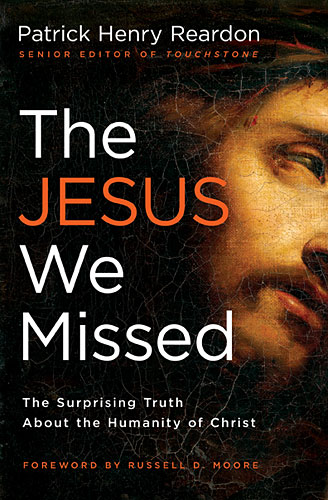
To be fair, I went into this expecting something more like a far more orthodox The Last Temptation of Christ—i.e., something that really focused on Christ’s humanness rather than His divinity. And the introductory material—especially the opening salvo “Did Jesus ever have a stomach virus?”—seemed to support that assumption.  Thus, 50 pages in, I’d felt that the author had missed the mark in terms of the title’s (and especially subtitle’s) promise.

But now, at the other end of reading this, I think Patrick Reardon really is talking about a Jesus I missed, and aspects of His humanity that I really hadn’t grasped before. Really, this book reveals a lot more about our humanness than Christ’s—and how God desires to transform it into what He’s always intended. And boy, is that a good thing. And as such, it’s a great book to work through during this Lenten season.

Patrick Henry Reardon. The Jesus We Missed: The Surprising Truth About the Humanity of Christ. 256p., $15.99, Thomas Nelson.

What Reardon does deliver, and in spades, is a view of what a perfect human life actually looks like, and how a man with a “clear channel to God,” as it were, reveals God/divinity at every turn. And of course it would. But how many times do we write off Jesus’ works on earth as, “Well, of course He could do it—He’s Jesus,” rather than believe the truth of Jesus’ own words: “Truly, truly, I say to you, whoever believes in me will also do the works that I do; and greater works than these will he do, because I am going to the Father” (John 14:12, ESV)?

In between, however, there’s some very fascinating observations. For example, imagine being Jesus reading the Old Testament, growing up in the synagogue, and recognizing Himself as the Messiah being spoken of, the co-composer of the words being read, the physical affirmation of the truth of those words. Also, to again, hit on above, the recognition that Jesus, being the perfect man, would of course manifest all the spiritual gifts of prophecy, healing, discernment and the like. If a man like Elijah could do these things, why wouldn’t Jesus?

There’s a lot more to discover here. But by examining the life of Jesus in detail, Reardon gives us a vision of the life Jesus means for each of us to have, as we believe and trust more deeply in Him. We see One who “emptied himself, by taking the form of a servant, being born in the likeness of men” (Phil. 2:7) but who nonetheless was  in constant communion with God. Because of this, Jesus looks at even the most common things in godly terms,  and by doing so transforms them into lessons, parables, teaching instruments…. temporary things capable of conveying eternal life. And in doing so, shows us how to follow Him as human beings.

Posted in Uncategorized | Tagged , | Leave a comment

Lay Down Your Ambition: the fuller version


Last week we explored how we build ourselves up by the things we do. This week is more about the “triggers” that lure us into that kind of thinking. Our circumstances are one set of triggers. Our own passions, and personal ambitions, are another.

Before we dig into further, let’s make one thing clear: It’s not as if God hasn’t given us hopes and dreams and ambitions to pursue. Not all of the “good things” we do are bad. Not by a long shot. The struggle is in who gets the credit, and in who’s really being served by what we do. Again, and for probably not the last time: Laying it down is about taking our-selves out of the equation and focusing on what God wants, rather than how we benefit from what we do. What we get out of it is the blessing, not the goal.

More often than not, we make even good things about our work and our accomplishments, as if we’re somehow made superior by them. We may give God lip service, and maybe even some sincere acknowledgement, but we know who really stepped up to the plate and got it done.

In his book The Spiritual Man, Watchman Nee points out, “The enemy well knows how we need our mind to attend the spirit so that we may walk by the spirit. Thus he frequently induces us to overuse it that it may be rendered unfit to function normally and hence be powerless to reinforce the spirit in time of weakness.” One well-used way of putting that today is, “If Satan can’t make you bad, he’ll make you busy.” But Nee points to an even more significant truth: Satan will use our busyness and our ambition to help us slowly become bad. As we drift from the leading of the Spirit, we leave ourselves increasingly open to things that aren’t of God.

We’ve seen this far too many times in recent church history, but it’s far from being a new problem. People may start off sincerely at first, and experience success, but then it become more and more about the success and less and less about serving God. And eventually success becomes “the spirit” of the thing, rather than something that’s measured by our obedience to The Spirit. Spiritual leadership that isn’t leading others closer to Jesus isn’t spiritual leadership at all.

Jesus, however, calls us to a different work: “If anyone would come after me, let him deny himself and take up his cross and follow me.” (Matthew 16:24, ESV). It is a challenge so difficult that only one man has ever done it entirely successfully. And He is the one who calls us to it. And He is the one who will make success happen, in His way and in His time. So lay down your ambition, and begin following Jesus into something far bigger than yourself.

Lay It Down Today

This idea starts off a little light, but roll with it: What gets you excited, makes you want to get up in the morning—or at least has you looking forward to getting back home? Let’s keep relationships off the table, as we already touched on that last week. For now, think of something that isn’t necessarily life-giving in itself but is life-giving to you—a hobby or activity, or something that benefits others? It might even be your work. Got that in your mind? Good.

Now: How can you invite Jesus (or invite Him further) into that activity? It might be as simple as adding prayer throughout your activity—notice I said “throughout,” not just before or after. Maybe it’s tweaking that activity so your actions are more directly giving God glory rather than just “taking a break.” Whatever you come up with, begin making it a regular part of that activity—then see how God begins changes things up as you do.

Also—and here’s the deeper part—consider how this attitude can be brought into the more “serious” parts of your life. Where are you striving to accomplish something, and how much of that is you? How can you begin taking your hands off and letting Jesus guide those things—and when success comes, give Him the glory instead taking the credit? This part obviously will take longer to develop, but begin today.

Posted in Uncategorized | Tagged , | Leave a comment

Lay Down Your Circumstances


I have to admit: I’ve always been perplexed by people who talk about the “comfort” of the Christian life, especially in terms of it being the primary reason for believing in Christ. To be sure, there’s “comfort and joy” to be had in knowing Christ, and “a peace that passes all understanding.” But humanly speaking, there’s still life to be lived. And life can be painful, so much so that it cuts through the veneer of all that joy and peace people both inside and outside of Christianity think we’re supposed to be exuding 24/7.

The good news is: God’s OK with that. In fact, He’s the one who’s allowed those circumstances to happen. And a big reason He allows them is this: Our circumstances reveal who we are and what we really trust. The situations we face each day—especially the bad ones—tend to bring out what we’re made of, whether we want them to or not. We may be shocked by what our circumstances reveal about us, but God isn’t. And He wants us to stop being shocked, too, and instead put our trust in Him rather than ourselves to get through them.

But very often, we don’t approach it that way. We think that if God cared about us, He’d change our situation. Consider this, then: That was pretty much the serpent’s argument in the garden, and it worked. Even Paradise wasn’t good enough for us.

On the other hand, when we lay our circumstances before God, He provides a way through them, even when we think things might be impossible—or probably closer to our real issue, even when we have no control over our circumstances. I already have the control, God reminds us; are you going let Me do what I need to do, or are you going to continue to fight Me?

We see a great example of laying down circumstances in the Exodus account. After the second plague out of 10 (frogs, by the way), Pharaoh asks Moses to remove this lousy set of circumstances. Moses’ response in Exodus 8:9 is worth noting: “Be pleased to command me when I am to plead for you and for your servants and for your people, that the frogs be cut off from you and your houses and be left only in the Nile” (ESV).  Moses is actually giving Pharaoh, the enslaver and persecutor of his people, permission to set the dates for this plague to be removed. Yet by doing this, he’s acknowledging that no matter what Pharaoh decides, God is still in control and will ultimately deliver Israel.

In contrast to this attitude is the well-known (and often over-argued) hardening of Pharaoh’s heart (Exodus 8:14, 19, 32, 9:12, etc.). The best definition I’ve seen of this “hardening” is “the continuation of a prior condition.” Put another way, God was pressing Pharaoh’s buttons and revealing his heart, knowing how he would respond to his circumstances. Because God had something better in mind for Israel, and that way led directly through those hard circumstances:

For by now I could have put out my hand and struck you and your people with pestilence, and you would have been cut off from the earth. But for this purpose I have raised you up, to show you my power, so that my name may be proclaimed in all the earth. You are still exalting yourself against my people and will not let them go (Exodus 9:15-17, ESV).

Sometimes, parting the Red Sea is a lot easier than opening up a human heart.

And that brings us back to… us. We want to change our outer circumstances; God is more concerned with changing our inner circumstances—the very ones we seemingly should have more control over but don’t. (Read Romans 7 if you don’t believe me, or even if you do.) When that happens, our outer circumstances already begin to change. And God will be there for the rest of it as well.

Lay It Down Today

Let’s spend some more time with a question you hopefully began addressing during last week’s small-group session: What circumstances are you facing right now that seem impossible to you—and maybe, therefore, also seem like they’re impossible for God to handle as well?

Ask God to open the way for you to walk through your circumstances—not a solution (although He may well provide one), but to see clearly how to follow Him through whatever it is you’re facing right now. Resolve to wait for God’s answer, and ask Him for the strength to wait. Start that waiting right now. Don’t just throw up a prayer and close this book, but spend time right now, waiting. Give God the chance to speak—and for yourself to hear.

Posted in Uncategorized | Tagged , , | Leave a comment

Lay Down Your Kingdom: a small-group session


To work through this session, it may help read through the devotionals that go with this study, especially the “Lay It Town Today” pieces. You can find them in bits and pieces under the following names:

Lay Down Your Independence
Lay Down Your Strength
Lay Down Your Reputation
Lay Down Your Possessions
Lay Down Your Relationships

For this session, you’ll need….
• enough name tags for everyone
• pens/markers for writing


Laying Down Your Day (15 minutes)

Make sure everyone has a name tag and something to write with. Then say something like: Think of something you’re especially proud of—for example, an accomplishment, an award you won, a title or position at work that you earned, or that major purchase you could finally make. Write it down on your name tag, but don’t show anyone else yet.

Give everyone up to a minute to write.

OK now, very quickly, peel the backs off of your name tags and slap them over your hearts where everyone can see them. And then, let’s talk.

1. Why did you choose that thing? And why are you so proud of it?

2. Looking back now, where was (or wasn’t) God as you worked toward obtaining or achieving that thing?

God has given us great gifts throughout our lives. But we need to remember that that’s what they are—gifts. Even our greatest accomplishments in this life are the result of how God has gifted us, and how faithful we’ve been to that gifting. That’s why this week has been all about laying down our kingdoms—which, after all, are only the kingdoms God’s let us have. As we lay down our kingdoms, we open ourselves further to God’s kingdom work in our lives. Let’s dig more into that right now.

Laying Down the Word (25 minutes)

Read the following passage from Day 3, and then discuss the questions afterward.

“[O]ne of the biggest reasons that God calls us to lay down our reputations…. is [that it’s] a way of securing and encasing ourselves in a human love that, even when genuine, is less than God’s love for us.

“Thomas Merton, in his book New Seeds of Contemplation, described it as ‘winding experiences around myself… like bandages in order to make myself perceptible to myself and to the world, as if I were an invisible body that could only become visible when something visible covered its surface.’”

3. When have you seen a person or group get too wrapped in his/her/their reputation? (No “bashing” permitted; just explain the situation, from your perspective.)

4. When have you been guilty of getting wrapped up in how others see you—or on the other hand, felt like “an invisible body”? How did (or does) focusing on that separate you from God and how He sees you?

In Day 2, we examined the example of Abraham. We observed how God had to deal with Abraham’s natural strength—and the image he tried to maintain before others—before Abraham could receive the even greater gifts God wanted to give him. We’re not going to re-read Abraham’s story today, but let’s reflect again on it as we discuss these questions:

5. Why do we rely on our own strength instead of God’s when it comes to the challenges we face? Put another way: Why do so often so go the “Ishmael route” rather than the “Isaac route”?

6. When have you found yourself tempted to go the “Ishmael route” lately? Why? How have you responded so far to that situation, both positively and negatively? What still needs to be laid down before God in that situation?

Read Matthew 19:25-30, and then discuss:

7. Think again about the situation(s) you’re facing right now. What seems impossible to you right now—and maybe, therefore, seems like it must be also impossible to God?

8. How do Jesus’ promises assure you otherwise? How can you live in those promises, rather than in what you believe?

Laying Down Your Life (20 minutes)

Have group members get into subgroups of three or four.

Have someone read the quote from Day 4 below, then talk about your “Lay It Down Today” assignments from this past week. Which assignments did you find most useful or interesting? Which were more difficult, or harder to connect with? In each case, why? Go on to discuss the questions below. Take 15 minutes to talk together in your subgroups, and then take a few more minutes to pray together about what you’ve shared. Once you’re done, remain quiet until everyone else is finished. May God bless you as you submit your lives ever further to Jesus, and discover His love and freedom as you do.

“We do not serve a God of either/or, but a God of both/and—if we’re willing to surrender all of our tiny little kingdoms and properties and belongings to Him. God must rule over the things He’s given us, and be the one who determines how they’re used.”

9. Which part of your kingdom—your independence, strength, reputation, possessions, relationships—is the hardest for you to lay down before Jesus? Why?

10. What would laying it down look like, in your case? What could Jesus do with that? What are you afraid He might (or might not) do if you took that step of faith?

Posted in Uncategorized | Tagged , , , , , , , | Leave a comment

One Small Step for Man… but a step, nonetheless


We have a new member on the blogroll… and in turn, they have a new contributor.

David Showers, whose book Ten Steps to a Closer Walk With God I reviewed recently, has just relaunched his online magazine Extant. And as part of that relaunch, starting immediately yours truly will be a regular columnist there. (My column is called The D-Word — I expect by now you know what that word is. :)) Longtime and/or incredibly faithful readers may recognize the material there (although my initial entry there was from scratch); the rest of you get another shot at some good reading.

And you’ll find plenty more good stuff there—videos; news; articles on spiritual growth and parenting; blogs; book, movie, music and technology reviews. It’s a work in progress, but you (and I) will get to see it progress from the ground up.

So go check it out, stand up and be counted, and we’ll talk again soon.

Posted in Uncategorized | Tagged , , | Leave a comment